
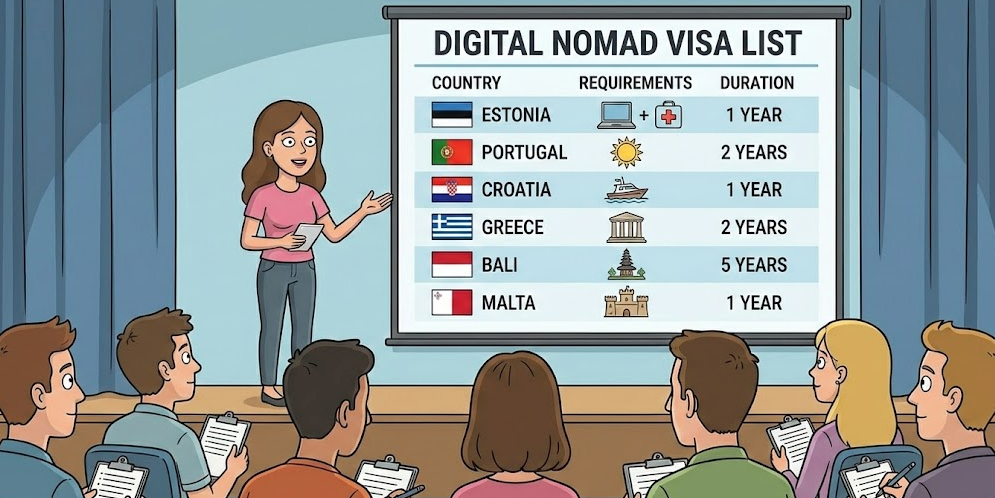
Digital Nomad Visa by Country (2026)
Exact Income Requirements. Clear Yes or No.
Digital nomad visas are not about freedom.
They are about permission.
Permission to stay longer.
Permission to stop resetting tourist visas.
Permission to plan your life without watching a calendar.
And permission is sold for one thing:
Proven income.
Not vibes.
Not potential.
Not “I’ll make more later.”
Real numbers.
This guide shows exact monthly income requirements by country in 2026, and who each visa actually works for.

Read This First
Income requirements mean:
- Recurring income
- Verified over time (usually 3–12 months)
- Documented with bank statements or contracts
One good month does not qualify you.
Consistency does.
Europe
Portugal — Digital Nomad Visa (D8)

Income requirement
- €3,480 per month
- ≈ €41,760 per year
(Linked to minimum wage ×4. Increases when minimum wage increases.)
Works if
- You earn €3.5k+ every month
- You want an EU base
- You’re okay with paperwork and taxes
Doesn’t work if
- Your income fluctuates
- You move every few months
Portugal rewards stability.
It punishes improvisation.
Spain — Digital Nomad Visa
Income requirement
- €2,700–€2,800 per month
- ≈ €33,000 per year
(200% of Spain’s minimum wage.)
Works if
- You earn €3k+ consistently
- You plan to stay 1–3 years
- You understand tax residency rules
Doesn’t work if
- You earn under €2.5k
- You don’t plan ahead
Spain is cheaper to enter than Portugal.
It is harder to exit cleanly.
Estonia — Digital Nomad Visa
Income requirement
- €4,500 net per month
- ≈ €54,000 per year
Works if
- You are a high-income remote worker
- Your income is clean and documented
Doesn’t work if
- You’re early-stage
- Your income varies month to month
Estonia does not negotiate.
You either qualify or you don’t.
Croatia — Digital Nomad Stay
Income requirement
- €3,295 per month
- ≈ €39,500 per year
Works if
- You want a one-year EU lifestyle
- You earn around €3.3k monthly
Doesn’t work if
- You need renewals back-to-back
- You want long-term residency
Latin America
Mexico — Temporary Residency (Nomad Favorite)

Income requirement
- $2,500–$3,000 per month
- ≈ $30,000–$36,000 per year
(Varies by consulate.)
Works if
- You’re starting out
- You want flexibility
- You want low bureaucracy
Doesn’t work if
- You expect a “digital nomad” label
- You want EU-style structure
Mexico works because it’s practical.
Not because it’s trendy.
Colombia — Digital Nomad Visa
Income requirement
- ~$1,100 per month
- ≈ $13,200 per year
Works if
- Your income is modest but stable
- You want low cost of living
Doesn’t work if
- You need premium infrastructure
- You earn irregular income
This is the lowest barrier legal long-stay option available.
Asia
Thailand — Long-Term Options (Not a True DN Visa)

Income equivalent
- $4,000–$6,000 per month
OR - Large upfront fees ($15k–$30k)
Works if
- You earn well
- You want multi-year stays
Doesn’t work if
- You’re budget constrained
- You want simple rules
Thailand is flexible in reality.
Unclear on paper.
Indonesia (Bali) — Remote Work Route
Income requirement
- $5,000 per month
- ≈ $60,000 per year
Works if
- You earn above average
- You track rule changes carefully
Doesn’t work if
- You want consistency
- You ignore updates
Indonesia changes rules often.
If you don’t pay attention, you lose.
Middle East & Islands
UAE — Remote Work Residency
Income requirement
- $5,000 per month
Dubai — Virtual Work Visa
- $3,500 per month
Works if
- You earn well
- You want infrastructure and banking
Doesn’t work if
- You’re cost sensitive
Barbados — Welcome Stamp

Income requirement
- $50,000 per year
- ≈ $4,167 per month
Works if
- Your income is clear and provable
- You want a one-year island base
Doesn’t work if
- Your income is inconsistent
Quick Decision Filter
Your monthly income:
- <$2,000 → Colombia
- $2,500–$3,500 → Mexico, Spain
- €3,300–€4,000 → Portugal, Croatia
- €4,500+ → Estonia
- $5,000+ → Bali, UAE, Barbados
This is the real gate.
Final Thought
Digital nomad visas are not dreams.
They are filters.
They don’t care where you want to live.
They care whether your income supports it.
If your income qualifies, options open.
If it doesn’t, no amount of motivation changes the outcome.