Most digital nomads are broke. They try to dropship cheap products. They try to be “influencers.” They fail. Meanwhile, there is a cash cow staring them in the face.
It’s called the East Asian Education Market.
Specifically, Japan and South Korea. These two countries are obsessed with English. They need it for promotions. They need it for exams. And they have the money to pay for it.
If you are a native (or near-native) English speaker, you are sitting on a goldmine. But you are probably mining it wrong. You are digging for pennies on generic platforms.
I am going to show you how to target the “Premium Tier” of Asia, combine it with the “Geographic Arbitrage” of Southeast Asia, and build a $5,000/month lifestyle.
Let’s do the math.
Why Japan and Korea? (The Market Logic)
Why not China? Why not Latin America? Because we care about Reliability and Rate per Hour.
1. The “Obsession” Factor
- Korea: English is survival. Samsung, Hyundai, LG employees must speak English to get promoted. They are desperate. They want results FAST.
- Japan: English is status. They are terrified of making mistakes. They want a “safe space” to practice. They are loyal.
2. The Time Zone Magic If you want to be a digital nomad in Bali, Bangkok, or Da Nang, targeting US students sucks. You have to work at 3 AM. Japan and Korea are GMT+9. Thailand is GMT+7. This means their “evening classes” (7 PM – 10 PM) are your “late afternoon classes” (5 PM – 8 PM). You can surf all day, work for 3-4 hours in the evening, and make a full-time income. It is the perfect lifestyle alignment.
The Tale of Two Markets: Know Your Customer
You cannot teach them the same way. If you try, you will lose both.
The Korean Student: “The Spartan”
- Goal: Scores. OPIc (Speaking Test), TOEIC Speaking, Business Presentation.
- Vibe: Fast. Efficient. “Pali-pali” (Hurry up).
- What they pay for: Corrections. Better vocabulary. “Make me sound professional.”
- Warning: If you are slow or unprepared, they will leave a bad review instantly.
The Japanese Student: “The Samurai”
- Goal: Confidence. Overcoming shyness. Travel conversation.
- Vibe: Polite. Quiet. Slow.
- What they pay for: Patience. A safe atmosphere. “Please listen to my broken English.”
- Warning: They will never tell you if they are unhappy. They just disappear (Ghosting).

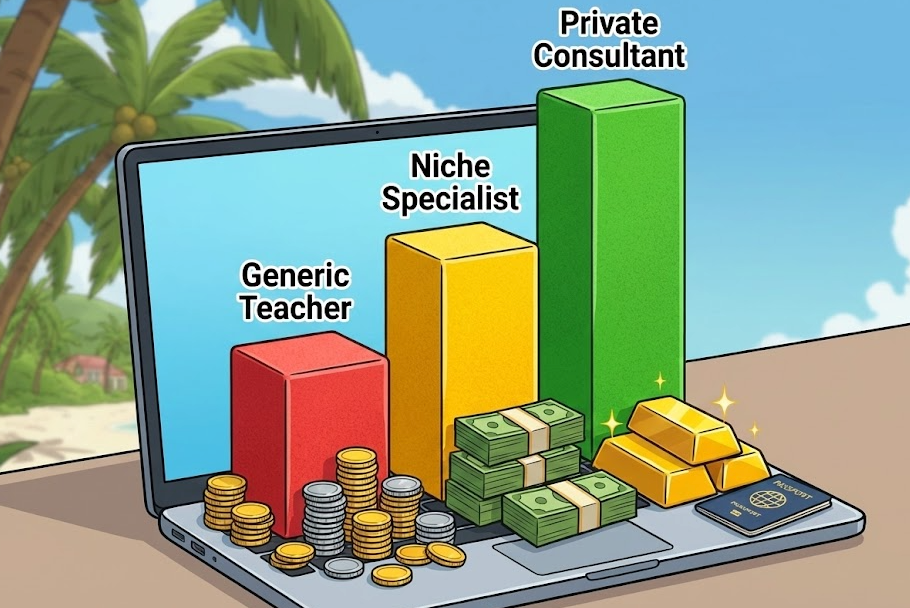
The Roadmap: From $10/hr to $50/hr
Do not stay at Level 1. Level 1 is poverty.
Level 1: The “Platform Grunt” ($10 – $15/hr)
This is where you start to get reviews.
- Japan Platforms: Engoo (Bibo Global), NativeCamp. Easy to join, low pay.
- Korea Platforms: Ringle (High end, requires degree), Carrot English.
- Strategy: Work here for 3 months. Get 100 5-star reviews. Learn the culture. Then QUIT.
Level 2: The “Niche Expert” ($25 – $40/hr)
Now you specialize. You don’t teach “English.” You teach:
- “Interview Prep for Koreans applying to Amazon/Google.”
- “Medical English for Japanese Doctors.”
- “Hospitality English for Tokyo Hotel Managers.”
- Where: Italki, Preply, or direct marketing on LinkedIn.
Level 3: The “Private Consultant” ($50 – $100/hr)
This is the end game. You take your best students off the platform (carefully). You offer packages.
- The Offer: “10-Week Intensive Business Speaking Bootcamp.”
- The Price: $1,000 upfront.
- The Math: You only need 5 students a month to make $5,000.
- The Lifestyle: You work 10 hours a week. You spend the rest of the time drinking coconuts.
The Tactical Setup (Don’t Ignore This)
You are selling to the most tech-savvy nations on earth. Korea has the fastest internet in the world. Japan loves high quality. If you lag, you lose.
1. Internet is Oxygen Do not use “Cafe Wifi” for lessons. It is disrespectful. If you are in Bali, get a private line or go to a dedicated coworking space with a silent booth (e.g., Tropical Nomad). Speed test must be 50mbps+ UP and DOWN.
2. The “Seoul Studio” Look Koreans judge you by your background. If your background looks like a dirty hostel bed, they think you are lazy. If your background looks like a clean office (bookshelf, plant, good light), they think you are a Professor. Perception = Price.
3. Payment Rail How do you get paid?
- Wise (formerly TransferWise): Essential. Gives you local bank details.
- Payoneer: Popular in Korea/Japan.
- PayPal: Avoid if possible (high fees), but Japanese students love it.
The Bottom Line (Your New Reality)
Here is the life you can build with this strategy.
Income:
- 10 Private Students (Mix of KR/JP) @ $400/mo Package = $4,000/mo.
- Work Hours: 15 Hours/week.
Expenses (e.g., in Chiang Mai or Da Nang):
- Luxury Condo: $500
- Food & Fun: $600
- Savings: $2,900/mo.
You are saving more money than your friends back home are earning. And you are doing it by talking to interesting people from two fascinating cultures.
Stop teaching everyone. Start teaching the markets that pay.