The “AI Expert” Trap vs. The Consultant Opportunity
Most people are looking at AI wrong. They see a magic trick. They see ChatGPT writing a poem and think that’s the business model. It’s not.
That is a toy. Toys don’t make money. Tools do.
Right now, we are seeing the biggest transfer of wealth since the internet started. But the money isn’t going to the people using AI to write blog posts. The money is going to the people who build the pipes.
Companies are drowning in inefficiency. They have bloated payrolls. They have slow processes. They are burning cash on tasks that a script could do for pennies.
This is where you come in.
You don’t need a PhD in Machine Learning. You don’t need to know how to code a neural network from scratch. You just need to know how to connect Piece A to Piece B to save a business owner 20 hours a week.
If you can save them 20 hours, you can charge them $5,000 a month. And they will thank you for it. That is the math. Everything else is noise.
The Problem: “Prompt Engineering” is a Race to the Bottom
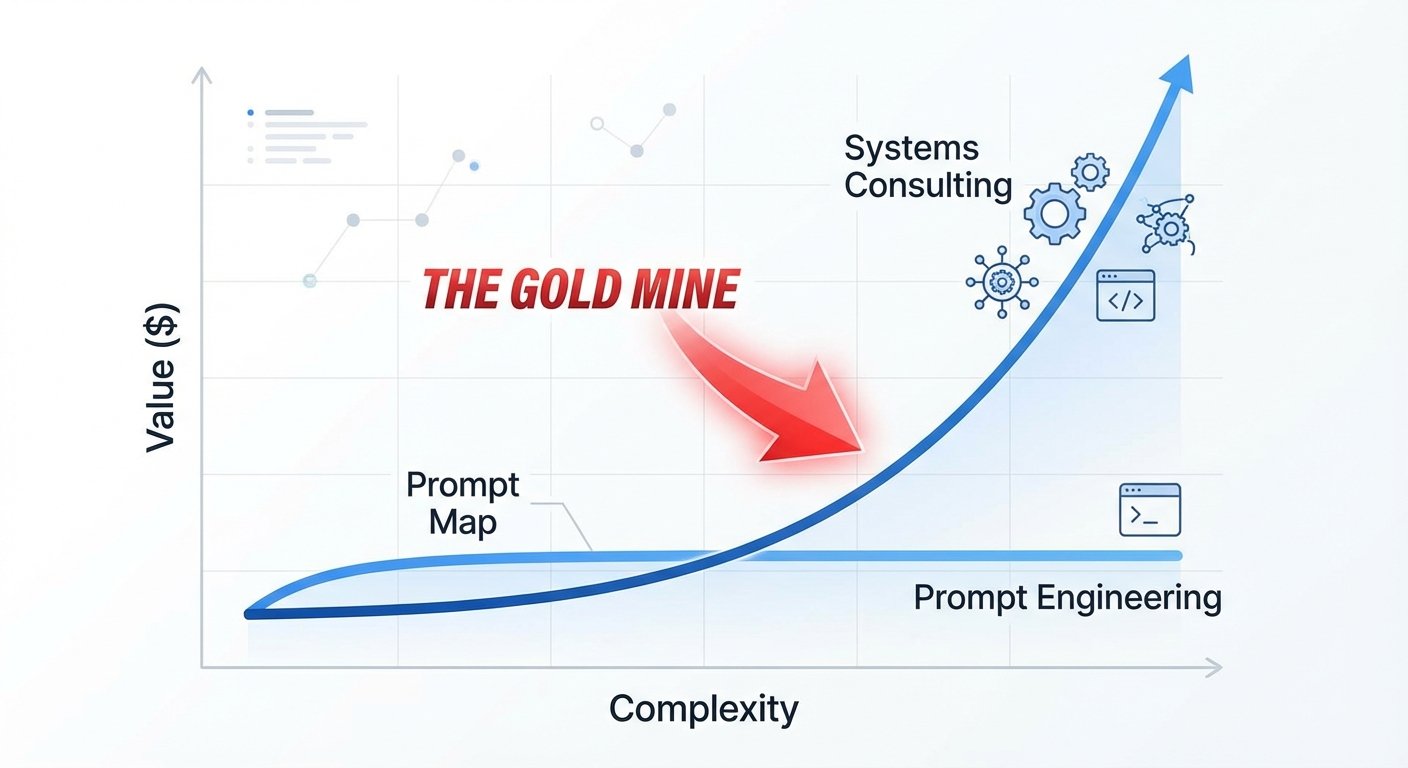
Stop calling yourself a “Prompt Engineer.”
Typing words into a box is not a high-income skill. It’s typing. Eventually, the AI will get smart enough to prompt itself. If your entire value proposition is “I know what to ask the bot,” your career has an expiration date of about six months.
Consulting is different. Consulting is diagnosing a problem.
Here is the reality for 99% of businesses (plumbers, dentists, law firms, e-commerce brands):
- They don’t care about Large Language Models.
- They don’t care about weights and biases.
- They care about profit margins.
If you walk in talking about “generative capabilities,” their eyes glaze over. If you walk in and say, “I will automate your customer support so you can fire your outsourced team and keep the profit,” you have their attention.
You are not selling AI. You are selling time. You are selling margin.
The Gear: You Cannot Build a Ferrari with a Plastic Hammer
If you are going to be a high-ticket consultant, you need to deliver speed. You cannot be the bottleneck.
I see guys trying to run local LLMs or massive automation workflows on a five-year-old Chromebook. It’s embarrassing. It’s like a contractor showing up to build a house with a spoon.
You need compute power. You need reliability. This is your capital expense. In the equipment leasing world, this is an asset that produces cash flow. Buy it once, rent it out (via your skills) forever.
1. The Workhorse: Apple MacBook Pro 16-inch (M3 Max)
If you are serious, this is the standard. Why? Because of the Unified Memory architecture. If you want to run local models (which offers privacy to your clients) or handle massive data sets without lagging, you need the M3 Max chip.
You are looking for the version with at least 36GB of Unified Memory, ideally more. It handles the “heavy lifting” of AI tasks better than almost any laptop on the market because the GPU and CPU share the memory pool. Speed equals money.
Price Range: $3,200 – $4,000

2. The Heavy Hitter: NVIDIA GeForce RTX 4090
Maybe you are a PC guy. Or maybe you need to train a specific model for a client on your own rig. You cannot do this with a standard graphics card. You need VRAM.
The RTX 4090 is currently the king of consumer GPUs for AI work. It has 24GB of VRAM. This is the magic number. It allows you to load significantly larger models (like Llama-3 70B quantized) locally. If a client has sensitive legal or medical data that cannot touch the cloud, you charge a premium to process it locally. You need this card to do that.
Price Range: $1,700 – $2,200 (Card Only) | $3,500+ (Pre-built PC)
3. The Authority Builder: Shure SM7B Microphone
This seems unrelated. It isn’t.
You are a remote consultant. You are charging high fees. If you jump on a Zoom call and you sound like you are in a wind tunnel, you lose authority instantly.
Perception is reality. If you sound like a broadcaster, clients assume you are a professional. If you sound cheap, they assume your work is cheap.
The Shure SM7B is the industry standard for a reason. It gives you that deep, rich, “podcast” voice. It signals status before you even pitch your price. It pays for itself with one closed deal.
Price Range: $350 – $400
The Strategy: Solve One Expensive Problem
Generalists stay poor. Specialists get rich.
Do not be the “AI Guy for Everyone.” Be the “AI Automation Expert for Real Estate Agents.”
Here is the logic:
- Broad: “I can use AI to help your business.” (Vague. Confusing. Worth $20/hour).
- Niche: “I build AI systems that automatically qualify inbound leads for Realtors so they never miss a commission.” (Specific. Valuable. Worth $5k/month).
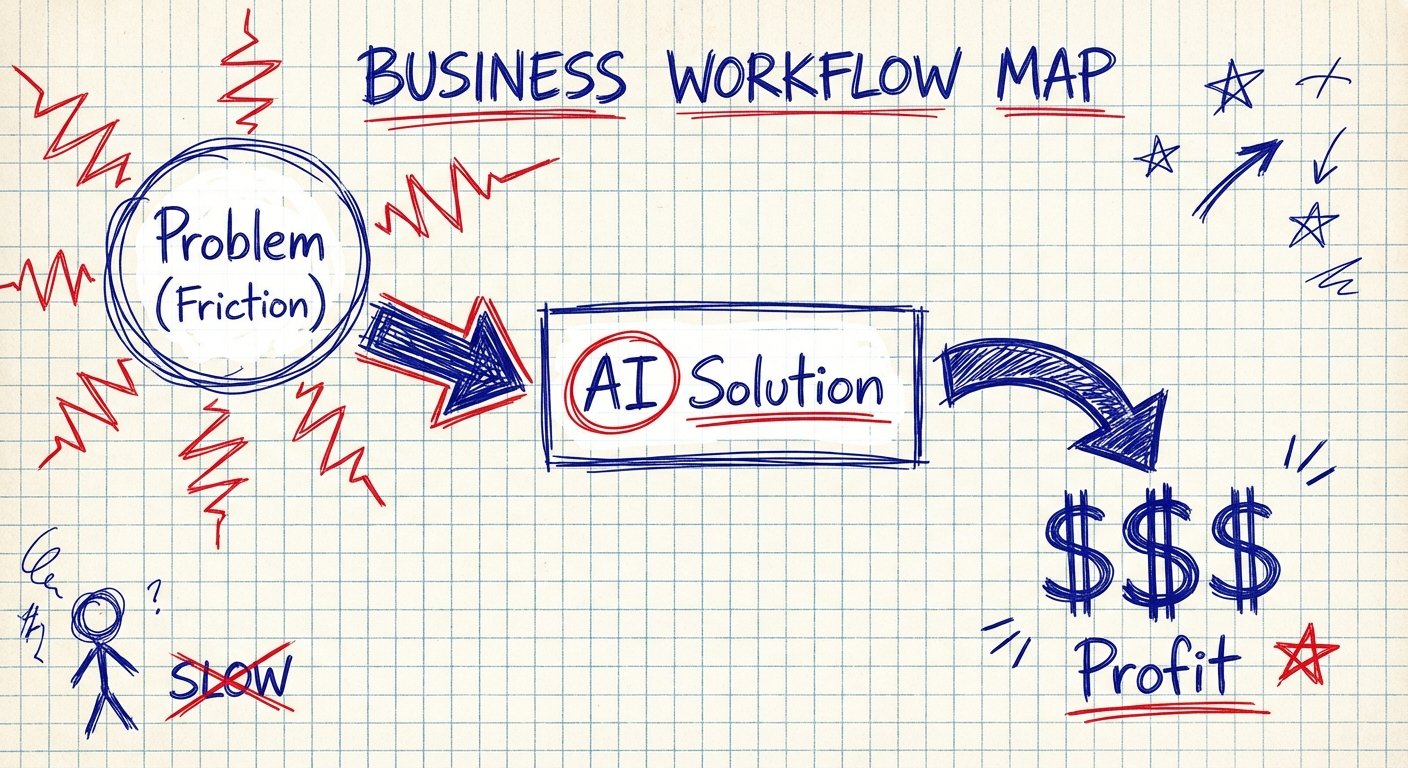
Find a niche where people are already spending money. Find the friction point. Remove the friction with AI.
The Blueprint: Audit, Automate, Arbitrage
Here is exactly how you execute this. No fluff.
Step 1: The Audit (The Trojan Horse)
You offer a “Workflow Audit.” You don’t sell the solution yet. You sell the diagnosis.
You look at their business. Where are they copy-pasting data? Where are they answering the same email 50 times a day? Where are they manually entering invoices?
These are “bleeding necks.” They hurt. The business owner hates them. You identify them.
Step 2: The Automate ( The Build)
You use tools like Make (formerly Integromat) or Zapier. You connect their email to OpenAI. You connect OpenAI to their CRM.
Example:
1. Email comes in.
2. AI reads email, classifies it as “Lead” or “Spam.”
3. If Lead, AI drafts a personalized reply based on the company’s pricing PDF.
4. Draft is saved to Drafts folder for approval.
You just saved the salesperson 2 hours a day. That is 10 hours a week. That is 40 hours a month. If the salesperson makes $50/hour, you just saved the company $2,000 a month in raw labor.
Step 3: The Arbitrage (The Retainer)
You do not charge by the hour. Never charge by the hour.
You charge for the system. You charge a setup fee (e.g., $3,000) to build it. Then you charge a maintenance fee (e.g., $1,000/month) to keep it running and tweak it.
It costs you zero hours to run once it is built. That is infinite ROI.

The ROI Equation
This is the only slide that matters in your pitch deck. You need to show them that paying you is cheaper than NOT paying you.
Scenario:
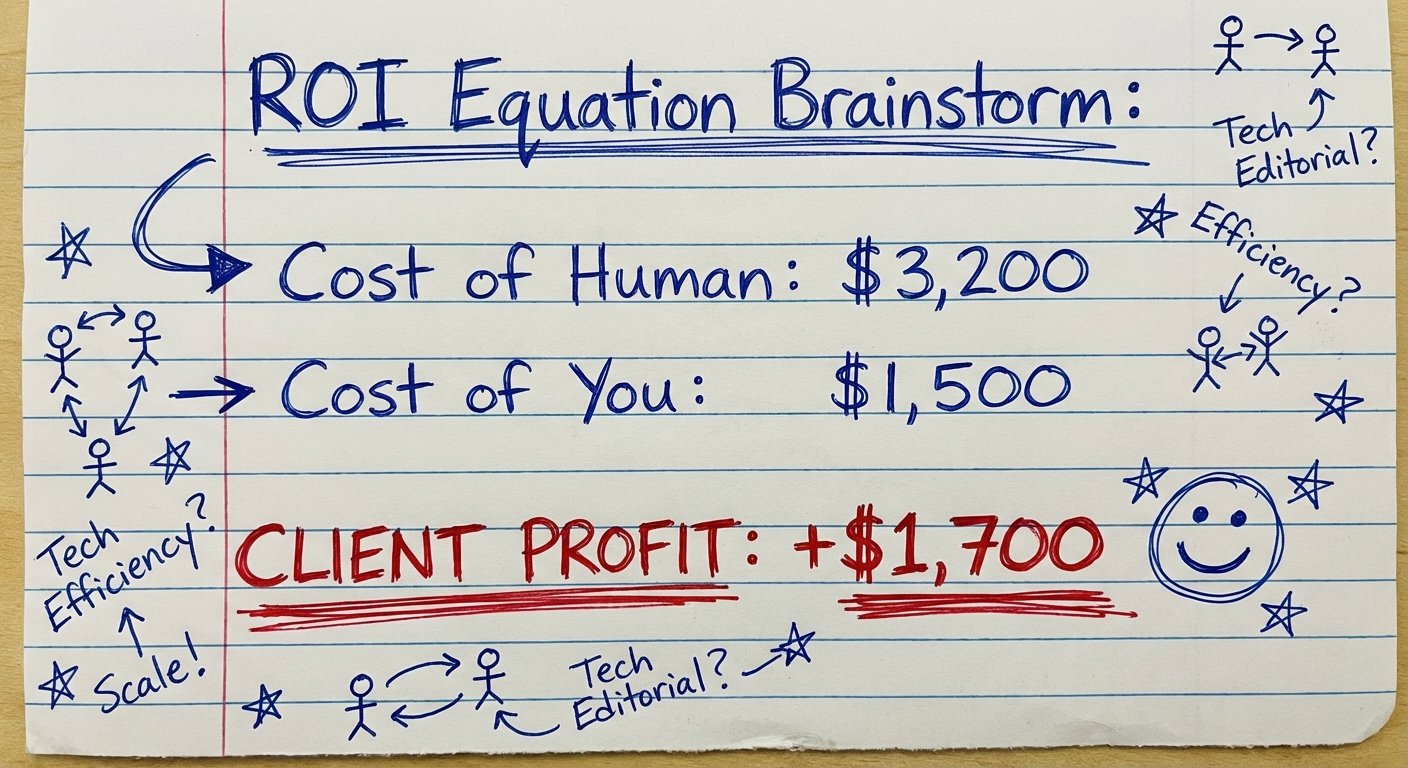
A Law Firm has a paralegal spending 20 hours a week summarizing case notes.
Paralegal cost: $40/hr.
Monthly cost: $3,200.
Your Solution:
You build a secure local LLM pipeline (using that RTX 4090) that summarizes notes instantly.
Your fee: $1,500/month.
The Client’s Math:
Old Cost ($3,200) – New Cost ($1,500) = $1,700 Net Profit per month.
They literally make money by hiring you. It is illogical for them to say no. That is how you close deals.
Conclusion: Speed is the Only Moat
The information is out there. The tools are available.
The only difference between the guy making $0 and the guy making $50k a month is action. While you are reading this and thinking about it, someone else is pitching your local real estate agency.
The market is empty right now. It is the Wild West. But in 24 months, the big consulting firms will have figured this out. They will flood the market. Prices will stabilize.
Right now, you can charge premium prices for basic implementations because nobody understands how it works yet. This is the arbitrage window.
Get the gear. Pick a niche. Solve a problem. Send the invoice.
Start today.