The “Follow the Sun” Trap
Most people think remote work is about freedom.
They picture a laptop on a beach in Bali. They think about waking up at noon.
That is a lie.
If you run a business, remote work is not about lifestyle. It is about leverage.
It is about accessing talent you cannot afford locally. It is about keeping your production line moving 24 hours a day.
But here is the problem.
Most managers treat remote teams like local teams. They try to sync everyone up. They want the guy in London, the girl in New York, and the developer in Manila on the same Zoom call.
This is stupid.
You are destroying the one advantage you have: Time.
If you force overlap, you force fatigue. Tired people make mistakes. Mistakes cost money.
If you want to lead teams across time zones, you have to stop acting like a babysitter. You need to build a machine.

The Cost of Synchronization
Let’s do the math.
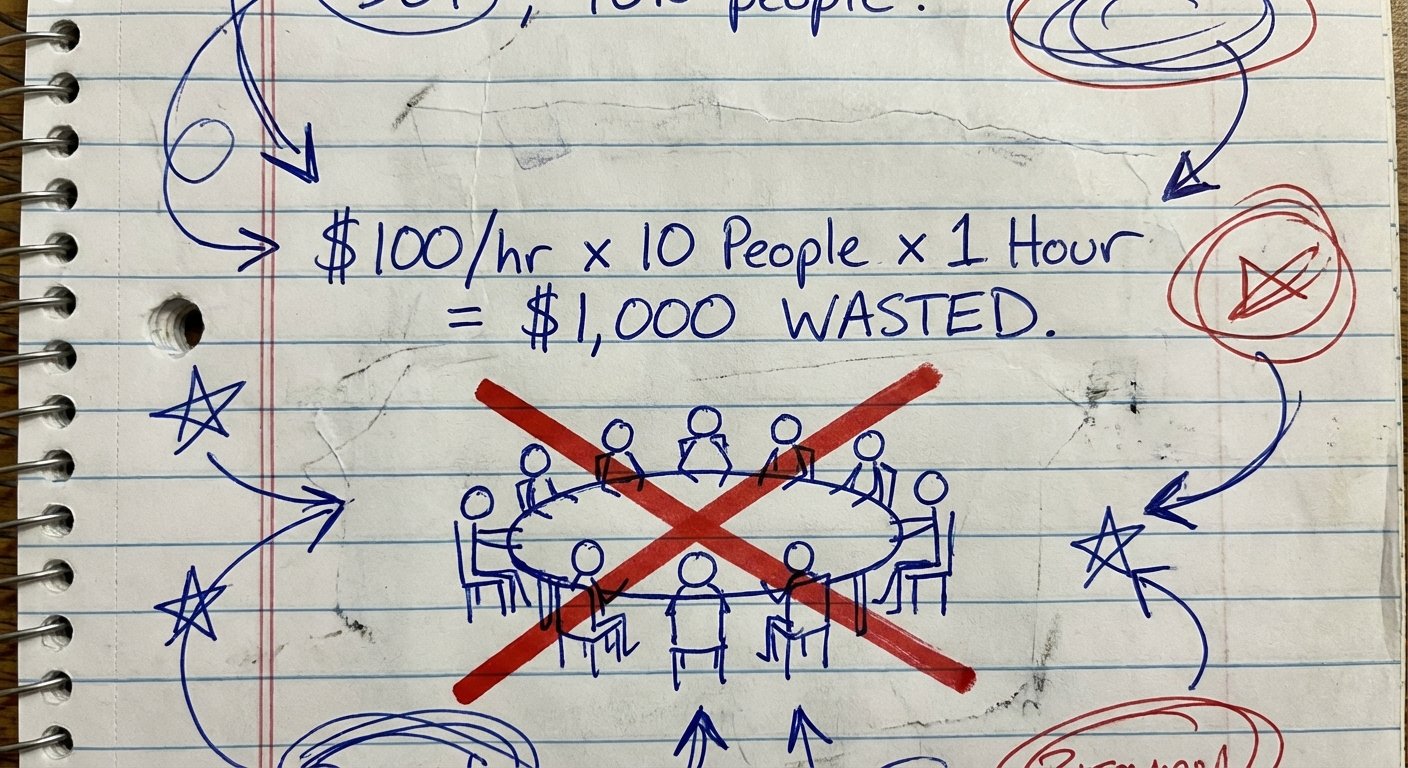
You have a team of 10 people. Their average effective hourly rate is $100. That includes salary, overhead, and opportunity cost.
You hold a “Daily Standup” at 9 AM EST to accommodate the UK team (2 PM) and the West Coast (6 AM).
The meeting lasts 30 minutes.
10 people x 0.5 hours x $100 = $500 per day.
$500 x 5 days = $2,500 per week.
$2,500 x 50 weeks = $125,000 per year.
You are spending $125,000 a year just to ask people “What did you do yesterday?”
That doesn’t even count the “context switching” cost. It takes a human brain about 23 minutes to refocus after an interruption. So that 30-minute meeting actually killed an hour of productivity for everyone.
The ROI of that meeting is negative. You are lighting money on fire.
The solution is not “better meetings.” The solution is Asynchronous Management.
The Asynchronous Operating System
To win at remote project management, you must move from “synchronous” (real-time) to “asynchronous” (on your own time).
This requires three things:
- Radical documentation.
- The “Two-Way Door” decision framework.
- High-fidelity tools.
1. If It Isn’t Written Down, It Doesn’t Exist
In an office, you can tap someone on the shoulder. In a remote team across time zones, that tap takes 12 hours to get a response.
A 12-hour delay on a simple question freezes the project. If that happens three times a week, your project is delayed by a month.
You need a “Single Source of Truth.”
Use Notion, Linear, or ClickUp. I don’t care which one. Just pick one.
Every task must have:
- A clear definition of “Done.”
- All assets attached (no “I’ll email it to you”).
- A hard deadline.
If a developer in Manila wakes up and has to ask you a question, you failed. You didn’t provide the inputs required for the output.
2. The Video Update Rule
Stop typing paragraphs in Slack. Writing is slow. Reading is slow. Tone gets lost.
Use Loom. Or simply record your screen.
If you need to give feedback on a design, record a 2-minute video. Talk through it. Point at the screen.
The recipient can watch it at 2x speed. They can replay it. They can’t claim they “didn’t understand.”
This compresses the feedback loop. It removes ambiguity.
The Hardware: Command Authority
You cannot lead a remote team if you look and sound like an amateur.
Low-quality audio and grainy video signal “low status.” It tells your team you don’t take this seriously. If you don’t care, they won’t care.
You need to control your environment. This is the hardware stack that produces ROI.
1. The Focus Engine: Sony WH-1000XM5
You are managing projects. That means you are selling decisions. You need to think clearly.
If you are working remotely, you are fighting your environment. Dogs barking. Coffee shop noise. Construction.
You need absolute silence.
The Sony WH-1000XM5 are the best noise-canceling headphones on the market. Period.
They have an explicit “Speak-to-Chat” feature that pauses audio when you speak, but more importantly, the Active Noise Cancellation (ANC) is industry-leading. It deletes the outside world.
Specs:
- 30-hour battery life (Quick charge gives 3 hours in 3 minutes).
- 8 microphones for call quality (your team hears you clearly).
- Multi-point connection (switch between laptop and phone instantly).
If you can’t focus, you can’t manage. This is a business expense that pays for itself in one week of saved productivity.
Current Price: $348 – $400

2. The Authority Lens: Logitech MX Brio
When you do have to get on a call, you need to look like the boss.
Most laptop webcams are 720p garbage. They make you look dark, grainy, and tired.
The Logitech MX Brio is a 4K webcam designed for streaming and professionals. It uses a larger sensor than standard webcams, which means better performance in low light.
It has AI image enhancement that automatically adjusts the lighting on your face. You look sharp. You look awake. You look competent.
It also has a “Show Mode.” You can tilt the camera down to show your desk or a sketch on a notepad, and it automatically flips the image so the viewer sees it right-side up.
Specs:
- Ultra HD 4K resolution.
- Dual beamforming microphones (backup audio).
- USB-C connectivity.
Current Price: $160 – $200
3. The Efficiency Switch: Elgato Stream Deck MK.2
This isn’t just for gamers. It’s for efficiency freaks.
The Elgato Stream Deck gives you 15 programmable LCD keys. You can automate your entire workflow.
- One button to open your Project Management Dashboard.
- One button to launch Zoom and mute your mic.
- One button to paste your standard email responses.
Remote management is repetitive. Clicking through folders is a waste of life. Automate the clicks.
Current Price: $130 – $150
The “Relay Race” Protocol
Here is how you actually execute.
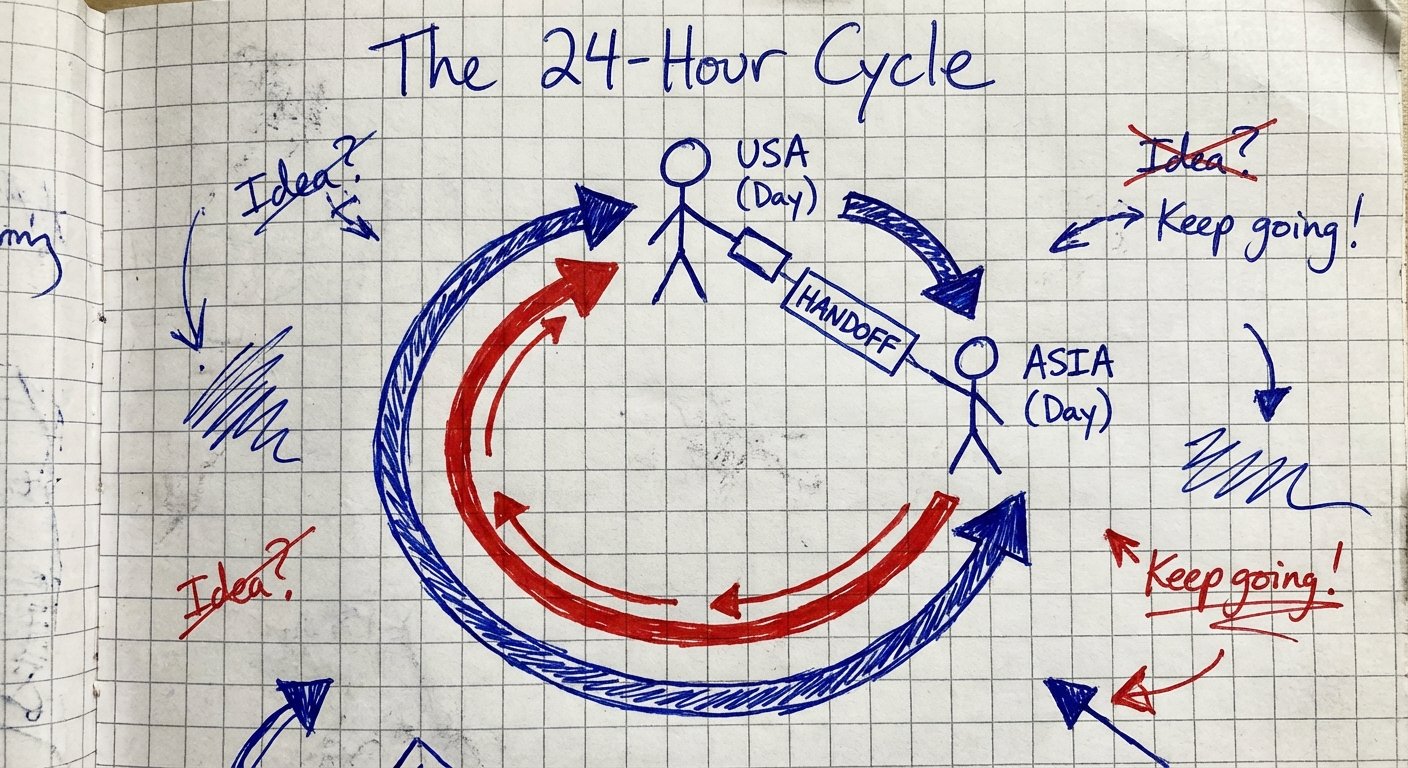
Think of your project like a relay race. The baton is the work.
In a normal office, you hand the baton to the guy standing next to you. In a time-zone-distributed team, you are handing the baton to someone who is currently asleep.
If you drop the baton, it stays on the floor for 8 hours until they wake up.
You need a Handoff Protocol.

The End-of-Day (EOD) Report
Every single person on the team must post an EOD update before they log off. No exceptions.
The format is simple:
- Completed: What did I finish today? (Links to work).
- In Progress: What is half-done?
- Blockers: What is stopping me?
- Next Up: What am I doing tomorrow?
This takes 5 minutes to write.
When you (the manager) wake up, you scan these reports. You unblock the blockers. You adjust the priorities.
When the team in Asia wakes up, they see your adjustments. They pick up the baton and run.
The work never stops. The sun never sets on your productivity.
Hiring for Autonomy
None of this works if you hire the wrong people.
You cannot micromanage across time zones. It is physically impossible.
You need people who are “Managers of One.”
When you interview for remote roles, ignore their resume for a second. Test their ability to work alone.
The 10-Minute Test
Give them a vague task. Something with missing information.
Example: “Research the top 5 competitors for our new product and put them in a spreadsheet.”
Don’t tell them the product name. Don’t tell them the market.
The bad hire: Does nothing. Emails you back asking “Which product?”
The good hire: Googles your company. Figures out what you just launched. Makes an assumption. Does the work. Adds a note: “I assumed you meant Product X, if not, let me know.”
You want the person who acts. You can correct their direction. You cannot teach them to move.
The ROI of Culture
People talk about “remote culture” and they mean virtual pizza parties.
That is fluff. Nobody wants a virtual pizza party. They want to finish their work and go be with their real families.
Winning is culture.
Culture is shipping on time. Culture is low friction. Culture is knowing exactly what you need to do and having the tools to do it.
When you respect your team’s time by killing useless meetings, they respect you.
When you give them high-quality equipment and clear instructions, they perform.
Summary: The Playbook
To lead teams across time zones, you must invert your behavior.
Stop syncing. Start documenting.
- Calculate the cost of meetings. Cut them by 80%.
- Buy the gear. Get the Sony headphones and the Logitech webcam. Clarity is authority.
- Implement the Relay Race. EOD reports are mandatory.
- Hire self-starters. If you have to push them, fire them.
Do this, and you turn the time zone difference from a liability into an asset.
You build a factory that runs 24/7/365.
That is how you scale.
Now go to work.