The Airbnb Trap: Why You Are Overpaying by 300%
Most people are lazy.
They want to live in Europe. They want the “digital nomad” lifestyle. But they treat housing like they are ordering a pizza.
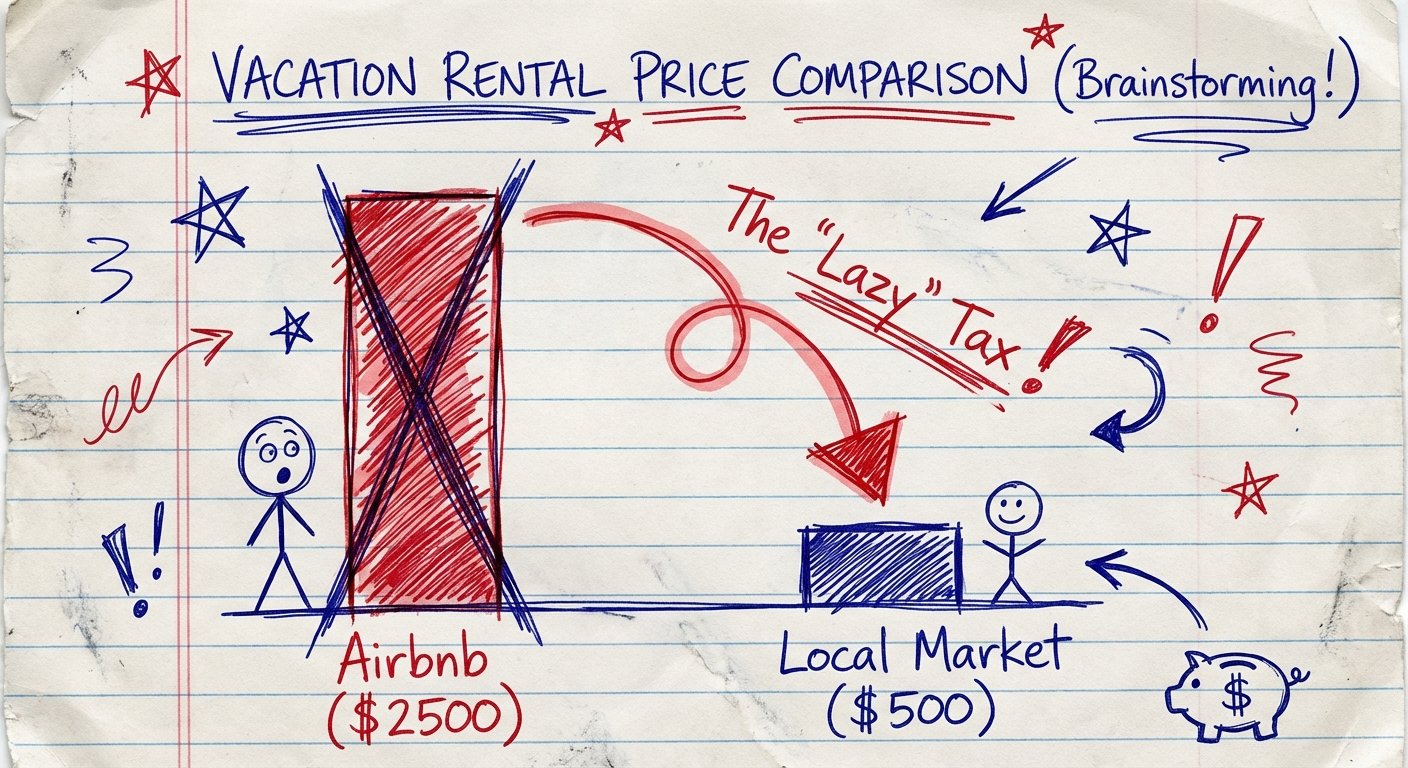
They open Airbnb. They filter by “Entire Place.” They see $2,500 a month for a studio in Lisbon. They pay it.
They think that is the market price. It is not.
That is the Tourist Tax.
If you pay the Tourist Tax, you are burning your ROI before you even get on the plane. You are paying for the landlord’s vacancy risk, the platform fees, and the convenience of clicking one button.
I don’t pay $2,500. I pay $500. For the same apartment. In the same city.
How? I stop acting like a tourist. I enter the local market.
This article is not about “couch surfing” or sleeping in hostels with 12 other people. This is about securing high-quality, private real estate for a fraction of the cost by using the leverage of local knowledge.

The Mathematics of Geoorbitrage
Let’s look at the numbers. Because feelings don’t pay rent.
When a landlord lists on Airbnb, they are running a hospitality business. They have to change sheets, pay for cleaning, and manage check-ins every 3 days. That requires effort. Effort costs money.
When a landlord lists on a local sublet site, they are looking for stability. They want cash flow. They want one person to pay them for 3 to 6 months so they don’t have to think about it.
The Spread:
- Airbnb Price: $80/night x 30 days = $2,400/month.
- Local Market Price: €450/month + utilities = ~$550/month.
The difference is $1,850 a month. That is $22,200 a year.
If you invest that $22,200 into the S&P 500 or your own business, you create wealth. If you give it to an Airbnb host, you are financing their retirement.
Stop being the customer. Be the operator.
The Hidden Websites (Country by Country)
Google hides these sites from you because they are not in English. They don’t have high domain authority in the US. They don’t run ads on your Instagram feed.
But this is where the locals trade. This is where the deals are.
You need to use Google Translate. If that is too much work for you, stop reading. Go pay the $2,000.
1. Germany: WG-Gesucht
Germany is the economic engine of Europe. It is also notoriously bureaucratic. But the sublet market is massive because German students travel often.
The Site: WG-Gesucht.de
The Strategy: Look for “Zwischenmiete” (temporary rent). This is someone leaving for an internship who needs to cover their costs. They are not trying to make a profit. They just want to break even.
Target Price: €400 – €600 for a room in a high-end shared flat, or €700 for a studio.
2. France: Leboncoin
France runs on Leboncoin. It is their Craigslist, but everyone uses it. From buying a toaster to renting a castle.
The Site: Leboncoin.fr
The Problem: The French ignore emails in English. They hate it.
The Fix: Use ChatGPT to write your introductory message in flawless French. Do not say you are an American tourist. Say you are a “Consultant working remotely.” It sounds stable.
3. Spain & Portugal: Idealista
Lisbon and Barcelona are overrun with nomads. Prices on English websites are inflated by 400%. You need to go where the grandmothers list their apartments.
The Site: Idealista.com
The Tactic: Use the map feature. Go 15 minutes away from the city center. The price drops by half. The subway system in Europe works. You don’t need to live next to the cathedral.
4. Eastern Europe: OLX & Facebook Groups
In Poland, Romania, and Bulgaria, the infrastructure is different. The “website” is often just a Facebook group.
The Site: OLX (works in Poland, Romania, Ukraine, Bulgaria).
The Facebook Strategy: Do not join “Expats in Budapest.” That is a trap. Join “Budapest Apartments for Rent” (the one written in Hungarian). Use the search bar for the local language keywords.
The Hardware: Infrastructure for the Mobile CEO
If you are paying $500/month, you are not getting a 5-star hotel concierge. You are getting keys to an apartment.
The internet might be spotty. The walls might be thin. The power outlets might be in weird places.
You cannot allow your environment to dictate your output. If you lose a client because the Wi-Fi dropped, you didn’t save money on rent—you lost revenue.
You need to bring your own infrastructure. I don’t travel with clothes; I travel with a mobile office.
1. Enterprise-Grade Security in Your Pocket
You will be connecting to random networks. Coffee shops. Sublets where the previous tenant might have messed with the router.
Do not trust foreign ISPs with your bank passwords. You need a travel router. It creates a private, encrypted tunnel for all your devices. You connect the router to the wall, and your phone/laptop connects to the router.
The Product: GL.iNet GL-AXT1800 (Slate AX)
This is the current king of travel routers. Wi-Fi 6. Gigabit speeds. Pre-installed VPN and WireGuard client. It fits in your pocket.
Price Range: $110 – $140

2. The One-Bag Protocol
European buildings often do not have elevators. If you rent a 5th-floor walk-up in Paris to save $1,000, you are going to hate yourself if you have a massive rolling suitcase.
Mobility is leverage. If a landlord acts crazy, you need to be able to pack and leave in 10 minutes.
The Product: Osprey Farpoint 40
This is the standard. It fits carry-on limits (saving you baggage fees). It opens like a suitcase, not a top-loader hiking bag. Indestructible.
Price Range: $160 – $185
3. Deep Work Environment (On Demand)
Cheap apartments have noise. Construction outside. Neighbors arguing. Tram lines.
You cannot control the noise. You can control what you hear. If you can’t focus, you can’t produce. If you can’t produce, you are poor.
The Product: Sony WH-1000XM5
The noise cancellation on these is superior to Bose for high-frequency erratic noise (like people talking). The battery lasts 30 hours. Put them on, and the world disappears.
Price Range: $348 – $399
The Negotiation Script
Finding the apartment is 50% of the work. Closing the deal is the other 50%.
Landlords on local sites are suspicious. They think you are a scammer. Or worse, a party tourist who will trash the place.
You need to frame yourself as the Ideal Tenant.
The Ideal Tenant is:
- Quiet (Works all day).
- Solvent (Has proof of funds).
- Low Maintenance (Won’t call about a lightbulb).

The Outreach Message (Copy Paste This)
Do not write: “Hi, is this available? I love travel!”
Write this:
“Hello [Name],
I am a software consultant [or your job] looking for a quiet place to work for 3 months starting [Date].
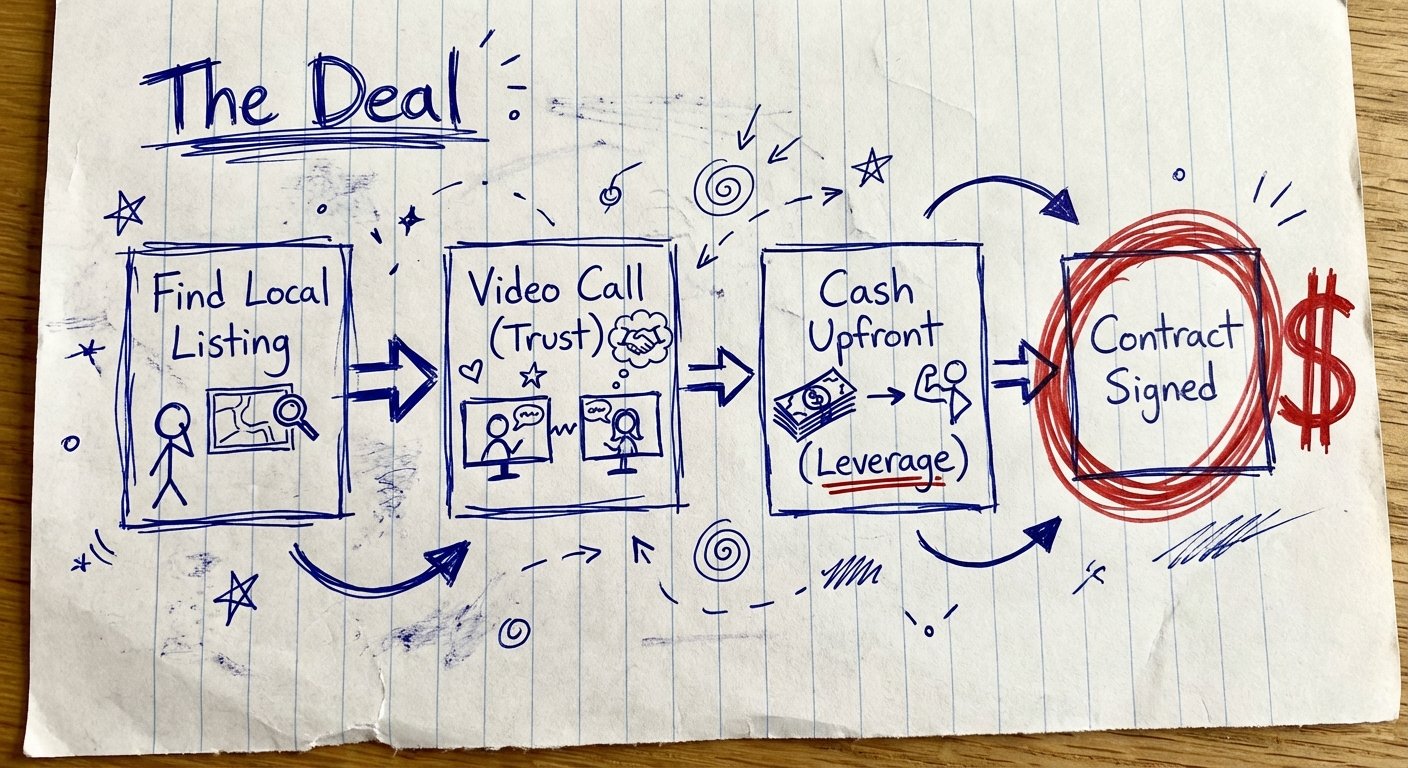
I see your apartment lists for €500. I am willing to pay the full 3 months upfront in cash/transfer upon signing. This gives you guaranteed income with zero risk.
I do not smoke, I do not have pets, and I work 10 hours a day.
Are you available for a video call on WhatsApp today to discuss?
Best,
[Your Name]”
Why this works:
- Cash Upfront: Money talks. This removes their fear of non-payment.
- “Quiet Place to Work”: Signals you are not there to party.
- Video Call: Establishes trust instantly.
The Risks (and How to Mitigate Them)
Is this riskier than Airbnb? Yes. That is why it is cheaper.
Risk is the price you pay for the discount.
Scam Warning: If they ask for money before you see the apartment (in person or video), it is a scam. Never wire money via Western Union. Use SEPA transfers or Wise where you have a paper trail.
The ” Bait and Switch”: Sometimes the photos are 10 years old. This is why you must do a video walkthrough. Ask them to turn on the tap. Ask them to open the window so you can hear the noise level.
Conclusion: The ROI of Discomfort
It takes 4 hours to find a place on a local site. It takes 4 minutes to book on Airbnb.
Those 4 hours save you $1,500.
That is $375 per hour tax-free. Do you make $375 an hour at your job? Probably not.
So, doing this work is literally the highest ROI activity you can do.
Stop overpaying for convenience. Build your infrastructure. Learn the local market. Keep your money.