The Luggage Tax: Why You Are Losing Money
Most people view luggage as an accessory. They worry about the color. They worry if it matches their shoes. They worry about the brand name.
They are wrong.
Luggage is an asset. It is a tool. Its only job is to get your gear from Point A to Point B with zero friction.
If your bag breaks, you lose money replacing it. If your bag forces you to check it at the gate, you lose time waiting at the carousel. If your bag is too heavy, you lose energy.
I value my time at thousands of dollars an hour. Standing at a baggage claim for 45 minutes costs me a fortune. It costs you a fortune too, even if you don’t realize it yet.
The year is 2026. Travel has gotten faster, but airlines have gotten stricter. You need equipment that works. You generally have two choices for high-ROI travel:
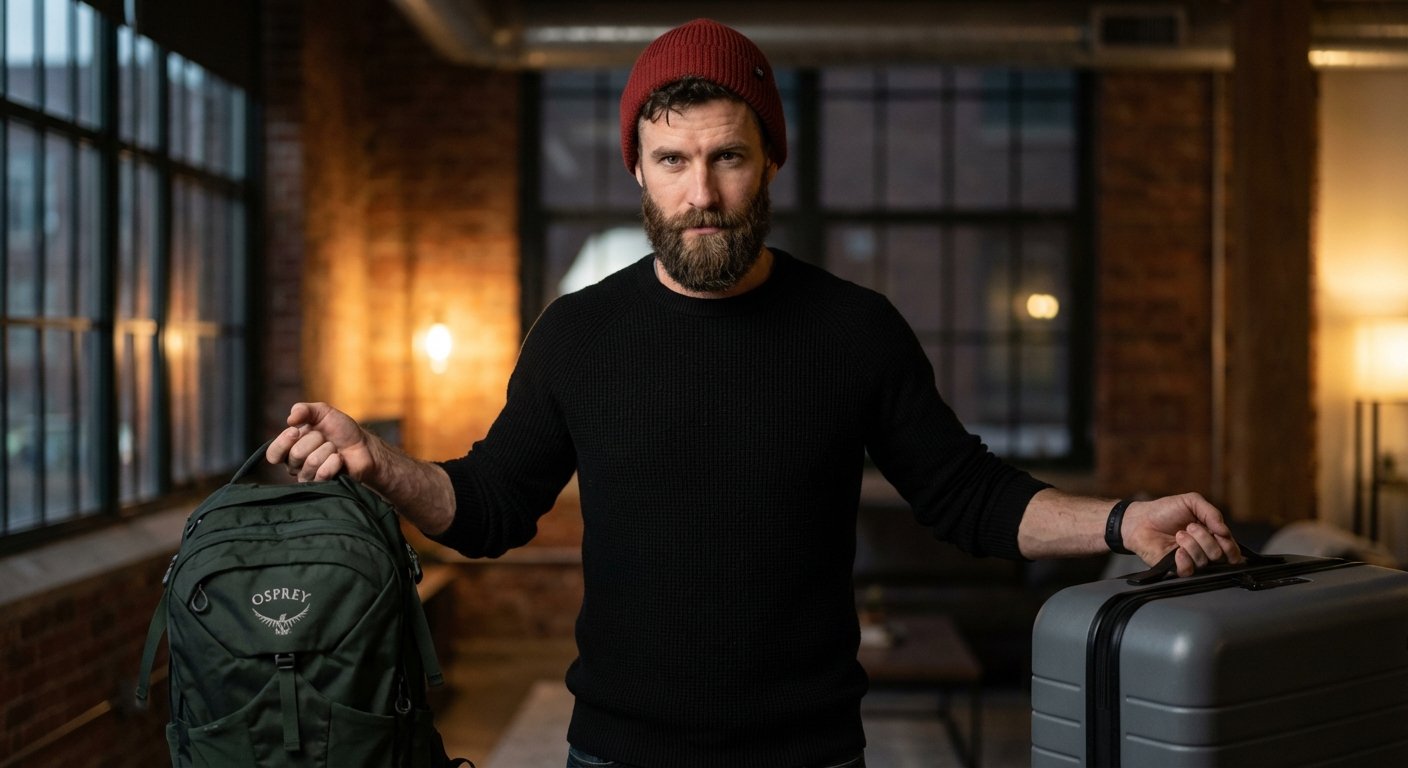
- The Classic Hardside Spinner (The sleek, rolling office).
- The Osprey Farpoint 40 (The backpack that beats the system).
I’m going to break down the math, the durability, and the utility. No fluff. Just the answer on which one makes you more efficient.

The Contender: The Hardside Spinner
When I say “Hardside Spinner,” I am talking about 100% Polycarbonate shells. Not ABS plastic (that cracks). Not soft-side fabric (that tears).
We are looking at the category leader: The Samsonite Freeform or the Monos Carry-On Pro. These are the gold standards for 2026.
The Pros: Professionalism and Ease
1. Zero Physical Strain
You push it. You don’t carry it. If you are wearing a suit or expensive gym gear, you don’t want sweat marks on your back. A 4-wheel spinner glides. It requires almost zero calories to move.
2. Crush Protection
If you carry camera gear, hard drives, or supplements in glass bottles, hardside is the only improved insurance. It creates a physical barrier between your assets and the outside world.
3. The “Boardroom” Aesthetic
Walking into a high-stakes meeting with a backpack makes you look like a student. Walking in with a matte black hardside spinner makes you look like you own the place. Perception is reality in business.
The Cons: The Mobility Tax
1. Stairs are the Enemy
Ever tried to drag a 4-wheel spinner up five flights of stairs in a walk-up apartment? It’s miserable. You lose all efficiency the moment the smooth floor ends. Cobblestones? Gravel? You are dead in the water.
2. The “Gate Check” Risk
Airlines target spinners. They look rigid. They look big. If the overhead bin is full, the gate agent will point at your spinner and say, “Check it.” Now you are stuck waiting 40 minutes at your destination. You just lost time. You just lost ROI.
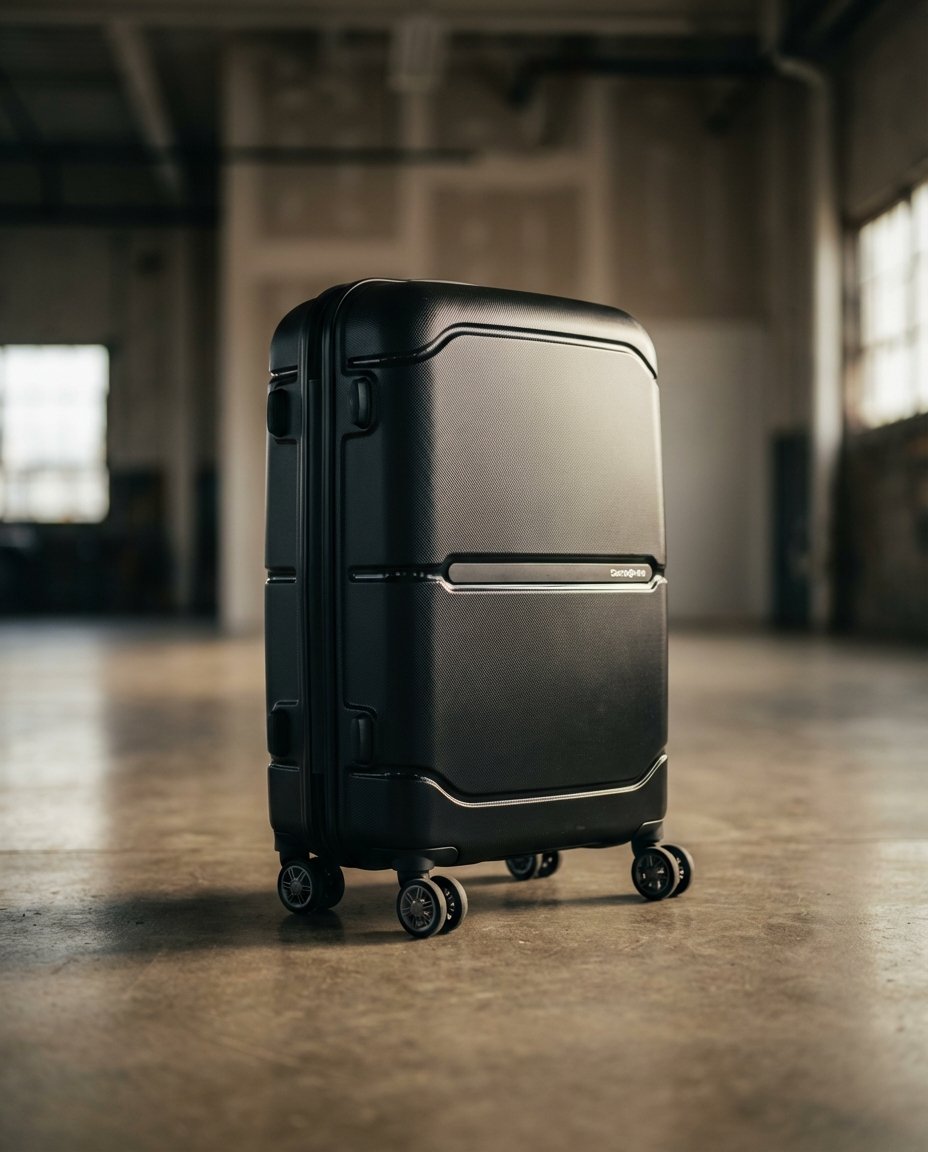
The Hardside Representative: Samsonite Freeform 21″
This is the volume king for a reason. It is light, durable enough, and relatively cheap.
- Material: Injection-molded Polypropylene.
- Weight: ~6.5 lbs.
- Price: $140 – $180 depending on sales.
If you stick to airports, Ubers, and hotels with elevators, this is a solid asset.
The Specialist: Osprey Farpoint 40
This is not a hiking bag. This is a travel system designed to bypass airline incompetence. The Osprey Farpoint 40 has been the king of “One Bag” travel for a decade. The 2026 model is even better.
The Pros: Speed and Invisibility
1. You Never Check a Bag
This is the biggest ROI factor. Because it is soft and on your back, gate agents ignore you. I have walked onto hundreds of flights with a “full” flight status. They take the spinners. They let me walk by. I save 30 to 60 minutes per flight. That adds up to days of your life over a few years.
2. All-Terrain Mobility
Stairs? Easy. Snow? Easy. Running to catch a train that is leaving in 30 seconds? You can sprint with the Farpoint. You cannot sprint with a spinner.
3. The Harness System
Most travel backpacks have garbage straps. Osprey uses a proper suspension system. It transfers the weight to your hips, not your shoulders. You can carry 30lbs and it feels like 10lbs.
The Cons: The Sweat Equity
1. You Carry the Weight
Physics is real. If you pack heavy, you feel it. If you have a bad back, this is a bad investment.
2. Wrinkled Clothes
You have to pack strategically. If you just jam a suit jacket in there, it will look like trash when you arrive. You need packing cubes. That is an extra step.
The Specs: Osprey Farpoint 40 (Latest Model)
This bag is built like a tank. It has a lifetime warranty. If you break it in 2040, they will still fix it.
- Capacity: 40 Liters (Carry-on compliant globally).
- Weight: ~3.5 lbs (Lighter than hardside).
- Features: Stowable harness (zips away to look like a duffel), Laptop sleeve moved to the back (better balance).
- Price: $160 – $185.
This is the choice for people who value speed over comfort.

The ROI Calculation: The Math of Travel
Let’s look at the numbers. We aren’t making decisions based on “feelings.” We make them based on returns.
Assume you take 10 trips a year. That is 20 flights.
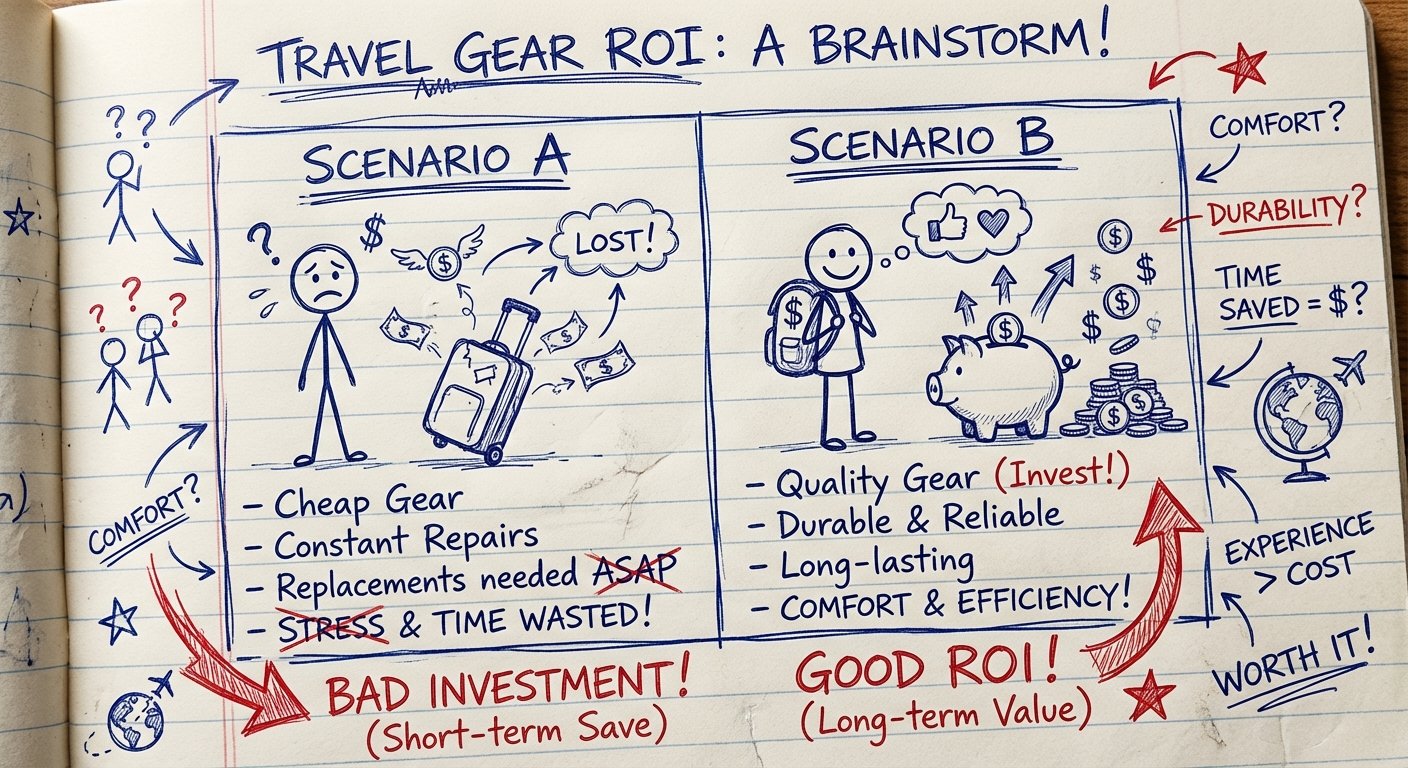
Scenario A: The Cheap Checked Bag
You buy a $50 bag. It breaks after 5 trips. You buy another one. Total hardware cost: $100.
You check the bag every time because it’s too big or you are lazy. Airline fees are roughly $35 each way.
20 flights x $35 = $700 in fees.
You wait 30 minutes at baggage claim per flight.
20 flights x 0.5 hours = 10 hours wasted.
If your time is worth $50/hour, that is $500 lost.
Total Cost of “Cheap” Travel: $1,300/year.
Scenario B: The Osprey / High-End Spinner Strategy
You buy the Osprey Farpoint 40 for $185. It lasts 10 years. Annualized hardware cost: $18.50.
You never check the bag.
Fees: $0.
You never wait at the carousel. You walk straight to the Uber.
Time wasted: 0 hours.
Total Cost of Smart Travel: $18.50/year.
The math is undeniable. Buying the right carry-on gear saves you over $1,200 a year in hard costs and opportunity costs. The bag pays for itself in two trips.
Comparison: Head-to-Head
I rated these on a scale of 1 to 10 based on pure utility.
Durability
- Hardside (Samsonite): 7/10. Wheels are the weak point. If a baggage handler throws it, a wheel snaps. Game over.
- Osprey Farpoint: 10/10. Fabrics rip, but Osprey fixes them. There are no moving parts to break. Simple systems last longer.
Capacity (Volume)
- Hardside: 8/10. The box shape is efficient. You can stack items easily.
- Osprey Farpoint: 7/10. The curved shape loses some corners. You have to be better at Tetris.
Speed (Through Airport)
- Hardside: 6/10. Great on smooth floors. Terrible on escalators and carpet.
- Osprey Farpoint: 9/10. You are agile. You can weave through slow crowds.
Professionalism
- Hardside: 10/10. Looks clean. Fits in a trunk.
- Osprey Farpoint: 4/10. You look like a digital nomad. This is fine for tech, bad for investment banking.
The Verdict: Who Wins?
The answer depends on the terrain you operate in.
Buy the Samsonite Hardside IF:
- You travel strictly for business meetings.
- You have back issues.
- You stay in hotels with bellhops and elevators.
- You carry fragile electronics that need a hard shell.
Buy the Osprey Farpoint 40 IF:
- You want maximum ROI on your time (speed).
- You travel to places with uneven ground (Europe, Asia, old cities).
- You refuse to pay airline baggage fees on principle.
- You want a bag that is literally impossible to break.
Final Word
Stop overthinking it. Analysis paralysis is poverty.
If you want speed, get the Osprey. If you want ease, get the Hardside. Both of them beat the cheap $50 bag you bought at a discount store five years ago.
Make the purchase. Book the flight. Go make money.