This post contains affiliate links. If you purchase through our links, we may earn a small commission at no extra cost to you.
The Two Lies You’re Being Sold
There are two types of people talking about digital nomad life.
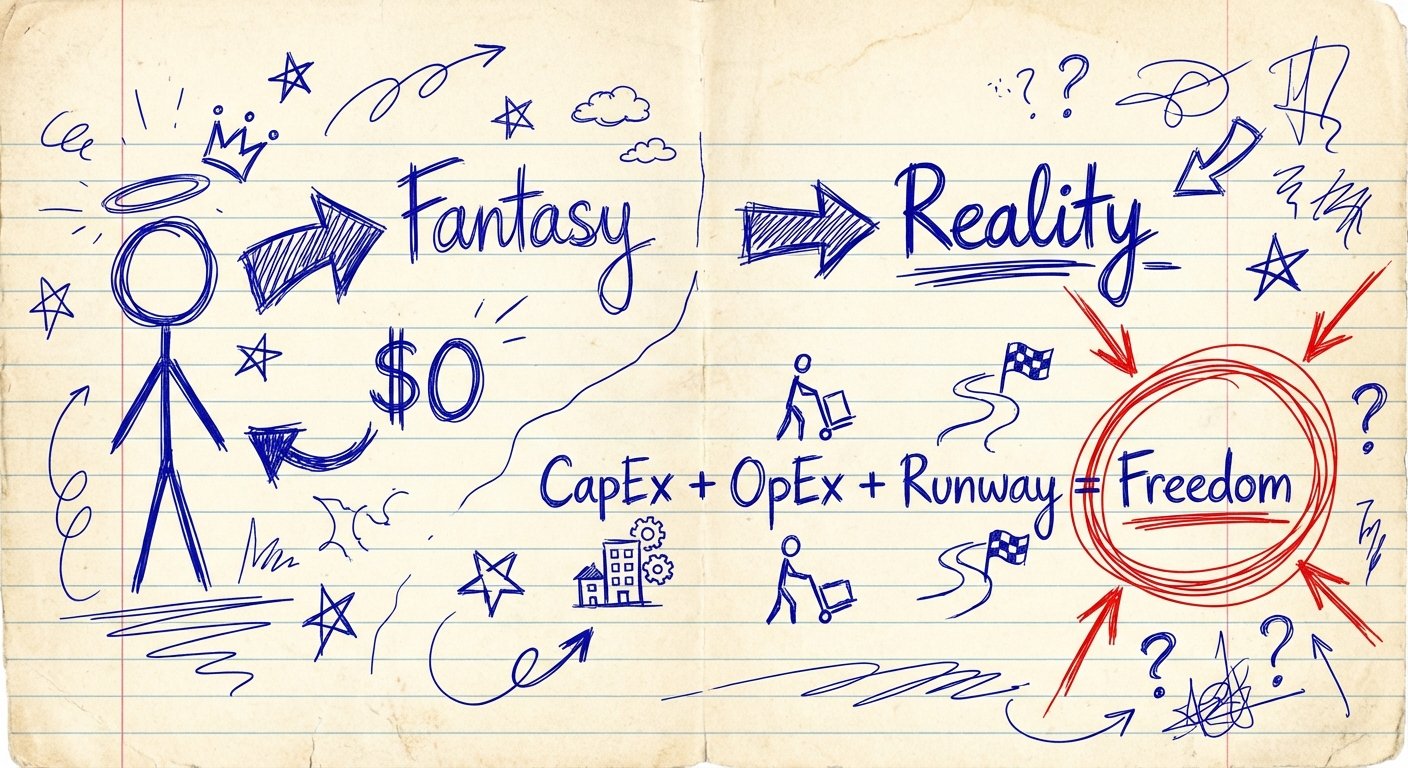
The first group is selling you a fantasy. They tell you that you can travel the world with $0 in your pocket. They say things like “just manifest it” or “work in a hostel for free accommodation.”
That is not a business plan. That is homelessness with a passport.
The second group tells you that you need $100,000 saved up, a passive income empire, and a diverse portfolio of real estate before you step on a plane. This is also a lie. This is procrastination disguised as preparation.
The truth is a boring math equation.
It’s not about how much money you have. It’s about your burn rate vs. your earning potential. It is about runway.
I am going to break down exactly what you need to spend to do this professionally. Not as a backpacker. As a business owner. We are looking for ROI (Return on Investment) on every dollar.
If it doesn’t make you money or save your life, you don’t buy it.
The Core Equation: CapEx vs. OpEx
In business, we have Capital Expenditures (one-time costs to get started) and Operating Expenditures (monthly recurring costs).
Your life is now a business. Treat it like one.
Most people blow their budget on CapEx. They buy a $4,000 camera and a drone they don’t know how to fly. Then they run out of money for OpEx (food and rent) in month two.
Here is the rule: Minimize CapEx. Optimize OpEx.
1. The Hardware (CapEx)
You are a knowledge worker. Your laptop is your factory. If your factory shuts down, you stop making money.
Do not buy a cheap Windows laptop that breaks in three months. Do not buy a $4,000 gaming rig that weighs 10 pounds unless you are a video editor rendering 8K footage.
You need reliability. You need battery life. You need resale value.
The Recommendation: MacBook Air M3 (13 or 15 inch)
This is the highest ROI computer on the planet right now. It is silent. It has no fans to clog with beach sand. The battery lasts 18 hours. You can work a full day without being tethered to a wall.
If you buy a cheap laptop for $400, you will replace it in a year. If you buy the M3 Air, it will last you five years. That is a cost of ownership of roughly $200 per year. That is a no-brainer.
Current Price Estimate: $999 – $1,299
The Ergonomic Insurance
Working from a laptop hunched over a cafe table destroys your neck. If your back gives out, you can’t work. If you can’t work, you don’t get paid.
Spend $150 now to save $5,000 in physical therapy later.
You need a portable laptop stand and a bluetooth keyboard. This allows you to raise the screen to eye level. It turns any Airbnb table into a proper workstation.
The Recommendation: Roost Laptop Stand V3
It’s expensive for a piece of plastic. Buy it anyway. It is the lightest, most durable stand made. I have had mine for six years. It still works perfectly.
Current Price Estimate: $85 – $95
2. The Safety Net (OpEx)
This is where amateurs get wiped out.
They think, “I’m healthy, I don’t need insurance.”
Here is the reality: A motorbike accident in Thailand costs $15,000 to fix. A medical evacuation flight costs $50,000+. If you do not have insurance, one bad day bankrupts you. That is infinite downside for a $45/month saving. That is bad math.
You need travel medical insurance that covers you while you work.
The Solution: SafetyWing
It is built for nomads. It works like a subscription. You turn it on when you leave, you turn it off when you get home. It covers medical emergencies and travel delays. It costs about $45/month for most people.
Do not overthink this. Just get it.
3. Digital Defense (OpEx)
You are going to be connecting to public WiFi in airports, cafes, and Airbnbs. These networks are insecure.
If a hacker intercepts your login credentials for your bank, you lose your runway. Game over.
You need a VPN (Virtual Private Network). It encrypts your data. It also lets you access content from home that might be blocked in the country you are visiting.
The Solution: NordVPN
It is fast. It is reliable. It is cheap. For the price of one coffee a month, you secure your entire digital life.

4. The Logistics of Money
Banks love fees. They love foreign transaction fees. They love bad exchange rates. Traditional banks will charge you 3% every time you swipe your card abroad.
If you spend $2,000 a month, you are giving the bank $60 for nothing. Over a year, that is $720. That is a round-trip flight.
Stop giving money to banks.
The Solution: Wise (formerly TransferWise)
Get a Wise multi-currency account. You get a debit card that uses the real mid-market exchange rate. You can hold USD, EUR, GBP, and 50 other currencies simultaneously. It is the industry standard for a reason.
5. The “Sleep at Night” Fund (Runway)
Now, let’s talk about cash in the bank.
How much do you actually need saved before you leave?
The common advice is “save $10,000.” That is a random number. It means nothing.
You need to calculate your Burn Rate.
If you move to Chiang Mai, Thailand, or Medellin, Colombia, your cost of living will be drastically lower than New York or London.
A realistic comfortable monthly budget for a solo nomad in a hub like Bali or Lisbon:
- Housing: $800 – $1,200 (Private apartment)
- Food: $400 – $600 (Eating out mostly)
- Transport: $100 (Scooter or Uber)
- Coworking Space: $150 – $200
- Gym/Misc: $100
- Insurance/Software: $100
Total Monthly Burn: $2,000 (approx)
You want 6 months of runway. Why 6 months? Because it takes 3 months to figure out a new environment and start being productive again. If you only have 2 months of savings, you will panic in week 4.
Calculation: $2,000 x 6 = $12,000.

The Emergency Ejection Button
There is one more cost you must account for.
The “Get Me Out of Here” fund.
Sometimes, things go wrong. A pandemic hits. A family member gets sick. You just hate the city you’re in.
You need the cash equivalent of a last-minute, one-way flight back to your parents’ house. This money is untouchable. It does not count towards your runway. It sits in a separate savings account.
Cost: $1,500.
The Grand Total Calculation
Let’s tally the bill. This is the “Professional” tier. This is for someone who wants to succeed, not just survive.
1. CapEx (One-Time Gear Purchase):
- MacBook Air M3: $1,100
- Roost Stand + Keyboard/Mouse: $200
- Decent Backpack (e.g., Osprey/Peak Design): $150
- Total CapEx: $1,450
(Note: If you already have a good laptop, your CapEx is practically zero.)
2. OpEx Setup (First Month):
- Travel Insurance (SafetyWing): $45
- VPN (NordVPN): $5
- Software Subs: $50
- Total OpEx: $100
3. The Runway (Cash in Bank):
- 6 Months Living Expenses: $12,000
- Emergency Flight Fund: $1,500
- Total Cash: $13,500
The Final Number: $15,000
If you have zero gear and zero savings, you need roughly $15,000 to launch properly.
If you already have a laptop, you need roughly $13,500.
Can you do it for less? Yes. You can go with 3 months of savings ($6,000). You can eat street food for every meal. You can stay in dorms.
But stress kills creativity. And creativity is what makes you money.
When you have 6 months of cash in the bank, you negotiate better. You don’t take bad clients out of desperation. You build a business that lasts.

Stop Planning. Start Stacking.
Now you have the number.
It’s not a million dollars. It’s the price of a used Honda Civic.
If you really want this life, stop scrolling Instagram. Look at your bank account. Look at your monthly spending. Cut the fat. Sell the crap you don’t need.
Hit the number. Buy the flight. Never look back.