This post contains affiliate links. If you purchase through our links, we may earn a small commission at no extra cost to you.
The True Cost of Packing Like an Amateur
Most people pack out of fear.
They look at their empty suitcase and think, “What if it snows? What if I get invited to a formal dinner? What if I spill coffee on myself three times in one day?”
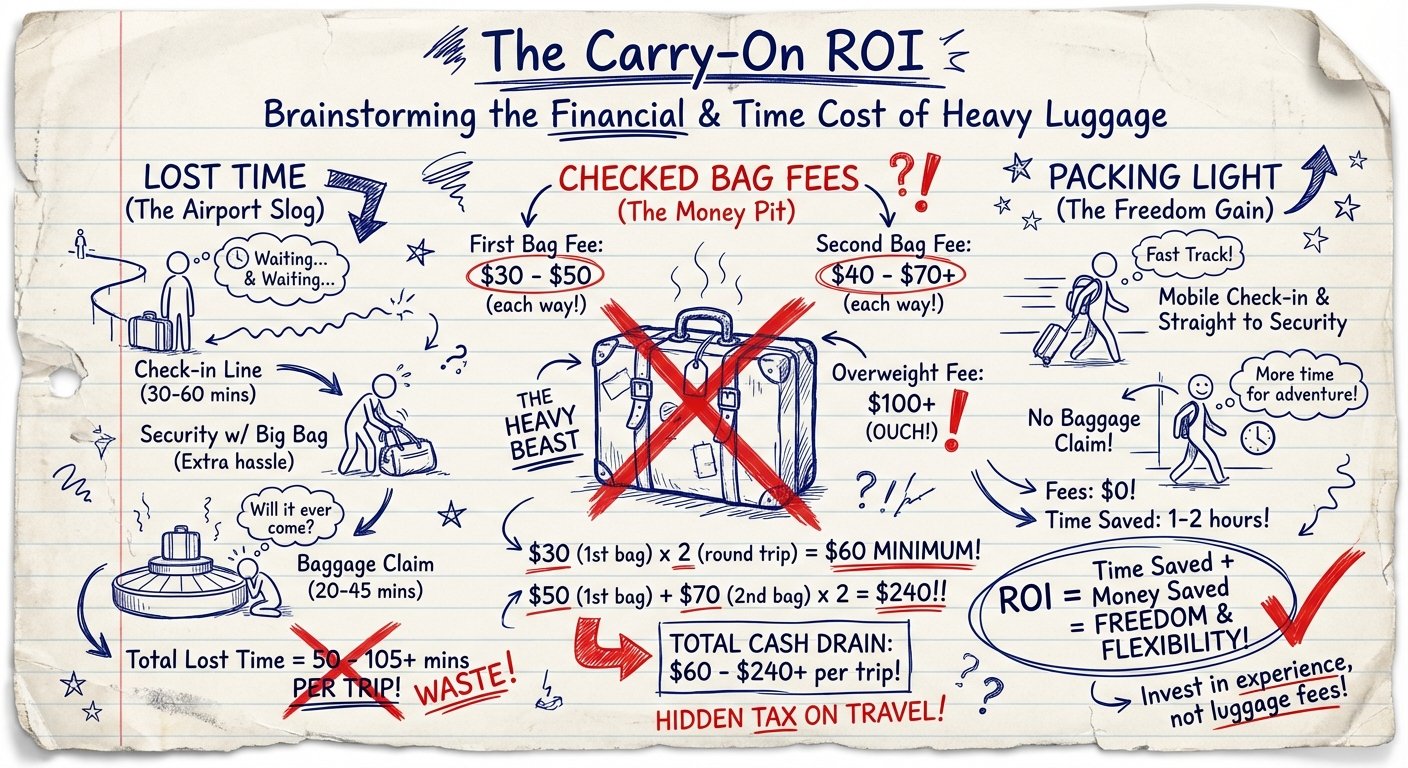
So, they pack three weeks’ worth of clothes for a seven-day trip. They drag a 50-pound monstrosity to the airport. They pay $70 to check it. They stand at a luggage carousel for 45 minutes praying it didn’t end up in Chicago.
Fear is expensive. It costs you money, time, and mobility.
Living out of one carry-on bag isn’t about being a dirty backpacker. It’s about being a ruthless optimizer. It’s about looking at travel as a math problem and solving it for maximum ROI.
If you value your time at $100 an hour, spending an hour packing, an hour at baggage drop, and an hour at baggage claim costs you $300 in lost time per flight. Add the $70 checked bag fee. You are paying $370 per flight just to drag around shirts you won’t even wear.
Stop doing this. I am going to show you exactly how to live indefinitely out of a single carry-on. No fluff. Just the exact gear, the exact math, and the exact mindset you need to travel lighter, faster, and cheaper.
The Bag: Your Mobile Real Estate
The biggest mistake people make is buying cheap luggage. Cheap luggage is a tax on people who don’t do math.
If you buy a $50 backpack from a generic brand, the zipper will break. It won’t happen when you’re at home. It will happen in a crowded train station in Tokyo. You will waste six hours of your trip trying to find a replacement bag in a foreign country. You just burned half a vacation day because you wanted to save $150.
Buy a good bag once. Cry once. Use it for a decade.
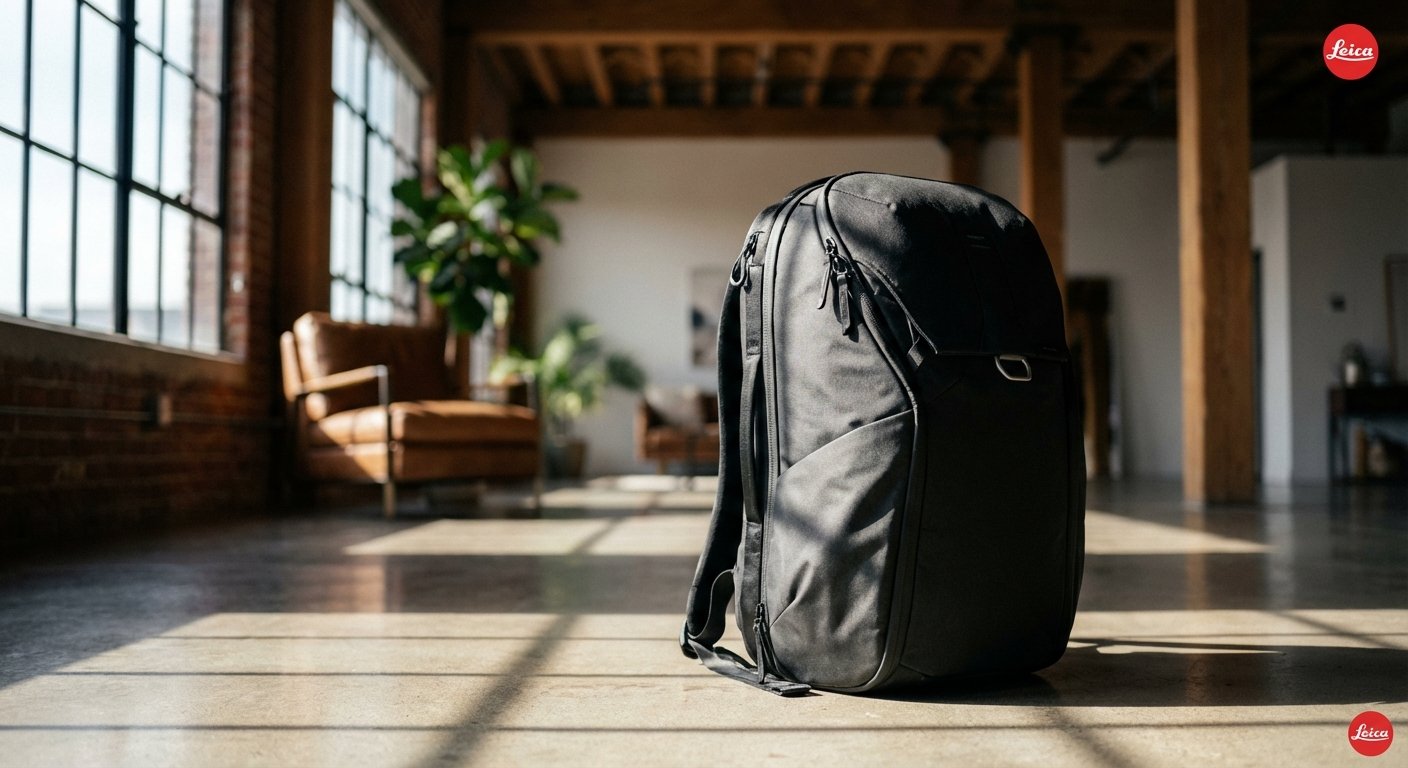
You need a bag that perfectly fits maximum legal carry-on dimensions (usually around 45 liters or less). It needs weatherproofing. It needs YKK zippers. It needs a dedicated, suspended laptop sleeve.
My top recommendation is the Peak Design Travel Backpack 45L. It compresses down to a 35L day bag when you need it, and expands to 45L when you’re maximizing your carry-on allowance. It’s built like a tank. Current estimated price: $299 – $329.
It’s not cheap. It’s an investment in your mobility.
The 80/20 Rule of Clothing
You do not need 14 shirts for a 14-day trip. That is a loser’s game.
You need to understand the 80/20 rule of travel clothing: 80% of the time, you end up wearing your favorite 20% of your clothes anyway. You pack a bunch of “just in case” outfits, and they sit at the bottom of your bag.
Here is the exact framework to use: The Rule of Three.
- One to wear.
- One to wash.
- One to dry.
That’s it. You only need three t-shirts. Three pairs of underwear. Three pairs of socks. Two pairs of pants (wear one, pack one). One jacket. One sweater.
But to make this work, you have to upgrade your fabric. You cannot do this with cheap cotton. Cotton traps sweat, holds onto odor, and takes 24 hours to air dry.
You need Merino Wool.
Merino wool is naturally anti-microbial. It regulates temperature. It does not smell. You can literally sweat in a merino wool shirt, hang it up overnight, and wear it again the next day. No one will know.
Yes, a good merino wool t-shirt costs $80. But you only need three of them. You’re trading a closet full of $15 cheap cotton shirts for three high-performance garments.
Look at Unbound Merino. Their shirts are designed to look like normal, stylish casual wear, not shiny hiking gear. Current estimated price: $85 – $90.
Footwear: The Space Killer
Shoes take up more volume in your bag than anything else. Most people pack three or four pairs. Big mistake.
You only get two pairs of shoes total.
Pair One: The heavy, bulky pair. You wear these on the airplane. Do not put these in your bag. This is usually a comfortable leather boot (like a Blundstone) or a chunky athletic shoe.
Pair Two: The packable pair. These go in your bag. These need to be lightweight, compressible, and versatile. They need to work for the gym, for a run, and for walking around the city.
I recommend minimalist “barefoot” style shoes because they roll up into almost nothing. The Vivobarefoot Primus Lite III is an excellent choice. They pack flat and weigh ounces instead of pounds. Current estimated price: $150 – $170.
The Tech Stack: Consolidate Power
If you pull out your bag right now and look at your electronics, I guarantee you have a tangled mess of cables. You probably have a brick charger for your laptop, a separate plug for your phone, another plug for your kindle, and a dozen random cords.
This is inefficient.
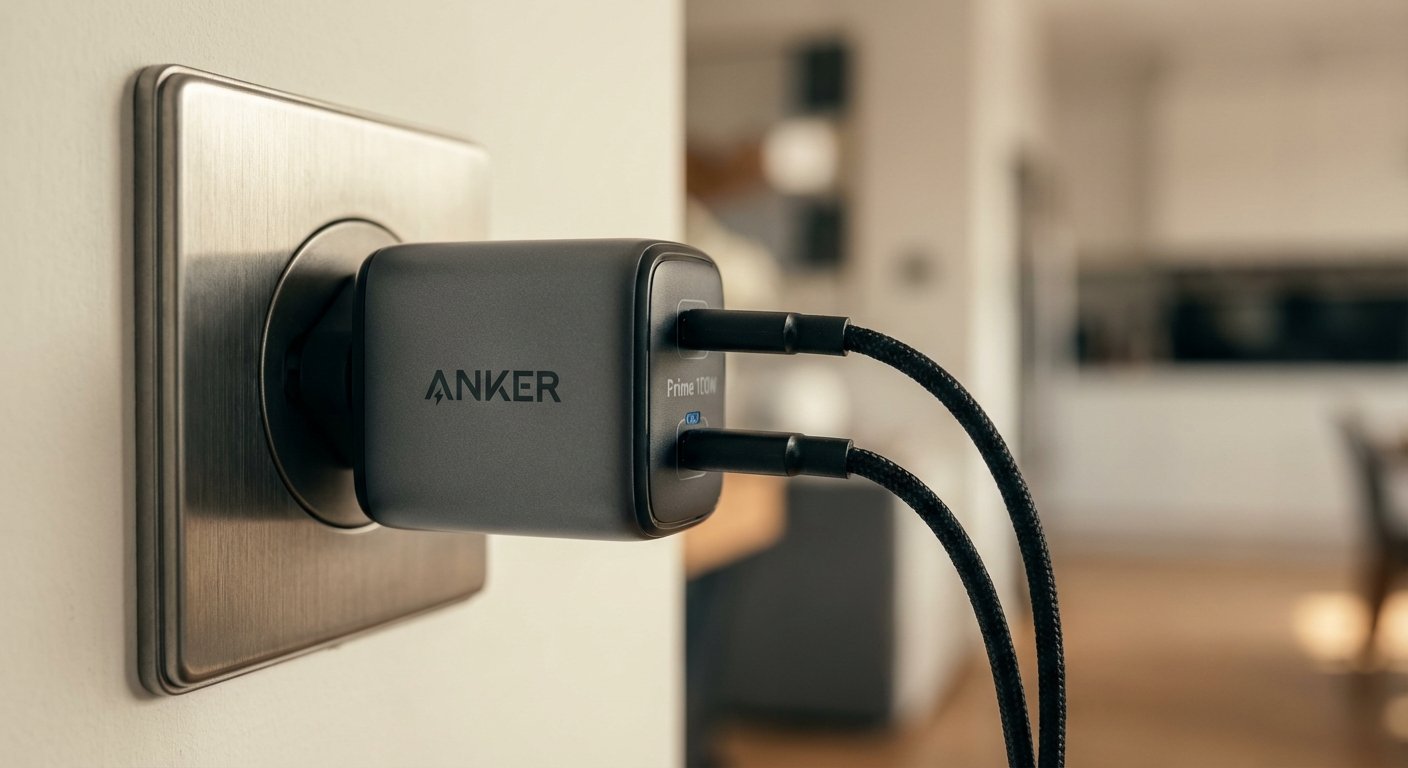
You need to consolidate your power. Technology has evolved. Gallium Nitride (GaN) chargers have replaced the old, chunky silicon chargers. They output massive power in a tiny footprint.
Buy one charger with multiple ports. The Anker Prime 100W GaN Wall Charger has multiple USB-C ports and a USB-A port. It is smaller than a deck of cards. It is powerful enough to charge a 14-inch MacBook Pro, an iPhone, and wireless earbuds simultaneously from a single wall outlet.
Current estimated price: $60 – $85.
Throw away the single-use chargers. Carry the Anker GaN charger and two high-quality USB-C cables. You are done.
Digital Security: Protecting Your Assets
While we are talking about tech, let’s talk about risk.
When you travel, you connect to airport Wi-Fi, hotel Wi-Fi, and coffee shop Wi-Fi. These networks are public. They are unencrypted. They are hunting grounds for people trying to steal your data.
If someone intercepts your login credentials while you are checking your bank account in a Starbucks in London, how much is that going to cost you? Thousands of dollars? Weeks of freezing credit cards and arguing with fraud departments?
Protecting your digital assets is non-negotiable. You need a VPN to encrypt your internet traffic.
Don’t use a free one. Free VPNs sell your data to pay for their servers. Use NordVPN. It’s fast, it doesn’t drain your battery, and it secures your connection instantly with one click. Consider it digital insurance.
The Toiletry Trap
Liquids are heavy. Liquids explode. The TSA throws liquids in the trash.
Stop packing giant bottles of shampoo, body wash, and shaving cream. Stop packing liquid at all if you can avoid it.
Shift to solids.
You can buy solid shampoo bars, solid soap, and solid deodorant. They last longer than liquids, they take up less space, and security doesn’t care about them.
Store your solid soaps in a breathable case so they don’t turn to mush in your bag. The Matador FlatPak Soap Bar Case is a game-changer. It’s made from a proprietary material that lets water vapor escape but keeps water droplets in. Your soap dries through the bag. Current estimated price: $13 – $15.
Health and the “Just In Case” Fallacy
One of the biggest excuses people make for overpacking is medical anxiety. They pack a massive first-aid kit. Bandages, antibiotic ointment, stomach meds, cold medicine, backup stomach meds.
Here is a dose of reality: Unless you are trekking deep into the Amazon rainforest, you are going to be near a pharmacy. If you get a headache in Paris, you can buy aspirin in Paris. They have doctors and pharmacies in other countries. You do not need to carry a mobile hospital.
Pack a tiny pouch with three days’ worth of your personal prescriptions and a few painkillers. That’s it.
However, while you shouldn’t pack physical backup gear for every minor ailment, you absolutely must pack financial backup for a catastrophe.
A headache costs $5 to fix abroad. A broken leg in a foreign country can cost you $30,000 out of pocket. Your domestic health insurance probably will not cover you internationally.
You need travel medical insurance. This is not optional. It is basic risk mitigation. For this, I exclusively recommend SafetyWing. It works like a subscription. It covers medical emergencies and travel delays, and you can start or stop it anytime. It’s incredibly cheap for the downside protection it provides.
Packing Cubes: Compressing Your Life
Even if you pair down your clothing to the bare minimum, you still need a system to manage it inside the bag.
If you just throw your clothes into the main compartment, they will expand. They will wrinkle. You will have to dig through everything to find one pair of socks, creating a mess you have to re-pack every single morning.
The solution is packing cubes.
Packing cubes act as drawers for your backpack. One cube for shirts. One cube for pants. One small cube for underwear and socks. When you get to your hotel, you just pull the cubes out and put them in the dresser. Done in 10 seconds.
Don’t just buy any packing cubes. Buy compression cubes. These have an extra perimeter zipper that squeezes the air out of your clothes, reducing their volume by up to 30%.
Eagle Creek makes the best ones. Look for the Eagle Creek Pack-It Isolate Compression Cubes. They are ultra-lightweight and the zippers never snag. Current estimated price: $35 – $45 for a set.
The Fantasy Self vs. The Real Self
Let’s talk psychology. Why is it so hard for people to leave things behind?
When people pack, they don’t pack for who they actually are. They pack for their “Fantasy Self.”
Your Fantasy Self wakes up at 5:00 AM, goes for a five-mile run, attends a black-tie gala, and reads three hardcover books on the beach. So, you pack running shoes, a suit, and three heavy books.
Your Real Self sleeps until 8:30 AM, walks to a coffee shop, wears a t-shirt, and reads articles on an iPad.
Be brutally honest about your daily habits. Pack for the Real You. If you don’t run at home, you aren’t going to start running in Rome. Leave the running shoes. If an absolute miracle happens and you get invited to a black-tie gala, spend the $150 to rent a suit for the night. Don’t carry a suit for 10,000 miles just in case.
You are paying a daily tax in physical energy and mental bandwidth to carry things for a person who doesn’t exist.
Laundry Logistics: The Three-Minute Routine
The obvious pushback to the “Rule of Three” clothing framework is laundry. “I don’t want to spend my vacation sitting in a laundromat.”
You don’t have to.
When you travel with high-performance fabrics like merino wool, you don’t use laundromats. You do sink laundry. It takes three minutes.
Here is the exact routine:
- Take your dirty shirt and socks into the shower with you at the end of the day.
- Wash them with warm water and a little bit of your solid soap or travel detergent.
- Rinse them out.
- Wring them out.
- Lay them flat on a dry hotel towel, roll the towel up tight like a burrito, and stand on it. The towel absorbs 90% of the moisture.
- Hang the clothes up.
Because merino wool is highly breathable, it will be completely dry by morning. You have just bypassed the need to pack 10 days of clothing by investing three minutes of your evening. That is an unbeatable ROI.
The Financial Freedom of Agility
Let’s tie it all together and look at the bottom line.
When you travel out of one bag, your options multiply. You can take ultra-cheap regional flights on airlines like Ryanair in Europe or AirAsia in Southeast Asia without paying the $60 baggage penalty. Over the course of 20 flights, that’s $1,200 saved. That is enough to pay for a month of rent in Thailand.
When you land, you don’t have to wait an hour at the carousel. You walk straight past the crowds, out the door, and into a taxi. You save time. Time is your most valuable asset.
When you need to take public transit, you aren’t struggling to lift a 50-pound box up a flight of stairs. You just walk.
You are no longer managing inventory. You are experiencing the world.
Look at your current packing list. Cut it in half. Then cut it in half again.
Invest in high-quality, multi-use gear. Digitize your risks. Consolidate your power.
Travel light. Move fast. Win the game.