
This post contains affiliate links. If you purchase through our links, we may earn a small commission at no extra cost to you.
Stop Burning Cash on the Wrong Setup
Most digital nomads are broke. They shouldn’t be.
They make $5,000 a month online. They travel to cheap countries. They think they are living the dream. But at the end of the month, their bank account hasn’t grown. Why?
Because they make terrible decisions about where they live.
Housing is your biggest expense. It is also your biggest lever. If you pick the right housing, you make more money. If you pick the wrong housing, you bleed time, energy, and cash.
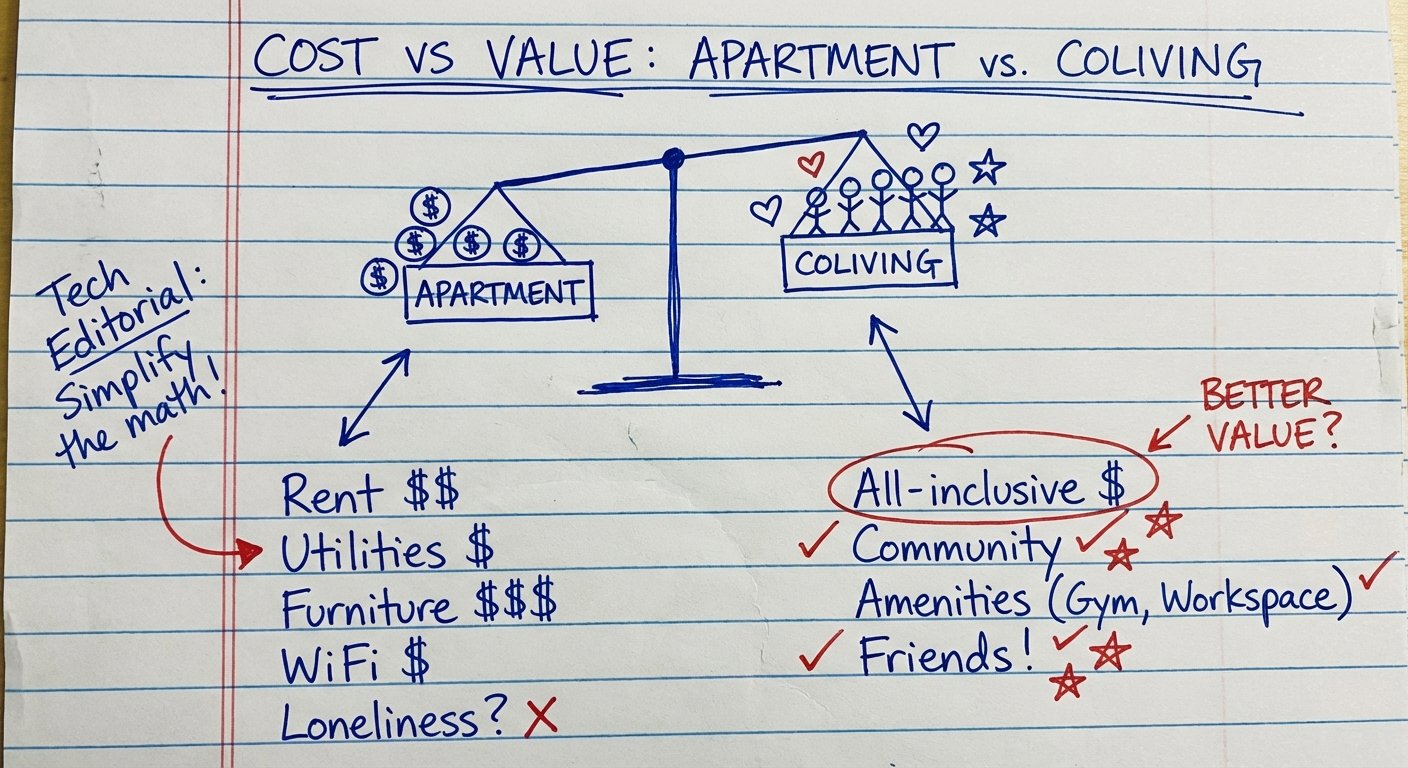
Right now, you have two choices: rent an apartment or pay for a coliving space.
The amateur looks at the price tag. The apartment is $800. The coliving space is $1,200. The amateur picks the apartment to “save $400.”
The professional looks at the ROI (Return on Investment). The professional knows that the $800 apartment will probably cost them $2,000 in lost productivity, hidden fees, and wasted time.
Let’s look at the math. Let’s look at the logic. Let’s figure out which option actually puts more money in your pocket.
The Real Cost of a “Cheap” Apartment
You land in Lisbon. Or Medellin. Or Bali. You booked a cheap Airbnb for a month.
You arrive. The host lied. The photos were taken with a wide-angle lens ten years ago. The desk is a wobbly kitchen table. The chair looks like it was stolen from a kindergarten.
Worse, the WiFi is 10 Mbps.
You have a client call in two hours. You can’t take it from the apartment. The video will lag. You will look unprofessional. The client will lose trust. If you lose a $2,000 retainer because of bad WiFi, your “cheap” apartment just became very expensive.
So, what do you do?
You pack up your laptop. You order an Uber. You drive 20 minutes to find a cafe. The cafe is loud. You can’t hear the client. You survive the call, but now you need to actually work.
You realize the cafe won’t cut it. You need a coworking space. That’s another $200 a month. You need to commute there every day. That’s $100 a month in Ubers or scooter rentals. You need to buy lunch near the coworking space instead of cooking at home. That’s another $300.
Let’s run the real numbers on your $800 apartment:
- Base Rent: $800
- Coworking Space: $200
- Daily Commute: $100
- Eating out (because you’re not home): $300
- Total Real Cost: $1,400
You didn’t save money. You spent more. And worse, you lost time. If you commute 40 minutes a day, that is 20 hours a month. If your time is worth $50 an hour, you just burned $1,000 of billable time staring at traffic.
Cheap housing is a trap for people who don’t value their time.
The Coliving Equation: Paying for Frictionless Output
Now let’s look at coliving.
A good coliving space costs a premium. Let’s say it’s $1,400 a month. On paper, it looks expensive. But what are you actually buying?
You aren’t buying a bed. You are buying the removal of friction.
You land at the airport. You go to the coliving space. You drop your bags. You connect to enterprise-grade WiFi. You walk downstairs to a built-in coworking space. You open your laptop. You start making money.
Zero hours lost. Zero stress. Zero setup.

If you are a serious professional, friction is your enemy. Every decision you have to make about where to work, how to get internet, and where to buy groceries drains your willpower. You want all your energy focused on revenue-generating activities.
But there is another factor that amateurs completely ignore: The Network.
If you rent an apartment, you are isolated. You work alone. You eat alone. To meet people, you have to go to forced networking events or awkward meetups.
In a coliving space, you are surrounded by other people doing exactly what you do. You share a kitchen with a Facebook Ads media buyer. You sit next to a SaaS founder in the coworking area. You grab a beer with an SEO agency owner.
I know people who have landed $10,000 contracts just by having breakfast in a coliving space. I know people who have found their business partners there. You cannot put a price tag on proximity to other ambitious people.
When you pay a premium for coliving, you are buying a curated network. If you can’t extract a positive ROI from a room full of entrepreneurs, that is a skill issue. Not a housing issue.
The “Frat House” Risk of Coliving
I need to give you a warning.
Not all coliving spaces are built for high performers. Some of them are just glorified hostels for broke backpackers pretending to be entrepreneurs.
If you book the wrong coliving space, it will destroy your productivity. People will be partying on a Tuesday at 2 PM. The “coworking area” will just be three people watching Netflix on a couch.
You must filter ruthlessly.
How do you find a good one? You look at the price. Cheap coliving attracts cheap people. Expensive coliving attracts people who make money. You want to be in the room with people who make money.
Look for spaces that explicitly market themselves to professionals, founders, and executives. Look for spaces that have a strict quiet hours policy. Look for spaces that have private call booths. If they don’t have call booths, it’s not a workspace. It’s an adult playground. Avoid it.
The Hidden Trap: Shared WiFi and Security
Let’s talk about the biggest technical flaw of both apartments and coliving spaces: Network Security.
If you are in a coliving space, you are sharing a WiFi network with 50 strangers. If you are in an Airbnb, you are using a router that the landlord bought for $10 five years ago and never updated.
Hackers love digital nomads. You have client data. You have crypto wallets. You have Stripe accounts logged in. If your Stripe account gets compromised, your cash flow goes to zero instantly.
You need a hardware barrier and a software barrier.
First, never connect your laptop directly to a public or shared router. Use a travel router. The industry standard right now is the GL.iNet GL-MT3000 (Beryl AX). It creates a private, encrypted sub-network between the sketchy public WiFi and your devices. It costs between $80 – $100.
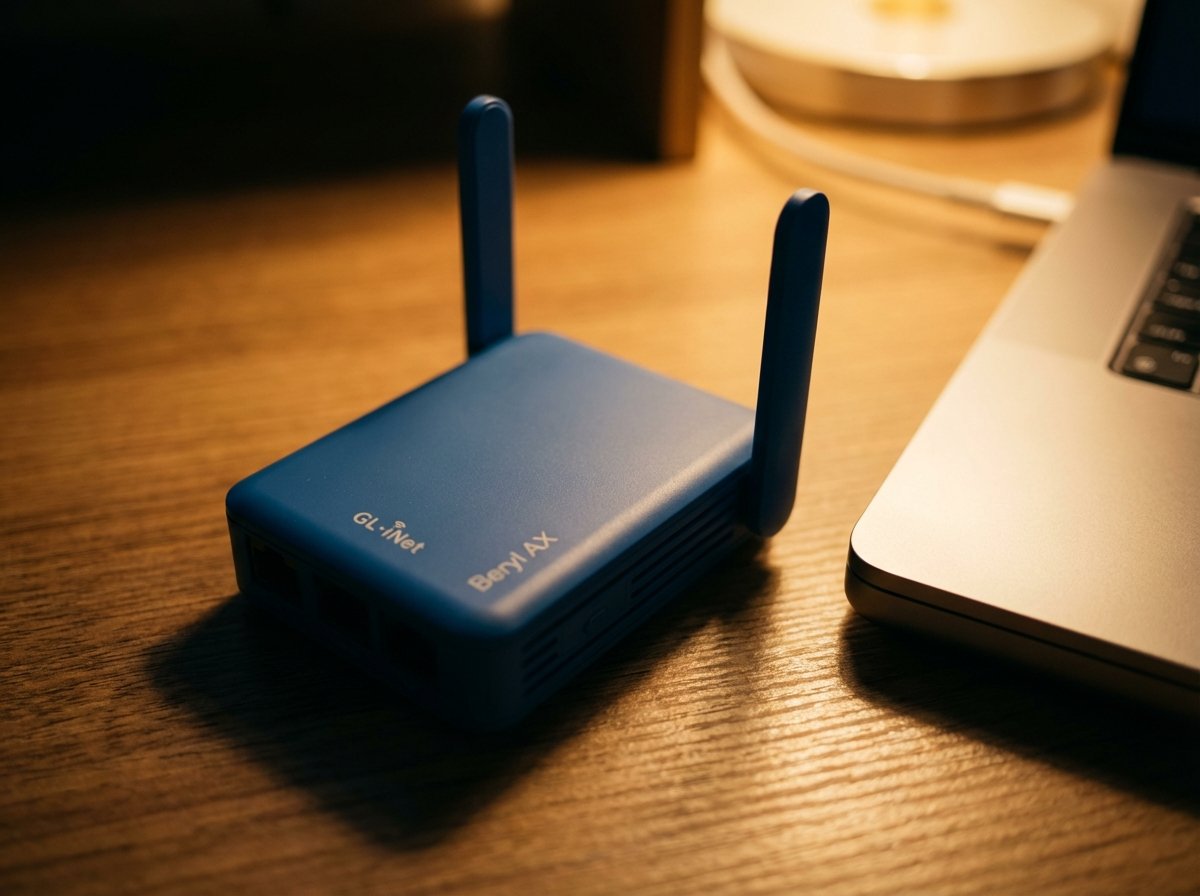
Buy it before you leave. It is the cheapest insurance policy for your business data.
Check Price on Amazon
Second, you need a VPN. A travel router protects the local connection. A VPN encrypts the traffic out to the internet. If you are logging into bank accounts from Colombia, Indonesia, or a cafe in Portugal, your bank’s fraud algorithm will freeze your account. A VPN with a dedicated IP prevents this.
Don’t use a free VPN. They sell your data. Use a premium, high-speed option that won’t throttle your Zoom calls. Get NordVPN. It costs a few bucks a month. If it saves your bank account from getting frozen once, the ROI is infinite.
How to Make an Apartment Work (If You Must)
Let’s say you make less than $5,000 a month. You are in the building phase. You literally cannot afford the $1,400 coliving premium. You need to keep your burn rate low.
Or, let’s say you are an extreme introvert. You hate people. You just want to lock yourself in a room and code for 12 hours a day.
In these cases, you will rent an apartment. But you must execute it like a professional.
Rule 1: Always verify the WiFi before booking.
Do not trust the listing. Message the host. Tell them to go to Speedtest.net, run the test, and send you a screenshot of the results. If they refuse, do not book. They are hiding bad internet.
Rule 2: Fix your ergonomics immediately.
Working on a couch will destroy your back. Medical bills are expensive. A cheap apartment usually means terrible furniture. You need to bring your own office setup. Buy a Roost V3 Laptop Stand. It costs roughly $85 – $90. It folds up to the size of a ruler and fits in your backpack. Combine it with a wireless keyboard and mouse.
Check Price on Amazon
Rule 3: Stop paying bank fees for rent.
If you rent an apartment locally, landlords want to be paid outside of Airbnb to avoid platform fees. They want local bank transfers or cash. If you use your traditional home bank to wire money internationally, you will lose 3% to 5% on awful exchange rates, plus flat wire fees.
That is stupid. It is a tax on laziness.
Open a multi-currency account. Convert your money at the mid-market rate (the real rate on Google). Send local transfers like a local. Stop giving banks your hard-earned margin. Try Wise to manage your international rent and expenses. It takes five minutes to set up.
The Disaster Scenario: When Cheap Housing Bites Back
People assume everything will go perfectly. They project their best-case scenario onto their spreadsheet.
Here is reality.
You rent a cheap apartment on the outskirts of Chiang Mai. You have to rent a scooter to get to the grocery store. It rains. You hit a pothole. You break your collarbone.
You go to the local hospital. Because you aren’t a resident, they charge you foreigner prices. The bill is $8,000. Your domestic health insurance back home says, “Sorry, you are out of network.”
You just wiped out three months of profit because you wanted to save $200 on rent by living outside the city center.
If you are traveling and working, you are taking on geographic risk. You need a hedge. You need travel medical insurance built specifically for nomads, which covers you in almost every country without needing to notify them when you cross borders.
Do not travel without a safety net. It is bad business logic. Get SafetyWing. It acts as a catastrophic backstop for your nomadic lifestyle.
The Verdict: Which One Makes You More Money?
Business is about allocating resources. Your resources are Time, Energy, and Capital.
If you have high Time and low Capital, you rent the apartment.
You deal with the friction. You take the bus to the cafe. You hustle. You use the money you saved to reinvest in ads, software, or skills. You do this until your income scales.
If you have high Capital and low Time, you buy the coliving space.
You are making $10k, $20k, or $50k a month. Your time is far too valuable to be arguing with a landlord in broken Spanish about a leaking toilet. Your time is too valuable to spend 45 minutes finding a cafe with decent WiFi.

You buy the coliving space to protect your output. You buy it for the infrastructure. You buy it for the collisions with other successful people.
Stop thinking like a backpacker trying to stretch $1,000 for six months. Start thinking like a CEO managing remote operations.
Every dollar you spend on housing should either buy you more time, buy you more focus, or buy you a better network. If it doesn’t do one of those three things, it is a bad investment.
Look at your current monthly income. Look at your hourly rate. Calculate the cost of friction.
Then, make the logical choice.