This post contains affiliate links. If you purchase through our links, we may earn a small commission at no extra cost to you.
The Instagram Lie vs. The Spreadsheet Reality
Most people think van life is free. They are wrong.
You see a 25-year-old on Instagram parked next to a beach. They are drinking pour-over coffee. The caption says something about “freedom” and “escaping the matrix.”
It looks amazing.
But Instagram does not show you the spreadsheet. It does not show you the depreciation. It does not show you the opportunity cost.
If you want to be a digital nomad, you have two main choices. You can buy a van and live on the road. Or you can rent apartments in different cities.
One is a massive capital expense that actively drains your net worth. The other is a fixed operational expense that protects your most valuable asset: your time.
I am not here to tell you how to live. I am here to do the math. Because if you make decisions based on aesthetics instead of ROI, you will lose money. Fast.
Let us look at the real cost of van life versus apartment life for remote workers.

CapEx: The Sunk Cost of the Build
Capital Expenditure (CapEx) is the money you spend upfront.
When you rent an apartment, your CapEx is a security deposit. Usually, it equals one month of rent. Let us say it is $2,000. When you move out, you usually get it back.
When you choose van life, your CapEx is a vehicle. And not just any vehicle. You need a home on wheels.
A reliable, used Mercedes Sprinter or Ford Transit costs between $30,000 and $50,000. That is just the metal box.
Then comes the build.
You need insulation. You need a bed. You need a kitchen. You need a bathroom. Unless you want to sleep on a mattress on the floor like a teenager, you are going to spend money.
A professional build costs $30,000 to $80,000. A DIY build costs $10,000 to $20,000. But the DIY build also costs you hundreds of hours. Time you could have spent making money.
Let us be conservative. You spend $60,000 total on a modest van and build.
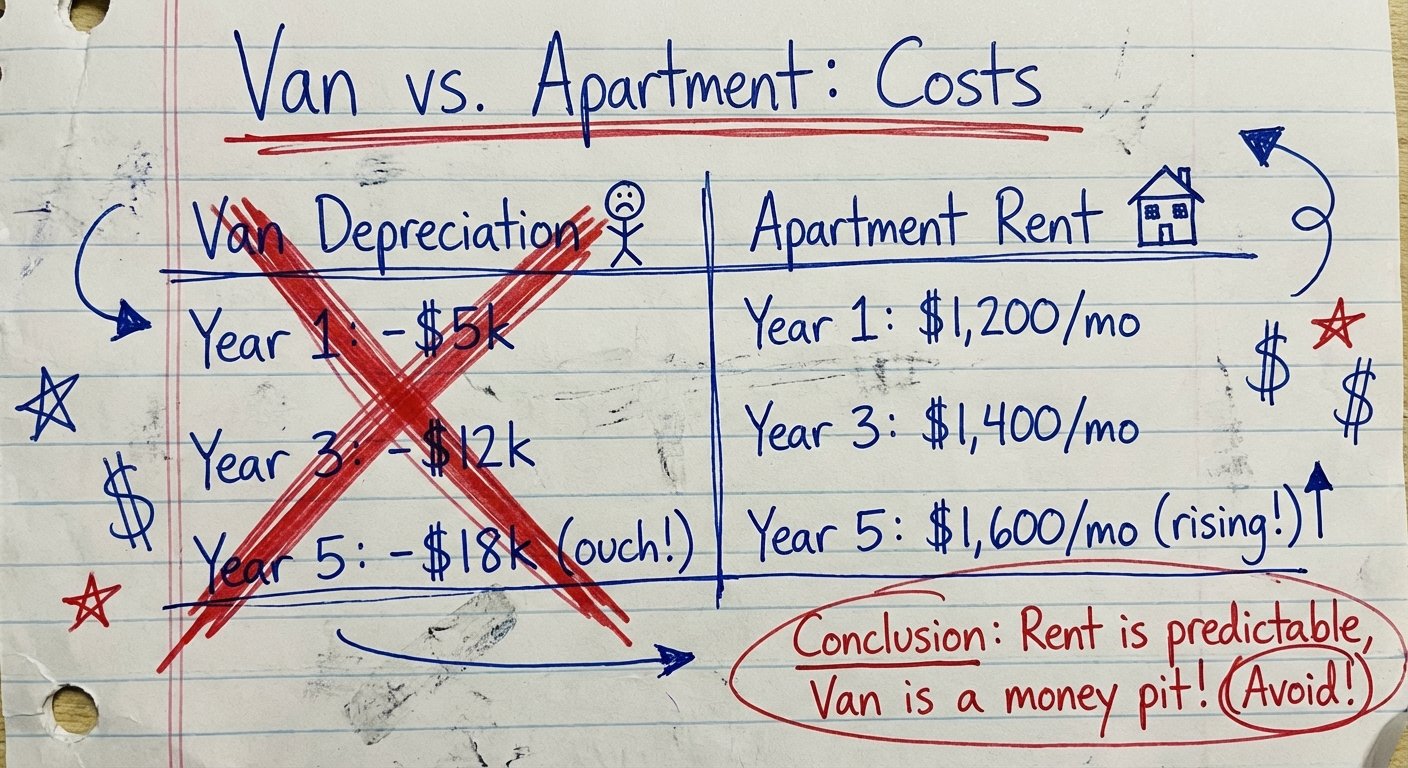
You just tied up $60,000 in a depreciating asset. A van goes down in value every time you drive it. An apartment does not.
If you put that $60,000 into an S&P 500 index fund instead, it would historically return about 10% a year. That is $6,000 a year. Or $500 a month.
By simply buying the van, you are already “spending” $500 a month in lost investment returns. This is called Opportunity Cost. Ignore it, and you stay poor.
OpEx: The Monthly Bleed
Operational Expenses (OpEx) are what you pay every month just to exist.
The van life pitch is simple: “No rent!”
But “no rent” does not mean “no cost.” You just trade rent for a different set of bills. Bills that are harder to predict.
Here is what van life actually costs per month:
- Gas: Vans are heavy. They get 15 miles to the gallon. If you drive 1,500 miles a month, you are spending $400 to $600 on fuel.
- Insurance: You need comprehensive RV insurance. Expect to pay $100 to $200 a month.
- Campsites: You cannot always park for free on BLM land. Sometimes you need a shower. Sometimes you need a safe place to sleep. Two nights a week in an RV park at $50 a night equals $400 a month.
- Maintenance: Vans break. Tires wear out. Oil changes cost more for big engines. Budget $200 to $300 a month for maintenance.
- Depreciation: Your van loses value every month. If your $60,000 van loses 10% of its value a year, that is $500 a month in invisible wealth destruction.
Add it up. You are spending $1,600 to $2,000 a month just to keep the van on the road. And that does not include food.
What does an apartment cost? Depending on the city, you can rent a great apartment in a tier-two US city for $1,500 to $2,000. If you go overseas to South America or Southeast Asia, you can rent luxury for $800 a month.
The apartment price is fixed. You know exactly what it costs. When the fridge breaks, the landlord fixes it. When the van breaks, you pay the mechanic. And you sleep in the mechanic’s parking lot.
The Connectivity Tax: Paying for Reliable Internet
If you are a remote worker, internet is not a luxury. It is oxygen.
If you cannot join a Zoom call, you cannot get paid.
In an apartment, you pay $60 a month for high-speed fiber. It works 99.9% of the time.
In a van, getting reliable internet is an expensive headache. You cannot rely on cellular hotspots in the middle of nowhere. You need satellite internet.
Most serious van lifers use Starlink. It is the only real solution for off-grid remote work.
The hardware costs money. The monthly subscription is currently around $150 for the mobile ROAM plan.
Estimated Amazon Price Range: $499 – $599
But when you use public networks or cellular towers, you expose your client data. Working from coffee shops or unsecure RV park Wi-Fi is a massive security risk. You need a VPN. I always tell remote workers to Get NordVPN. It is cheap insurance to stop your bank accounts and client files from getting hacked on the road.

The Productivity Tax: The Real ROI Killer
This is the part nobody talks about. This is where van life destroys your income.
Time is your only non-renewable resource.
If you make $50 an hour, your time is worth $50 an hour. Every hour you spend doing something a minimum-wage worker could do, you are losing money.
Van life forces you to do minimum-wage tasks every single day.
Here is your daily schedule in a van:
- Find a place to park where you will not get towed. (30 minutes)
- Rearrange the bed to set up your desk. (15 minutes)
- Find fresh water to fill your tanks. (30 minutes)
- Find a dump station to empty your black water (your literal waste). (45 minutes)
- Drive to a place with cell service. (30 minutes)
You easily waste two to three hours a day on logistics. Logistics you do not have in an apartment. In an apartment, water comes out of the wall. Waste goes down a pipe. The desk is always there.
Let us do the math.
If you waste 2 hours a day on van logistics, that is 10 hours a week. That is 40 hours a month.
At $50 an hour, van life is costing you $2,000 a month in lost productivity.
You are not living for free. You are paying for it with your time. You traded a high-paying remote job to become a part-time plumber and driver for yourself. It is a terrible trade.

Power Dynamics: Keeping the Lights On
You need power to run your laptop. You need power to run your Starlink. You need power to keep your food cold.
In an apartment, you pay $100 a month to the utility company. It just works.
In a van, you have to become an electrical engineer.
You need solar panels. You need an inverter. You need deep-cycle lithium batteries.
A proper off-grid electrical setup for a remote worker costs $3,000 to $8,000 to install. And batteries degrade over time. You will have to replace them.
If you don’t build it into the van, you have to buy a heavy-duty portable power station. The EcoFlow DELTA series is the gold standard for remote workers who need to run laptops and Starlink off-grid.
Estimated Amazon Price Range: $1,500 – $2,500
That is another massive CapEx hit. Just to get what an apartment gives you for pennies a day.

The Risk Factor: Health and Emergencies
Bad things happen. It is just a matter of time.
When you live in an apartment and get sick, you lie in your bed. You order delivery. You recover.
When you live in a van and get sick, it is a nightmare. It is freezing cold or boiling hot. You have a tiny toilet. You have limited water. You are miserable.
And what if you get in an accident? If your van gets rear-ended, you do not just lose your car. You lose your home. You lose your office. You are instantly homeless and unemployed.
Risk mitigation is mandatory.
If you are traveling continuously, especially crossing borders in a van, standard health insurance often drops you. You need nomad coverage. You need a policy that travels with you. I recommend you Get SafetyWing. It is designed for people who do not have a fixed address. Do not risk a $50,000 hospital bill to save $50 a month.
The Geo-Arbitrage Alternative
People choose van life because they want freedom and lower costs.
But van life in America is not cheap. It is expensive and stressful.
If you truly want freedom and lower costs, use Geo-Arbitrage.
Geo-arbitrage means earning a strong currency (like US Dollars) and spending a weak currency.
Instead of spending $60,000 on a Sprinter van to sleep in Walmart parking lots, buy a plane ticket. Go to Buenos Aires. Go to Chiang Mai. Go to Lisbon.
You can rent a fully furnished, luxury apartment in these cities for $800 to $1,200 a month. High-speed internet is included. A gym is included. Often, a pool is included.
You keep your $60,000 in the bank earning interest.
You wake up. You sit at a real desk. You do deep work for four hours. You make your money.
Then you walk outside and explore a beautiful city. You eat incredible food that costs $10 a meal.
You do not dump human waste. You do not worry about your transmission blowing up on a mountain pass. You focus entirely on increasing your earning power.
When Van Life Actually Makes Sense
Am I saying van life is always a bad idea?
No.
Van life makes sense in exactly one scenario.
It makes sense if you genuinely love the lifestyle, and you are willing to pay a premium for it.
If your ultimate goal in life is to rock climb in Yosemite on Tuesday, and surf in Big Sur on Thursday, then buy the van. If you love waking up in the dirt, away from civilization, buy the van.
But do not buy the van because you think it will save you money.
It will not.
It is a luxury lifestyle disguised as frugality. It is a hobby. Hobbies cost money. They do not make money.
If you are a high earner making $10,000+ a month, and you want to spend your disposable income on a van to explore national parks, do it. You have the cash flow to absorb the inefficiencies.
But if you are a freelancer making $3,000 a month, trying to escape rent? You are walking into a financial trap.
Final Verdict: Do The Math On Your Life
Business is about leverage. Getting more output for less input.
Living in an apartment provides massive leverage. The landlord handles the building. The city handles the water and trash. The utility company handles the power. You just pay a flat fee and focus 100% of your energy on your business and your life.
Living in a van strips away all leverage. You become responsible for every basic human need. Sourcing water. Generating power. Disposing of waste. Securing shelter.
You go back to the pioneer days.
It is romantic. But it is terribly inefficient.
If your goal is to grow your income, build wealth, and travel comfortably, skip the van. Keep your overhead low, keep your productivity high, and rent apartments where you actually want to be.
Don’t be seduced by the aesthetic. Be seduced by the math.
Choose your hard.