The ROI of Your Eyes: Why Most “Travel” Glasses Are Garbage
You travel for work. You take red-eyes. You work in hotel rooms with terrible lighting.
Then you wonder why your brain feels like fog the next morning.
You blame the plane. You blame the bed. You blame the coffee.
You are wrong.
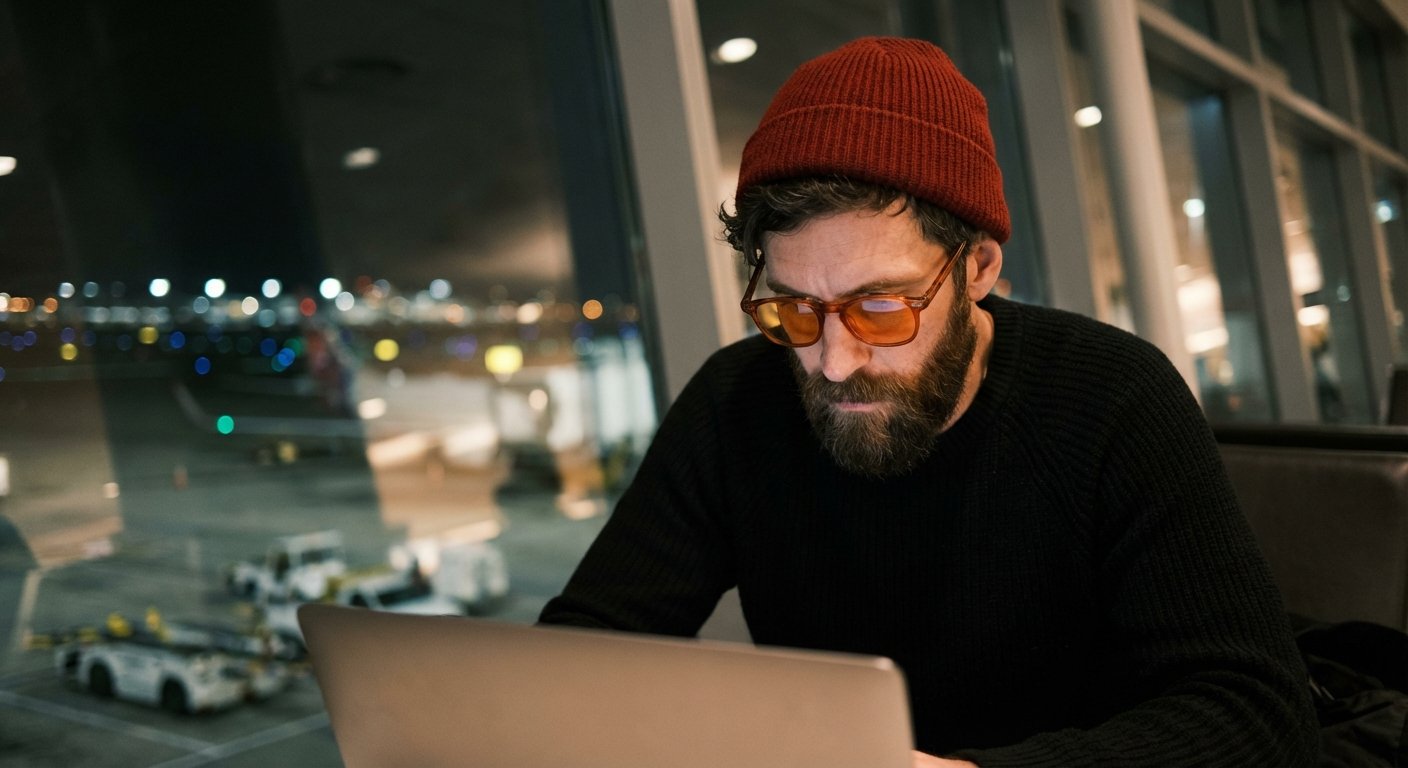
You poisoned your own biology. You blasted your retinas with artificial blue light at 11 PM. Your body thinks it is noon. Your cortisol spiked. Your melatonin crashed.
Now you are tired. You are slow. You miss details.
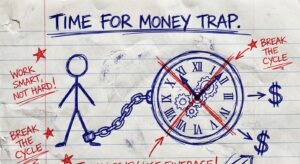
If you make $100 an hour, and you operate at 50% capacity for 8 hours, you just lost $400. Do that three times a trip. That is $1,200 burned.
Fixing this costs less than $100.
But you have to buy the right tools. Most blue light glasses are scams. They are clear pieces of plastic that block nothing. They are a placebo for weak people.
Here is how you actually save your eyes, sleep on planes, and crush it when you land.
The Physics of the Problem (Keep It Simple)
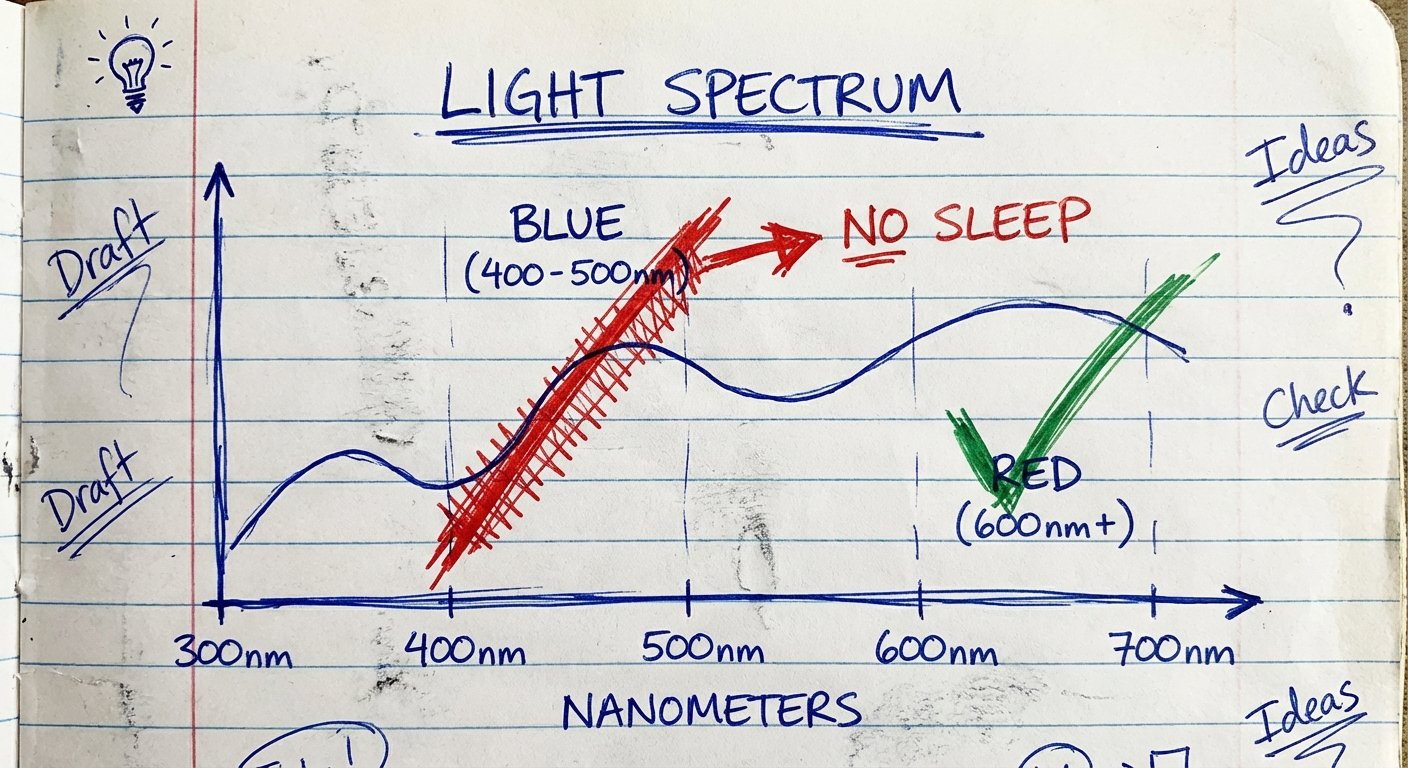
Light is a spectrum. Blue light sits between 400nm and 495nm.
During the day, blue light is good. It comes from the sun. It tells your body “Wake up. Hunt. Work.”
At night, blue light is poison. It suppresses melatonin. Melatonin is the hormone that makes you sleep.
When you are in an airport terminal at 10 PM, the LED lights are blasting blue light. When you open your laptop in a dark hotel room, you are staring into a blue light torch.
The Scam: Most “computer glasses” are clear. They block maybe 10% or 20% of blue light. This does nothing for your sleep hormones.
The Solution: You need to block 99% to 100% of the blue light range, specifically up to 550nm (which includes some green light). To do this, the lens must be amber or red.
If the lens is clear, it is not for night shifts. Period.
Criteria for High-ROI Travel Glasses
I don’t care about fashion. I care about function. If looking like a bug for 2 hours on a plane means I sleep for 6 hours and close a deal the next day, I will look like a bug.
Here is the checklist:
- Spectrum Blocking: Must block 99%+ of blue light (400-500nm). Ideally up to 550nm.
- Coverage: Light leaks are failures. If light comes in the sides, the glasses don’t work. Wraparound or large frames are mandatory.
- Durability: Travel is rough. You will throw these in a bag. Flimsy wire frames will break. You need acetate or polycarbonate.
- Comfort: If they pinch your head, you will take them off. If you take them off, you lose.
The Top Contenders
I analyzed the market. I looked at the specs. Here are the only ones worth your money.
1. Swanwick Sleep “Night Swannies” (The Standard)
These are the heavy hitters. Swanwick popularized the orange lens movement. They aren’t cheap, but they are built like tanks.
The Specs:
- Lens Color: Deep Orange
- Blocking: Blocks over 99% of blue light between 400-500nm.
- Material: High-quality acetate frames. Spring hinges.
- Price: $69 – $89
Why they win: They use CR-39 lenses. This is prescription-grade optical clarity. Most cheap glasses use acrylic which distorts your vision. If you are working on spreadsheets during a night flight, you need optical clarity to prevent headaches.
They are also durable. You can sit on these. They probably won’t break.
The Downside: They are bold. You will get looks. Get over it.
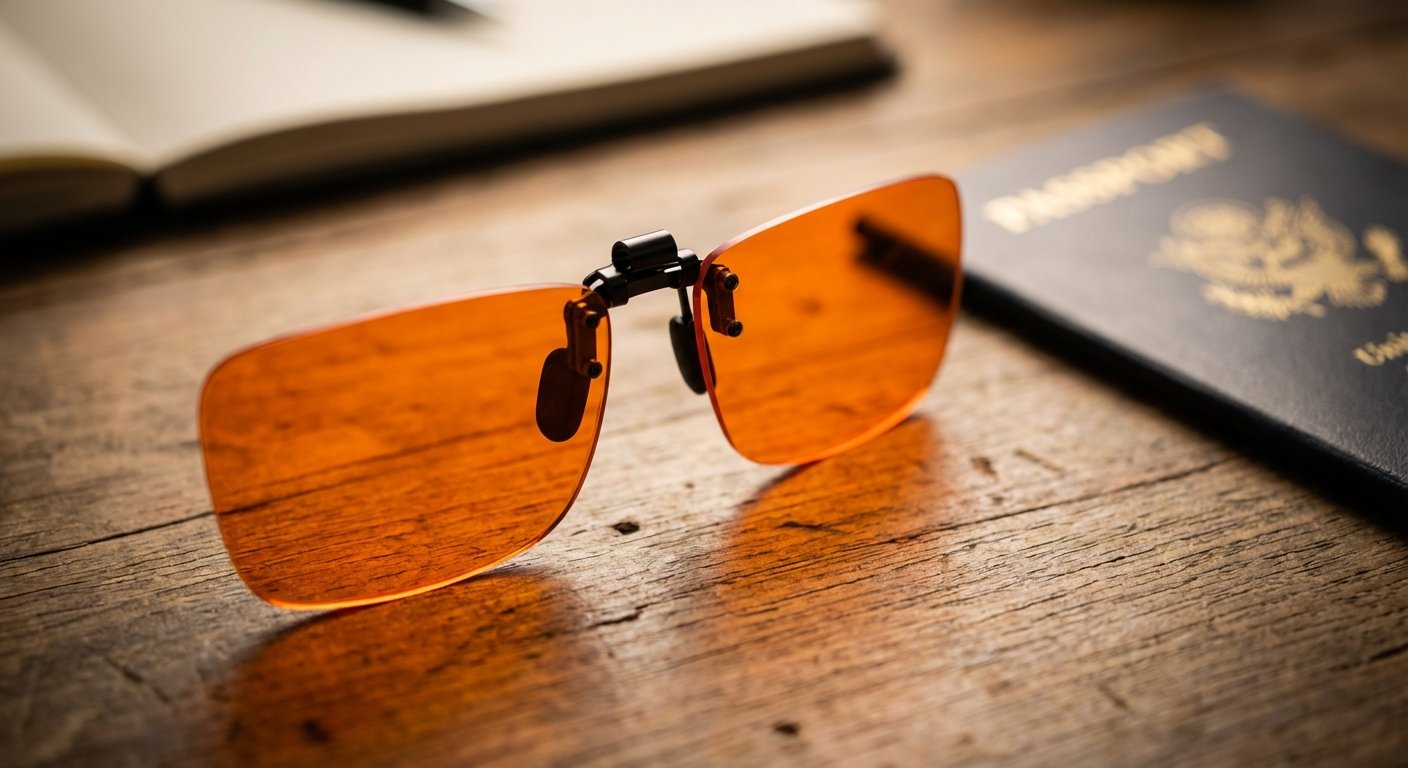
2. Spectra479 Clip-Ons (The Budget Hack)
Maybe you already wear prescription glasses. Maybe you don’t want to carry a second bulky case.
Spectra479 makes a clip-on lens. It has zero “cool factor.” It has 100% utility factor.
The Specs:
- Lens Color: Bright Orange
- Blocking: Blocks 99.9% of blue light (400-500nm).
- Portability: Tiny. Fits in a shirt pocket.
- Price: $30 – $40
Why they win: Pure ROI. For $35, you get the same biological protection as a $150 pair. They clip onto your existing frames. Great for travel because they take up zero space.
The Downside: Flimsy. The clip mechanism is plastic. If you step on them, they are dust.
3. ElementsActive Fit-Over (The Utility Play)
If you wear reading glasses but hate clip-ons, you get fit-overs. These go over your current glasses. They create a seal around your eyes.
The Specs:
- Lens Color: Amber/Red
- Blocking: 99.5% blocking.
- Design: Wraparound side panels (blocks peripheral light).
- Price: $25 – $35
Why they win: Light leakage. Most glasses let light in from the sides. In an airport, light is everywhere. These block the sides. They create a dark room for your eyes.
The Downside: They are huge. You look like you are doing welding work. Again, who cares? You want to sleep.
4. THL Sleep (The Scientific Choice)
THL stands for “True Human Living.” Cheesy name. Great product.
They focus on the specific spectrum. They block 100% of blue light and roughly 80% of green light (up to 550nm). Green light also disrupts melatonin, but less than blue. Most companies ignore this. THL does not.
The Specs:
- Lens Color: Red/Orange
- Blocking: 100% Blue, High Green blocking.
- Style: Aviator and Wayfarer styles available.
- Price: $60 – $80
Why they win: Better color perception than pure red lenses, but better blocking than pure orange. It is the sweet spot for working on a laptop at night without destroying your sleep cycle.
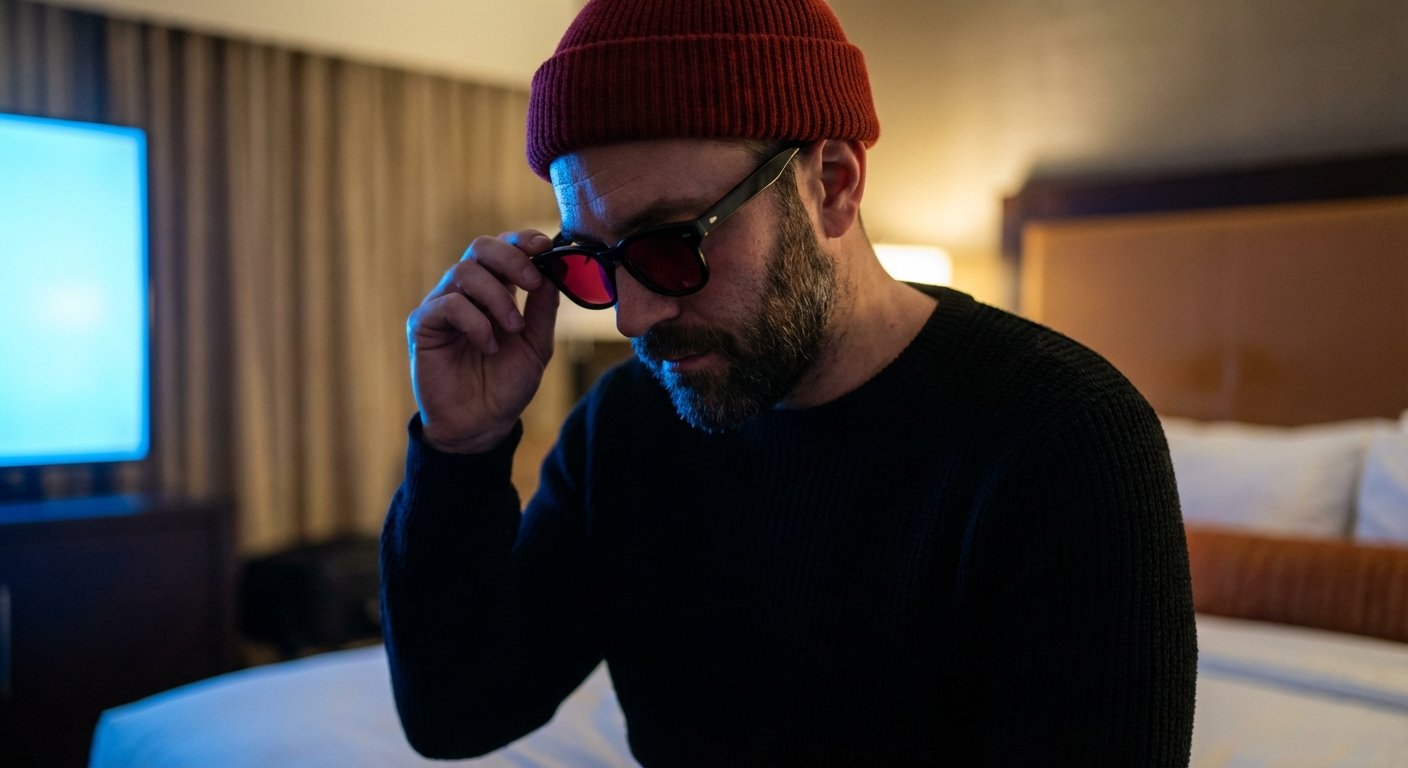
Implementation: The Travel Protocol
Buying the glasses does nothing. Wearing them correctly does everything.
Here is the protocol I use when crossing time zones.
Phase 1: The Departure Lounge
If it is past sunset at your destination, put the glasses on. I don’t care if it is 2 PM where you are. You are traveling to the future. Align your body to the destination time.
Airport terminals are the enemy. They use “cool white” LEDs to keep staff awake. This destroys your rhythm. Glasses on immediately.
Phase 2: The Flight
Cabin lights are bright. Screens are bright. The guy next to you is reading with a reading light.
Keep the glasses on. Do your work. When you are ready to sleep, use an eye mask over your eyelids, then the glasses (or just the mask). But if you wake up to pee, put the glasses on before you open your eyes fully. Do not let the bathroom light hit your naked retina.
Phase 3: The Hotel Room
Hotel rooms have terrible switches. You turn on one switch and six floodlights turn on. Keep the glasses on until you are in bed with the lights out.
Common Objections (Excuses)
“They look ugly.”
Being broke looks uglier. Being tired makes you weak. Weakness is ugly.
“I can’t see colors properly.”
You are writing emails or reading reports. You don’t need to color grade a film. If you are a graphic designer, do your color work in the morning. Do your admin work at night with the glasses on.
“I bought a $10 pair on eBay.”
Garbage in, garbage out. Cheap lenses have distortion. Distortion strains eye muscles. Eye strain causes fatigue. You are saving $40 to lose energy. Bad trade.
The Math of Sleep
Let’s look at the numbers.
A good pair of Swannies or THL glasses costs $80.
They last for 2 years (conservative estimate).
That is $40 per year. Or $0.11 per day.
If these glasses get you 30 minutes more deep sleep per night, that is 182 extra hours of high-performance recovery per year.
You are paying 11 cents for superior recovery. This is an infinite return on investment.
Conclusion
Travel is hard. Night shifts are harder.
The world is not designed for your health. It is designed for convenience. Lights are everywhere. Screens are everywhere.
You can complain about it, or you can adapt.
The adaptation is simple. Filter the light.
Get a pair of real, orange-lens blue light blockers. Put them in your carry-on. Use them relentlessly.
Protect your sleep. Protect your asset. Make more money.
PS: If you wear prescription glasses, buy the Fit-Overs. No excuses.
Top Recommendation (Best Overall): Check Price on Amazon