
The Cold Email is Dead (Unless You Do This)
Most people suck at sales.
They suck because they are lazy. They want maximum return for zero effort. They buy a list of 10,000 emails. They use a generic template. They blast it out. Then they complain that “cold email doesn’t work.”
Cold email isn’t dead. Your offer is dead. Your approach is dead. You are boring.
If you want to reach a CEO in 2026, you have to understand the environment. The inbox is a war zone. AI filters are the guards. The CEO is the king. And you are a peasant trying to sell magic beans.
To get a response, you need to stop acting like a spammer and start acting like a partner. You need to understand the math. You need to understand the leverage.
This is how you get a response from a CEO without begging.
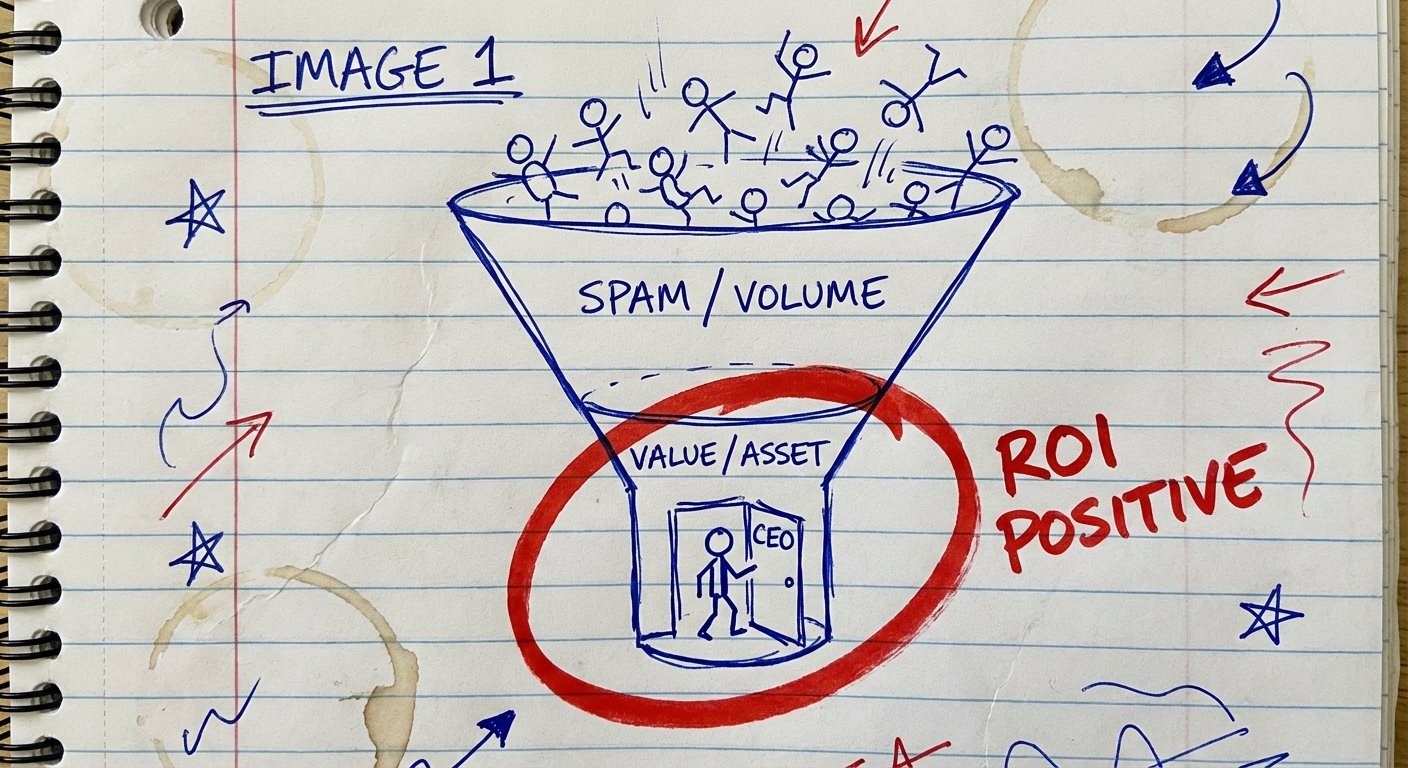
The Math of the Inbox
Let’s look at the numbers. Because business is just math.
If you send 1,000 emails and get 0 replies, your cost per lead is infinite. You wasted time. You burned your domain reputation. You lost.
If you send 10 emails and get 2 replies, you are winning. Even if it took you 5 hours to write those 10 emails.
Why?
Because the value of a CEO’s attention is high. If you are selling a $50,000 service, getting one CEO on the phone is worth thousands of dollars in potential revenue. Spending 30 minutes researching them is a tiny investment.
Most people optimize for Volume. I optimize for relevance.
In 2026, volume is punished. Email providers (Gmail, Outlook) use AI to scan for patterns. If you send the same email 50 times, you go to spam. Game over.
You must personalize. But not “Hey, I saw you went to [College].” That’s fake personalization. Real personalization is relevance.
The Gear You Need to Win
Before we get into the script, let’s talk about execution. Speed matters. If you are going to do deep research, you need to move fast.
You cannot be fighting your equipment. I see guys trying to run a six-figure agency on a $200 laptop with a sticky trackpad. It’s stupid. It costs you money in lost speed.
You need a setup that lets you fly through tabs, copy-paste data, and navigate CRM software instantly.
1. The Mouse for Speed
If you are still using a trackpad, stop. You are losing seconds every minute. Those seconds add up to hours every month.
I use the Logitech MX Master 3S. It has a hyper-fast scroll wheel. You can scroll through a CEO’s LinkedIn feed or a 10-K report in one second. It has programmable buttons. I map them to “Copy,” “Paste,” and “Screenshot.”
It tracks on glass. It tracks on anything. It is the industry standard for a reason.
Price: $90 – $100
2. The Keyboard for Volume
When you are writing high-value emails, you need tactile feedback. You need to type fast without errors.
The Keychron Q1 Pro is a tank. It’s mechanical. It’s wireless. It sounds good. It feels good. When you sit down to work, you want to feel like a professional, not a kid in a coffee shop.
It’s heavy. It doesn’t slide around. It connects to 3 devices via Bluetooth. So you can switch from your laptop to your iPad instantly.
Price: $190 – $210

The 2026 Framework: Beating the AI Gatekeeper
In 2026, your email is likely read by an AI agent first. Or a very smart Executive Assistant using AI tools.
These tools look for “Sales Intent.”
- “I’d love to pick your brain…” (Delete)
- “Do you have 15 minutes…” (Delete)
- “I can help you scale…” (Delete)
To get through, you need Contextual Validity.
Your email must look like it comes from a peer, not a vendor. Peers don’t pitch immediately. Peers discuss problems.
The Subject Line
Stop trying to be clever. Clever gets deleted. Boring gets opened.
Bad: “10x your revenue with this simple trick!”
Good: “Question about Q3 logistics”
Good: “referral from [Name]” (Only if true)
Good: “Opinion on [Specific Competitor]”
The goal of the subject line is to get the open. That’s it. Don’t sell the product in the subject line.
The Strategy: Give First (The Asset)
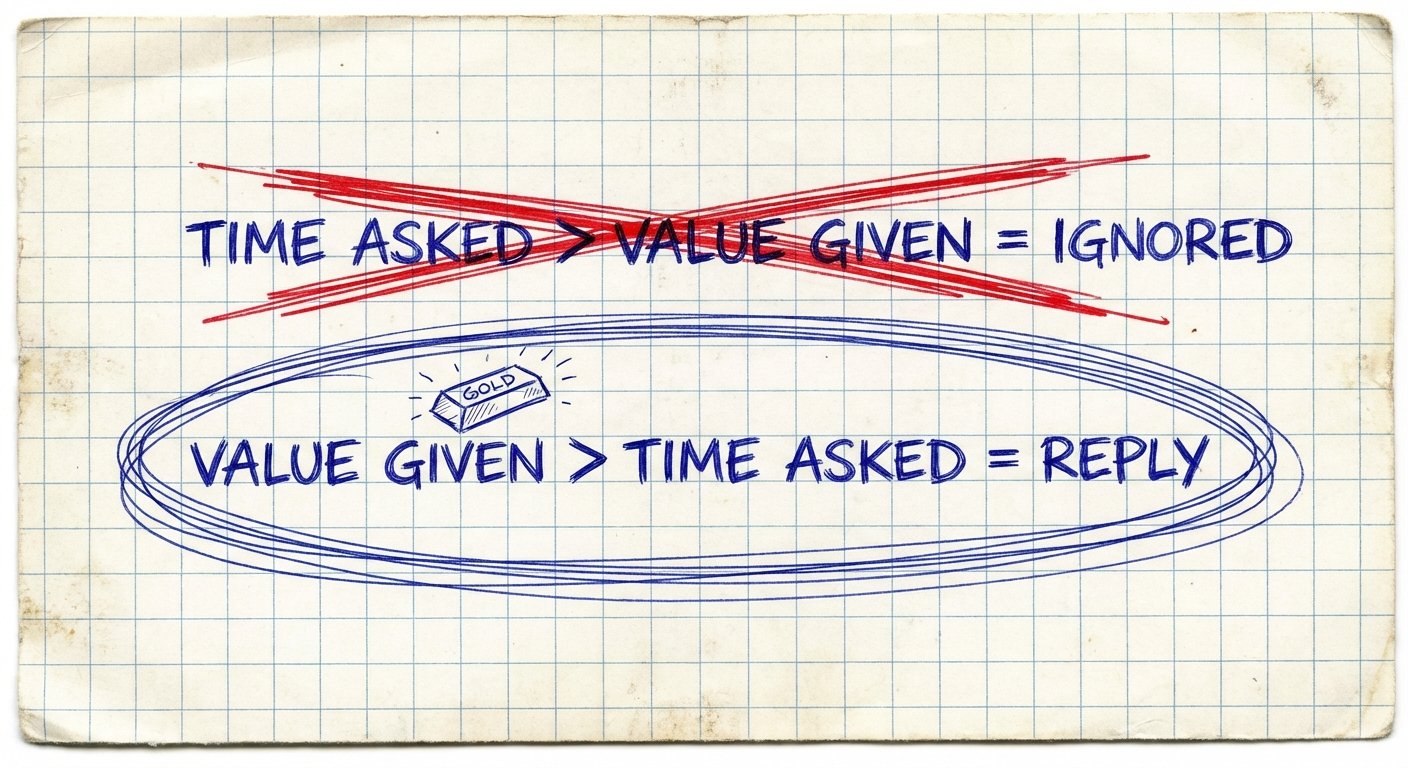
This is where everyone fails. They ask for time before they establish value.
A CEO’s time is worth $1,000+ an hour. You are asking for 15 minutes. You are asking them to give you $250 of value. What are you giving them?
Nothing. You are promising “potential” value.
Stop promising. Start delivering.
Create an Asset.
Do the work before you send the email.
- Audit their website.
- Redesign their ad creative.
- Find a broken link in their checkout process.
- Record a video showing them how to fix a specific problem.
When you send the email, you say: “I made this for you. It’s free. Here is the link. If you want me to do more, let’s talk.”
This flips the dynamic. You are now a provider of value. You have deposited into their account. Now you have the right to ask for a withdrawal (a reply).
The Audio/Visual Standard
If you send a video audit (which is the highest converting method right now), the quality must be good.
If you sound like you are in a bathroom, you look like an amateur. If your video is blurry, you look cheap.
High performers signal status through quality. You need a dedicated microphone and a real camera.
3. The Microphone
Do not use your laptop microphone. It picks up the fan noise. It sounds thin.
Get the Blue Yeti X. It’s USB. You plug it in. It works. It has a “broadcast” sound. It makes your voice sound deeper and more authoritative.
When a CEO clicks your Loom link, clear audio is the first thing they notice. It signals competence.
Price: $130 – $170
4. The Camera
The webcam on your MacBook is okay. But “okay” doesn’t close million-dollar deals.
The Logitech Brio 4K is the standard. It handles low light well. It’s sharp. It supports HDR. It puts your face in high definition.
Trust is visual. If they can see your eyes clearly, they trust you more. It’s primal. Use it.
Price: $150 – $200

The Script Template
Here is the structure I use. It is short. It assumes the recipient is busy.
Subject: Thoughts on [Company Name] checkout flow
Body:
Hey [Name],
I was buying [Product] on your site yesterday and noticed the cart page loads slow on mobile. I think it’s costing you conversions.
I made a 3-minute video showing exactly why it’s happening and how to fix it for free.
[LINK TO VIDEO]
No expectations here. Just wanted to flag it for you.
Best,
[Your Name]
P.S. If you want me to fix it for you, let me know. If not, give the video to your dev team.
Analyze this script:
- No fluff: I didn’t ask how their day was.
- Specific observation: I proved I looked at their business.
- The Asset: I gave them the solution for free.
- Low friction: “Give it to your dev team.” I removed the pressure to buy.
When you remove the pressure to buy, people become interested.
The Follow-Up: Where the Money Is
Most people send one email and quit.
CEOs are busy. They might see your email, think “that’s cool,” and then get distracted by a fire they have to put out.
You need to follow up.
But do not send: “Just bumping this to the top of your inbox.” That is annoying. It adds zero value.
Your follow-up must add new value.
Follow-up 1 (3 days later):
“Hey [Name], also noticed your competitor [Competitor Name] is running this ad format. Might work for you guys. Attached a screenshot.”
Follow-up 2 (7 days later):
“Made a quick mock-up of how that landing page could look. Let me know if you hate it.”
You are relentless. But you are relentlessly helpful.
The Psychology of “No”
You are going to get rejected. Good. Rejection is data.
If they say “Not interested,” reply with: “Got it. Just so I don’t waste your time in the future, is it because you handle this in-house, or just not a priority right now?”
You would be shocked how many CEOs answer this. And that answer tells you how to sell to the next guy.

Conclusion: Do the Work
There is no magic button.
There is no software that will automate trust.
To get a response from a remote CEO in 2026, you have to be worth responding to. You have to be sharper, faster, and more valuable than the 500 other emails in their spam folder.
Buy the gear so you don’t have technical bottlenecks. Do the research so you have relevance. Build the asset so you have leverage.
Then hit send.