
This post contains affiliate links. If you purchase through our links, we may earn a small commission at no extra cost to you.
Stop Paying Retail for Long-Term Stays
Most people overpay for rent when they travel. They treat Booking.com like a grocery store. They see a price, put it in their cart, and checkout.
That is stupid.
Booking.com is not a store. It is a marketplace. And in any marketplace, the listed price is just the starting point. It’s the “sucker price” designed for people staying two nights.
If you are booking a stay for 14, 30, or 60 days, paying the retail price is financial self-sabotage. You are burning cash that could be sitting in your investment account. A 30-day stay priced at $3,000 can be negotiated down to $1,500. By sending a few text messages, you just made $1,500 tax-free.
I am going to show you exactly how to bypass the algorithm, manipulate the pricing mechanics, and negotiate long-term rates on Booking.com.
No fluff. Just the exact math, the psychology of the host, and the copy-paste scripts that actually work.
The Math: Why Hosts Actually Hate Booking.com
To win a negotiation, you have to understand the counterparty’s pain. You need to know how they make money.
Booking.com charges hosts a base commission of 15%. In some regions, with “Genius” or premium visibility boosts, that fee climbs to 20% or even 25%.
If a host lists an apartment for $100 a night, they do not get $100. They get $80. Then they have to pay for cleaning. Then they pay for electricity, water, and internet. Then they pay taxes.
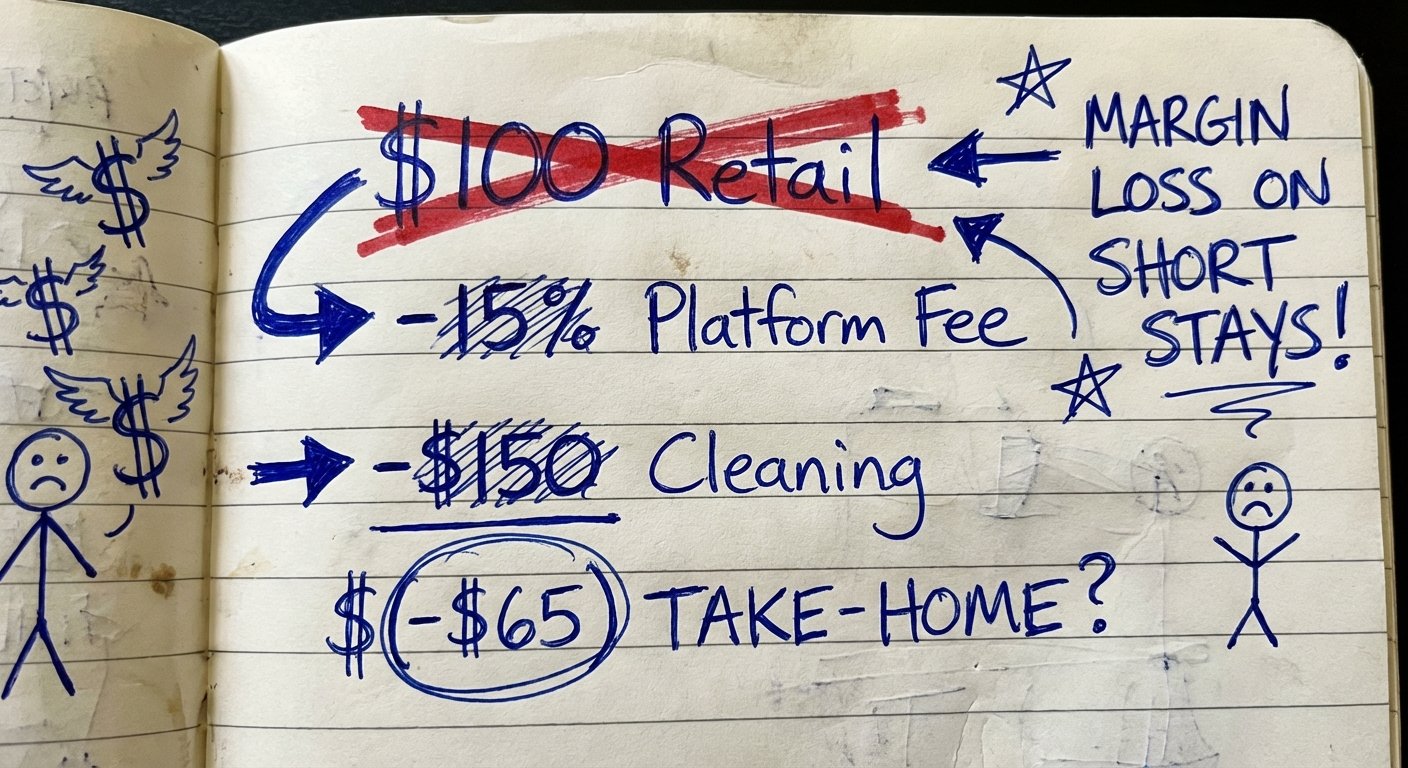
But it gets worse for them. Their biggest expense isn’t the platform fee. It’s vacancy.
An empty room generates exactly $0. Actually, it loses money, because the mortgage and utilities still need to be paid. A host’s primary objective isn’t getting the highest nightly rate. It’s maximizing occupancy.
If you come along and offer to buy 30 days of inventory in bulk, you solve their two biggest problems:
- You eliminate their 20% platform fee (if you negotiate direct).
- You eliminate their vacancy risk for a whole month.
You have the leverage. You are the cash buyer in a market full of empty inventory. You just need to know how to structure the deal.
Step 1: The VPN Pricing Hack
Before you even talk to a host, you need to fix your base price.
Booking.com uses dynamic pricing. They track your IP address, your device type, and your browsing history. If you are searching from a Macbook Pro in New York City, you are going to see higher prices than someone searching from a budget Android phone in Colombia.
This isn’t a conspiracy. It’s algorithmic price discrimination. They charge what the data says you can afford.
You fix this by spoofing your location. Turn on a VPN, clear your cookies, and set your IP address to the country you are traveling to. Better yet, set it to a lower-income country. Watch the prices drop by 10% to 15% instantly.
If you don’t have a reliable VPN for this, Get NordVPN. It pays for itself in one search. Don’t waste time with free VPNs; Booking.com blocks their IP pools.
Now that you have the true “floor” price, you can start hunting for targets.
Step 2: Finding the Right Targets
Not every host will negotiate. You need to filter for desperation and logic. Do not try to negotiate with massive corporate hotel chains. The person answering the messages is a $15/hour front desk employee. They don’t have the authority to change the price.
You want independent boutique hotels, locally managed aparthotels, and private landlords with multiple listings.
Here is your filtering checklist:
- Look for High Availability: Open their calendar. If they are 90% booked for the next month, they won’t negotiate. They don’t need you. If their calendar is wide open, they are sweating. Target them.
- Look for “New” Listings: Properties with fewer than 10 reviews need momentum. They need a long-term guest to cover their baseline costs while they build their profile.
- Avoid the Cheapest Options: The absolute cheapest listings are already at rock-bottom margins. They have no room to drop. Look at the middle-to-high tier. A $3,000/month place has a lot more fat to trim than a $500/month place.

Step 3: The “Off-Platform” Pivot
You cannot negotiate a massive discount inside the Booking.com messaging app. The platform monitors chat logs. If you try to exchange phone numbers or emails, their algorithm will redact it. It will look like this: “Call me at [PHONE NUMBER HIDDEN]”.
You have to find the host in the real world.
Here is the exact framework to trace a property:
- Look at the name of the property on Booking.com. E.g., “Sunset Villas Bali”.
- Open Google Maps. Search for “Sunset Villas Bali”.
- Find their actual Google Business Profile.
- Look for a link to their direct website.
- Look for a local phone number. In 90% of countries outside the US, that phone number is attached to a WhatsApp account.
If the property is a private apartment with a generic name like “Beautiful City Center Flat,” look at the photos. Look for a watermark. Reverse image search the photos on Google. Look at the host’s profile name. Combine the host’s name + the city + “apartments” in Google. You will almost always find their direct management website.
Once you have their WhatsApp or email, you own the communication channel.
Step 4: The Offer Framework
When you reach out, you do not ask for a discount. Asking for a discount makes you look cheap. It makes you look like a problem guest.
Instead, you make an offer. You present a business proposition.
You need to frame the math so they realize they are making more money with you, even at a lower price.
Here is the logic you use in your head:
Retail Price is $100/night.
Booking.com takes $15.
Cleaning 10 different short-term guests takes $150.
Average vacancy is 40%.
So out of 30 days, they only rent 18 days.
18 days * $85 (after commission) = $1,530. Minus $150 cleaning = $1,380.
Their actual take-home for a month is $1,380. Even though they list it for $3,000.
If you offer them $1,600 cash, upfront, for the whole month, they are mathematically beating their average. You just saved $1,400. They just secured guaranteed cash flow with zero turnover work.
Win-win.
Step 5: The Exact Scripts to Copy and Paste
Do not be emotional. Be direct. Be polite. Be a business person.
Script 1: The Direct WhatsApp Pitch
“Hi [Name], I saw your property [Property Name] on Booking.com. Beautiful place. I am a remote worker looking for a 30-day stay from [Date] to [Date]. I prefer to book directly with hosts so we both avoid the platform commissions. If I pay upfront for the full month, what is the best direct rate you can do? Let me know. Thanks.”
Notice what this does. It establishes you are a working professional (not a partier). It states exactly what you want. It reminds them of the commissions they hate paying. It promises immediate cash.
They will usually reply with a 15% to 20% discount. This is just their opening bid.
Script 2: The Counter-Offer
“Thanks for the quick reply. I appreciate the offer. My maximum budget for accommodation this month is $[Your Target Number]. I know this is lower than your retail rate, but it guarantees you 100% occupancy for the month with zero cleaning turnover or platform fees. I am ready to send the deposit today if we can make that work. If not, I completely understand.”
You give them a hard number. You remind them of the ROI of zero vacancy. You give them a way out so they don’t feel pressured. Most importantly, you show them the money is ready right now.

Step 6: Executing the Payment (Without Losing Your Margin)
If they agree to the deal, do not ruin it by using a terrible payment method.
If you wire money from a traditional US bank, you will pay a $40 wire fee. The host’s bank will charge them a $20 receiving fee. The bank will use a terrible exchange rate, stealing another 3% of the transaction. Suddenly, your “discount” shrinks by $150.
Amateurs pay foreign transaction fees. Professionals use multi-currency accounts.
When you agree on a price, ask for their local bank details. Then use Wise to send the exact amount in their local currency. You get the mid-market exchange rate. The fees are pennies. The host gets exactly what you promised, usually instantly. If you aren’t doing this already, Try Wise.
Rule of thumb for safety: Never send 100% of the money before arriving unless you are 100% certain the property and host are legitimate (e.g. an established local hotel with a real website). The standard practice is to send a 10% to 20% deposit to hold the dates, and pay the balance in cash or transfer on arrival after you have walked through the property.
Step 7: Bulletproofing Your Setup
When you negotiate off-platform, you lose Booking.com’s customer service. If the internet drops or the AC breaks, you can’t complain to corporate for a refund. You are dealing directly with the landlord.
You have to take responsibility for your own setup.
If you are working remotely, the biggest risk is the host’s Wi-Fi. Hosts lie about internet speeds. Or they put the router behind three concrete walls. If your income depends on Zoom calls, you cannot rely on consumer-grade hotel Wi-Fi.
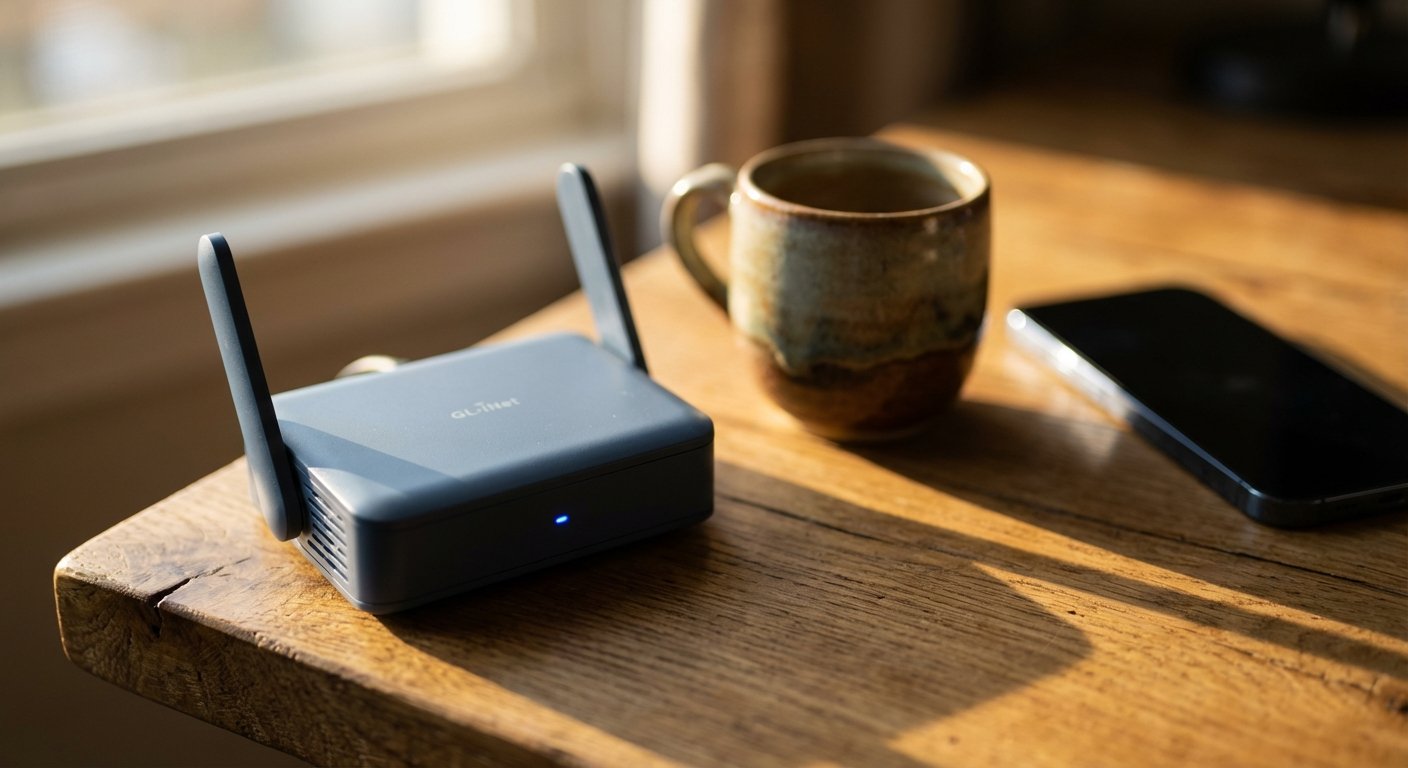
Bring your own network infrastructure. Buy a high-powered travel router. You plug it directly into the host’s modem, or use it to repeat their Wi-Fi signal with military-grade encryption.
The standard for this is the GL.iNet Beryl AX. It fits in your pocket, costs between $90 – $130, and protects your devices from sketchy local networks. You can Check Price on Amazon. Consider it mandatory equipment for long-term rentals.
Second, manage your personal downside risk. When you live in foreign rentals long-term, accidents happen. You step on glass. You get food poisoning. You crash a rented scooter. When you aren’t on a standard tourist package, you need your own safety net.
Traditional travel insurance is overpriced garbage designed for two-week cruise ship vacations. You need coverage built for long-term travelers that operates like a subscription. Get a medical policy that covers you month-to-month. Get SafetyWing. It’s cheap, scalable, and covers the exact scenarios remote workers face when living in negotiated rentals overseas.
The Volume Game: How to Guarantee a Win
Negotiation is a pipeline. It is a numbers game.
If you message one host, make a lowball offer, and they say no, you failed. Not because the strategy doesn’t work, but because your volume was pathetic.
You should not be messaging one host. You should be messaging ten.
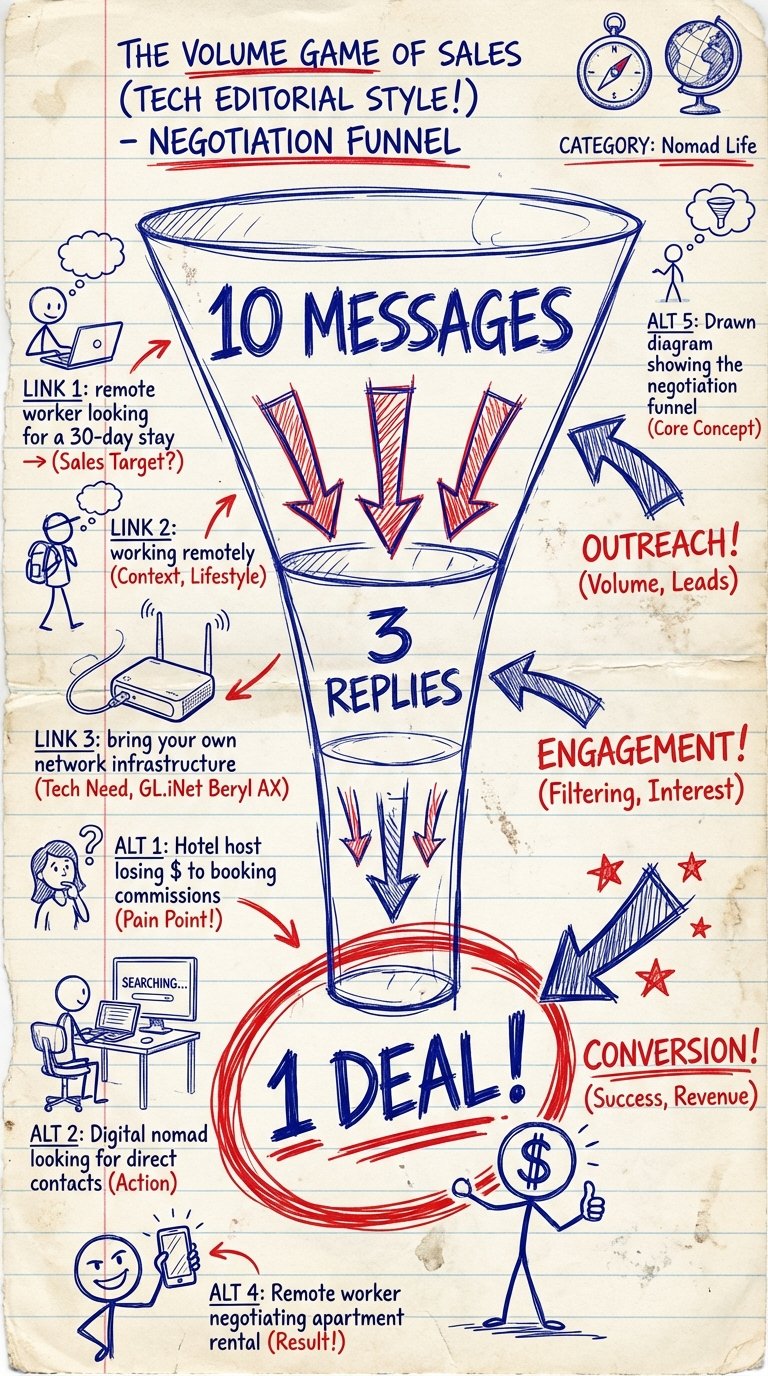
Here is the reality of the funnel:
- You trace and message 10 properties.
- 3 will ignore you or say they are fully booked.
- 4 will give you a tiny 5% discount that isn’t worth it.
- 2 will counter with a solid 20% discount.
- 1 will be feeling the pain of an empty calendar and accept your 40% discount offer just to get the cash flow.
You only need one “yes.”
Treat this process like a job. Spend two hours doing research, finding WhatsApp numbers, and sending pitches. If those two hours of work result in a $1,200 discount on your monthly rent, you just paid yourself $600 an hour.
Show me another task you can do today that yields a $600/hour ROI.
Summary of the Strategy
Stop acting like a consumer and start acting like a buyer.
Consumers accept the sticker price. Buyers understand the supply chain, bypass the middlemen, and negotiate directly with the supplier.
- Use a VPN to find the absolute lowest base price in the algorithm.
- Find independent properties with empty calendars.
- Trace the property name to Google Maps to find their direct website or WhatsApp.
- Bypass the platform messaging completely.
- Make a logical, cash-upfront offer that guarantees them 100% occupancy and zero commission fees.
- Pay securely using low-fee transfer tools.
- Secure your own internet and health risks since you are off-platform.
The money is sitting on the table. The hosts are literally begging for occupancy. Booking.com is taking a massive cut for doing nothing but running a website. Cut them out, give the host guaranteed revenue, and keep the difference in your bank account.
Go run the plays. Send the messages. Close the deal.