
This post contains affiliate links. If you purchase through our links, we may earn a small commission at no extra cost to you.
The Remote Work Trap
You thought working from home meant freedom.
Instead, you’re checking emails at 11 PM on a Sunday. You wake up, grab your phone, and start reacting to problems before you even get out of bed. You work 12 hours a day, but when you look back at the week, you have nothing to show for it.
Why? Because you tried to copy the 9-to-5 office schedule in your living room.
It doesn’t work. The office schedule is designed to trap you in a building so managers know where you are. It is not designed for output. It is designed for attendance.
When you go remote, attendance doesn’t matter. Only output matters. But if you don’t build a system to protect your output, the distractions will eat you alive.
Most people are broke and stressed because they treat their time like it has no value. They let Slack notifications dictate their day. They sit on the couch and call it “working.”
If you want to make actual money, you need a schedule that forces ROI. Here is how you build a remote work schedule that actually works.
Stop Pretending You Work 8 Hours a Day
Let’s look at the math.
In a normal office, people work about 3 hours a day. The rest of the time is spent walking to the water cooler, pretending to listen in meetings, and looking busy while the boss walks by.
If you try to do 8 hours of deep, uninterrupted work at home, your brain will break. You will burn out in two weeks.
Stop measuring your day in hours. Start measuring it in blocks of energy.
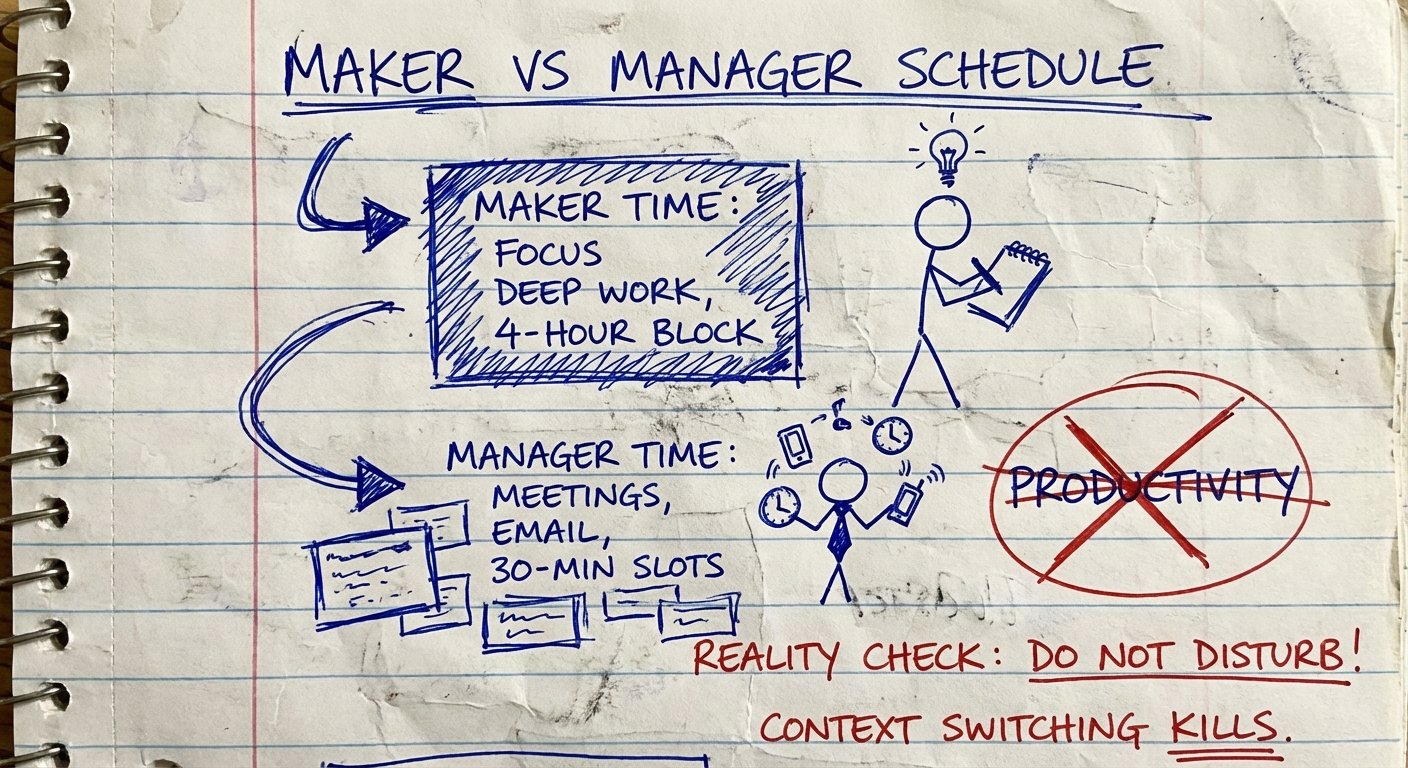
You have two types of work:
- Deep Work: Writing code, writing copy, building systems, closing deals. This makes you money.
- Shallow Work: Answering emails, checking Slack, organizing your calendar. This keeps you from getting fired, but it doesn’t grow the business.
Your goal is to do 3 to 4 hours of Deep Work every single day. That is the entire game.
If you do 4 hours of pure, undistracted work, you will outperform 99% of people sitting in an office for 9 hours. You just have to protect those 4 hours with your life.
Rule 1: Build the Bunker (Control Your Environment)
The Instagram digital nomad aesthetic is a scam. You cannot do high-ROI work sitting on a beach with a laptop on your knees. The sun glares on the screen, sand gets in the keyboard, and your back hurts.
To produce world-class output, you need a world-class environment.
If you work from your couch, your brain thinks it’s time to watch Netflix. If you work from your bed, your brain thinks it’s time to sleep. You need a dedicated physical space where your brain knows it is time to execute.
You also need gear that forces focus. If you are distracted by your dog, your neighbor, or the street noise outside, you are losing money. Every time you lose focus, it takes 23 minutes to get back into a state of flow. If you get distracted three times a day, you lose over an hour of peak output. If your time is worth $100 an hour, that distraction just cost you $100.
Do that every day, and you lose $25,000 a year.
Buy your focus back. The highest ROI purchase you can make is a premium pair of active noise-canceling headphones. Put them on, and the world goes away. It is a physical trigger to your brain that it is time to work.
I recommend the Sony WH-1000XM5. They have 30 hours of battery life, incredible active noise cancellation, and they pair to two devices at once so you don’t have to fight with Bluetooth settings.
- Estimated Price: $350 – $400
- Check Price on Amazon

Think about the ROI. If a $400 pair of headphones saves you 4 hours of distracted time, they pay for themselves in the first week. After that, it is pure profit.
Next, get a visual timer. The Pomodoro technique works, but using your phone as a timer is stupid. You pick up the phone to set the timer, see a text message, and boom—you lost 20 minutes.
Get a physical desk timer. The Time Timer MOD is a visual countdown clock. You turn the dial to 60 minutes. The red disk slowly disappears. It gives you an immediate, physical sense of time passing. No screens. No notifications.
- Estimated Price: $20 – $35
- Check Price on Amazon
Rule 2: Secure the Perimeter (Protect Your Assets)
Working remotely often means working from coffee shops, airports, or Airbnbs. It sounds great until you realize public Wi-Fi is a massive security vulnerability.
Let’s talk about risk. If you are handling client data, accessing business accounts, or making transactions on a public network, you are exposed. All it takes is one compromised network for someone to scrape your credentials.
If you get hacked, you don’t just lose time fixing it. You lose client trust. Lost trust means lost contracts. Lost contracts mean lost revenue.
Protecting your connection is non-negotiable. You need a VPN (Virtual Private Network). It encrypts your internet traffic so nobody can intercept it. It costs a few bucks a month. Consider it cheap business insurance.
I use and recommend NordVPN. It’s fast, it doesn’t throttle your connection, and it takes one click to turn on.

Rule 3: Batch Your Communications (Kill the Pings)
Slack is the enemy of wealth.
Most remote workers treat their inbox like a slot machine. They pull the lever every 10 minutes hoping for a dopamine hit. You cannot do Deep Work if you are constantly monitoring a chat app.
You have to train your clients and your boss on how to interact with you. If you reply to emails in 30 seconds, they will expect a 30-second reply every time. You are teaching them that your time is cheap and you are always available.
Stop doing that.
Batch your communications. Check email and Slack exactly twice a day. Once at 11:30 AM, and once at 4:30 PM. Tell your team: “I am going into focused work for the next 3 hours. If it is an absolute emergency, call my phone. Otherwise, I will reply at noon.”
Spoiler alert: Almost nothing is an actual emergency. People will learn to solve their own problems or wait.
Rule 4: Keep the Money Simple (Stop Bleeding Fees)
If you are a remote worker or freelancer, you are probably dealing with international clients. Or maybe you are working abroad while getting paid in USD.
If you use traditional banks to move money across borders, you are getting robbed. Banks charge terrible exchange rates and add flat wire fees on top.
Let’s do the math again.
If a client pays you $5,000 and your bank takes a 3% hidden markup on the exchange rate plus a $25 wire fee, you just lost $175. If you get paid twice a month, that is $350 a month. That is $4,200 a year gone. For what? So a dinosaur bank can press a button?
You need a multi-currency account. It lets you get local bank details in USD, EUR, GBP, and more. Your clients pay you like a local, and you convert the money at the real, mid-market exchange rate. No hidden fees.
I recommend Wise. It is the cleanest, fastest way to move money globally. Keep your margins. Don’t let banks steal your profit.
The Ideal Remote Work Schedule
So what does a high-ROI remote schedule actually look like? It is simple. It is boring. And it works.
Here is the exact blueprint:
07:00 AM – 08:00 AM: The Primer
Wake up. Drink water. Do not touch your phone. If you open Instagram or email, you are instantly reacting to other people’s agendas. Own your morning. Review your primary goal for the day.
08:00 AM – 11:30 AM: The Block (Deep Work)
This is where you make your money. Phone goes in another room. Noise-canceling headphones go on. VPN is active. You execute the single most important task of the day. No meetings. No Slack. Just pure, unadulterated output.

11:30 AM – 12:00 PM: The Cleanup
Open the floodgates. Check Slack, answer emails, unblock your team. You do this fast and ruthlessly. Be brief.
12:00 PM – 01:30 PM: The Reset
Step away from the screens. Eat food. Go to the gym. Go for a walk. If you skip this, your afternoon output will be garbage. You have to reset the machine.
01:30 PM – 04:30 PM: Manager Time (Meetings & Shallow Work)
Take your calls. Do your Zoom meetings. Do the administrative tasks that require low brain power. You don’t need peak energy to sit on a Zoom call, so don’t waste your morning energy on it.
04:30 PM – 05:00 PM: The Shutdown
Final email check. Write down the top priority for tomorrow. Close the laptop.
Rule 5: The Hard Stop
This is where most remote workers fail.
Because there is no commute, the lines between work and life blur. You end up answering emails at dinner. You tell yourself “I’ll just fix this one bug” at 9 PM.
This is Parkinson’s Law in action: Work expands to fill the time allotted for it. If you give yourself 14 hours to do a task, it will take 14 hours. If you give yourself 4 hours, you will get it done in 4 hours.
You must have a Hard Stop. At 5:00 PM (or whatever time you choose), the day is done. Close the laptop. Walk away.
If you do not force a Hard Stop, you will never truly rest. You will live in a permanent state of mild anxiety. You will wake up exhausted. And your output the next day will drop.
Rest is not a reward for hard work. Rest is a requirement for hard work. If you skip it, you are stealing from tomorrow’s productivity.
Track the Output, Not the Hours
How do you know if your remote work schedule is working?
You measure the results.
At the end of the week, look at what you actually produced. Did you write the code? Did you close the deals? Did you publish the articles?
If you got all your high-value work done in 25 hours instead of 40, you don’t need to sit at your desk for another 15 hours just to feel productive. You won. Take the time back. Read a book. Go to the gym. Build a side hustle.
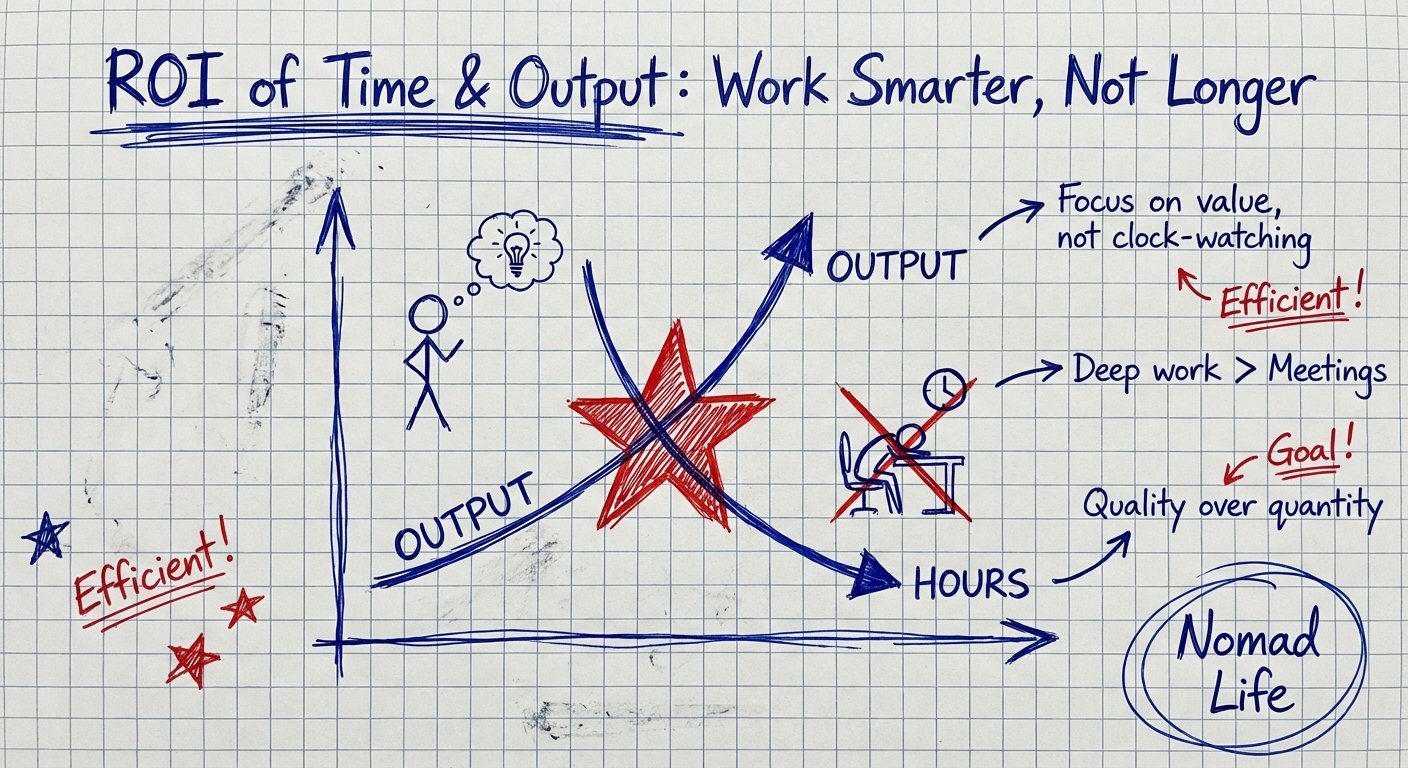
Stop rewarding yourself for being busy. Start rewarding yourself for being effective.
A good remote work schedule does two things:
- It maximizes the ROI of your working hours.
- It prevents work from bleeding into your personal life.
Everything else is noise.
The Final Checklist
If you want to stop spinning your wheels and start operating like a professional, do this today:
- Stop the 8-hour myth: Plan for 4 hours of Deep Work. The rest is admin.
- Buy your focus back: Invest in high-ROI gear. A good desk, a Time Timer MOD, and Sony WH-1000XM5 headphones.
- Protect your assets: Never work on public Wi-Fi without NordVPN. Don’t risk your client’s data.
- Stop bleeding money: If you get paid across borders, use Wise to kill bank fees.
- Batch your communication: Check email twice a day. Train people to respect your time.
- Enforce the Hard Stop: When the day is done, close the laptop. Parkinson’s Law is real.
Freedom isn’t the absence of a schedule. Freedom is the result of a strict schedule.
If you control your time, you control your income. If you let other people control your time, they get the ROI.
Choose wisely.