
The Cost of Chaos
You are losing money every time you open your backpack.
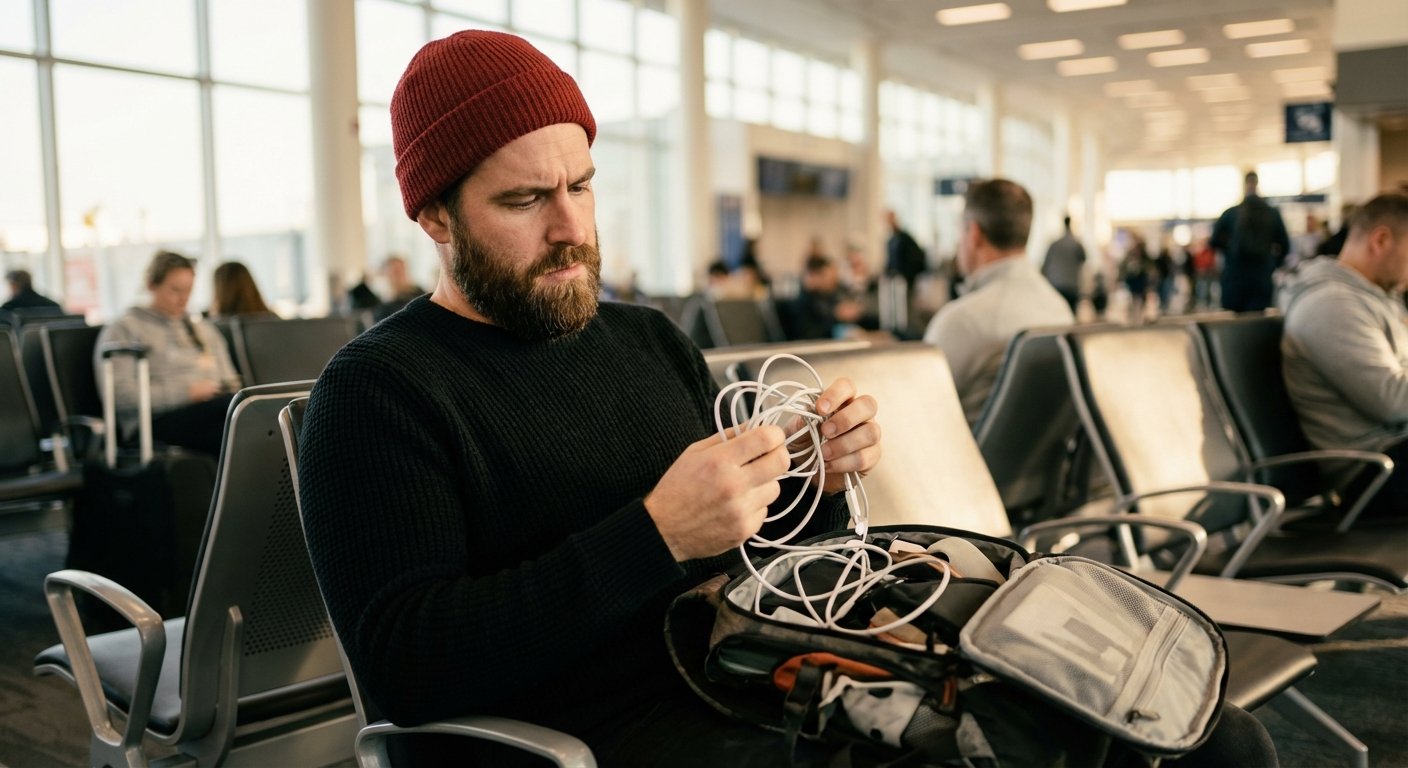
I don’t care how smart you are. I don’t care how good your pitch deck is. If you sit down at a conference table, open your bag, and pull out a tangled ball of white plastic spaghetti, you look like an amateur.
You look like you don’t have your life together.
And if you don’t have your cables together, why would I trust you with my capital?
Most people treat travel organization as an afterthought. They buy a $2,000 laptop. They buy a $1,000 phone. Then they throw the chargers for those devices into the bottom of a bag like garbage.
This creates friction.
Friction kills flow. Friction kills speed. And in business, speed is the only advantage that matters.
Stop accepting the spaghetti. It’s time to professionalize your carry.
The ROI of Not Being Lazy
Let’s do the math.
You might think buying a dedicated tech pouch is a “nice to have.” You are wrong. It is a “must have” if you value your time at more than minimum wage.
The Scenario:
You travel 10 times a year. On each trip, you set up your workstation (hotel, airport lounge, client office) roughly 5 times.
That is 50 setups per year.
The Amateur Approach:
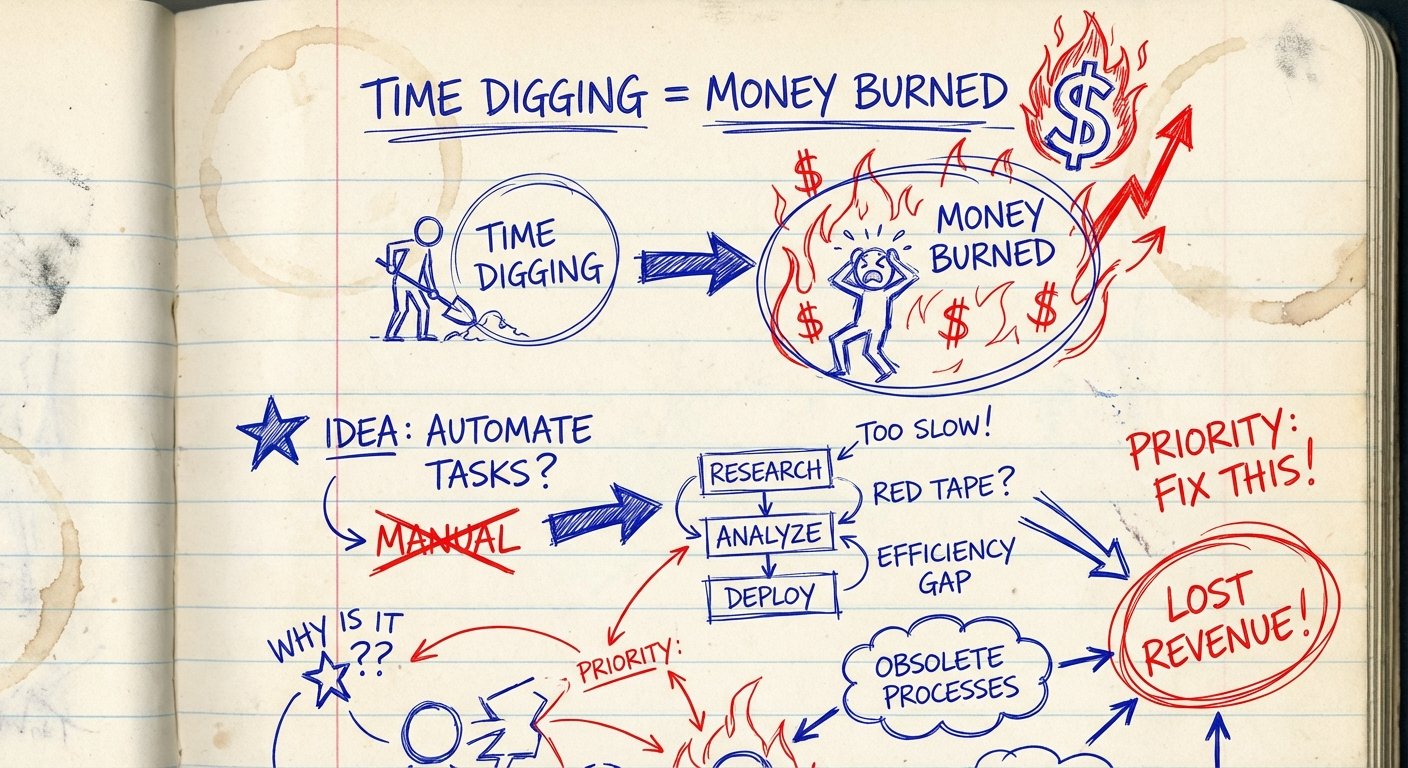
You spend 3 minutes digging for the right cable, untangling it from your headphones, and finding the power brick that slid into a shoe.
3 minutes x 50 setups = 150 minutes lost per year.
The Pro Approach:
You unzip a pouch. You grab exactly what you need. It takes 10 seconds.
Total time: 8 minutes per year.
The Leverage:
You save roughly 2.5 hours of pure frustration per year. If your billable rate is $200/hour, you just saved $500 in opportunity cost.
But the real ROI isn’t the time. It’s the mental bandwidth.
Decision fatigue is real. Every time you have to fight your equipment, you burn a match. You only have so many matches in a day. Don’t burn them on untangling a USB-C cable.
Save your matches for the decisions that make you money.
The System: Zone Defense
Before you buy gear, you need a system. Buying a bag without a system just gives you a bag full of organized garbage.
You need to categorize your tech into three tiers.
- Tier 1: The Lifelines. These are the things that, if lost, end your trip. Laptop charger, phone charger, main backup drive. These live in the main tech pouch.
- Tier 2: The Dongle Life. SD card readers, HDMI adapters, presentation clickers. These are situation-specific. They need their own pockets so they don’t clutter the main flow.
- Tier 3: The “Just in Case.” Spare batteries, SIM card tools, obscure cables. These should be hidden away.
Once you understand the tiers, you buy the gear to support the tiers. Do not do this backward.
The Gear: Pay Once, Cry Once
I see people putting $5,000 worth of electronics into a $9 cosmetic bag they stole from their wife. Stop it.
You need gear that protects your assets and presents them clearly. We are looking for structure, visibility, and accessibility.
Here are the only options worth considering.
1. The Industry Standard: Peak Design Tech Pouch
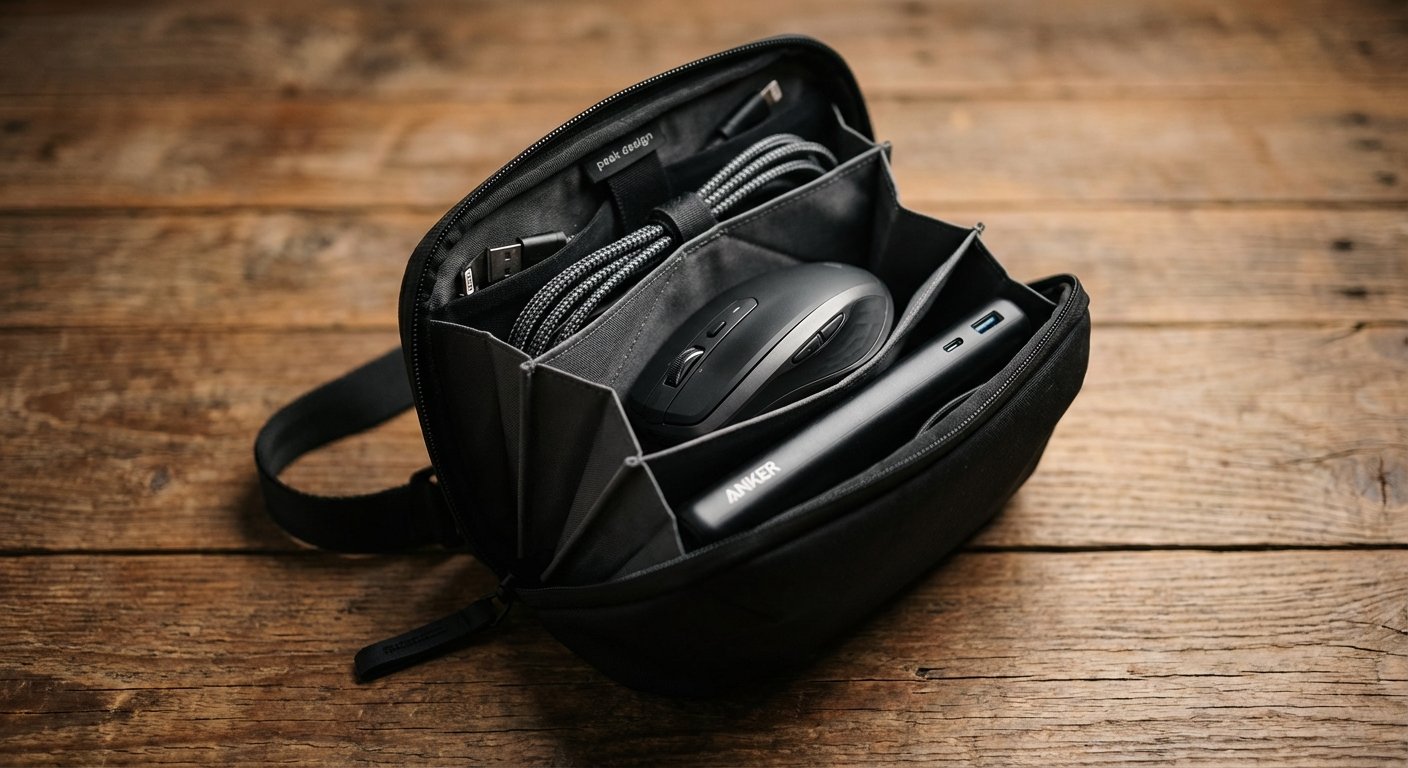
If you carry a lot of gear—mouse, hard drive, brick, five cables, power bank—this is the one. It isn’t a bag; it’s a filing cabinet for your electronics.
It uses an “origami” style internal layout. This means when you open it, everything fans out. You can see every single item instantly. No digging. No black holes.
Specs:
- Capacity: 2L
- Material: Weatherproof 200D Nylon Canvas
- Price: $55 – $65
The Win:
The organization is unmatched. You can sit it upright on a desk, unzip it, and work out of it like a toolbox. It holds its shape perfectly.
The Trade-off:
It is big. Even when empty, it takes up space. If you are a minimalist traveler with only one cable, this is overkill. It will eat up a significant chunk of a smaller backpack.
2. The Minimalist: Bellroy Tech Kit
Maybe you aren’t shooting video content. Maybe you just have a laptop, a phone, and a mouse. You don’t need a toolbox. You need a wallet for your tech.
Bellroy makes stuff that feels expensive. It signals status. When you pull this out, people know you appreciate quality.
Specs:
- Capacity: Compact (approx 1L)
- Material: Recycled Woven Fabric / Premium Leather accents
- Price: $55 – $65
The Win:
It unzips completely flat. This gives you a clean tray to work from. It is much slimmer than the Peak Design option, making it easier to slide into a messenger bag or briefcase.
The Trade-off:
The price-to-volume ratio is bad. You are paying for the brand and the aesthetic, not the capacity. If you try to stuff a bulky charger in here, the zipper will scream. It has zero forgiveness for overpacking.
3. The Value Play: Tomtoc Electronic Organizer
You want 90% of the function for 30% of the price. I respect that. That is good business leverage.
Tomtoc copied the best features of the high-end brands and stripped out the marketing budget. It works. It holds stuff. It doesn’t break.
Specs:
- Capacity: Varies (Compact to Large)
- Material: Cordura Ballistic Nylon or Polyester
- Price: $25 – $35
The Win:
The ROI is massive. It has excellent zippers (YKK) and water resistance. The internal elastic loops are tight and hold cables well. You can buy three of these for the price of one Peak Design pouch.
The Trade-off:
It feels cheaper. Because it is. The internal dividers are a bit floppy compared to the rigid structure of Peak Design. It doesn’t stand up on its own as well.

The Power Game: Stop Carrying Bricks
The biggest reason your pouch is messy is your power brick. The standard Apple brick is huge, heavy, and only charges one thing.
That is obsolete technology.
If you are still carrying the white brick that came with your laptop, you are failing. You need GaN (Gallium Nitride) chargers. They are smaller, cooler, and more powerful.
The Solution: Anker Prime 100W GaN Wall Charger
This is the only charger you need. It has three ports (2 USB-C, 1 USB-A). It can charge your laptop, your phone, and your watch simultaneously, at full speed.
Specs:
- Output: 100W Max
- Size: 45% smaller than original 96W MacBook charger
- Price: $75 – $90
The Win:
It replaces three separate chargers. It folds up. It is dense and reliable. This single purchase clears up 50% of the space in your tech pouch.
The Trade-off:
It is heavy for its size. Dense means weight. Also, if you plug in three devices, the 100W gets split between them (so your laptop might charge slower if you are also charging a drained iPad). You need to understand power distribution logic.
The Final Detail: Cable Discipline
You bought the pouch. You bought the charger. If you throw standard 6-foot rubber cables in there, you still lose.
Standard rubber cables tangle. They stick to each other. They rot.
You need braided nylon cables, and you need velcro ties.
The Rule: Every cable must be tied. No exceptions. If you put a cable away without tying it, you are borrowing time from your future self at a high interest rate.
- Velcro Ties: Buy a roll of 100. Put them on everything. Cost: $10. Value: Infinite.
- Short Cables: Do you really need 6 feet of cable to charge your phone on an airplane tray table? No. Get 1-foot cables for travel. Less slack = less mess.
The Execution
Information without action is just entertainment. You just read 1,500 words on tech pouches. If you close this tab and do nothing, you wasted your time.
Here is your checklist:
- Audit your gear. Throw away the cables that work “sometimes.”
- Pick your pouch. Peak Design for heavy loads. Bellroy for style. Tomtoc for value.
- Buy the GaN charger. Eliminate the bricks.
- Pack it once. Set it up. Never cannibalize it for your home office. This pouch lives in your travel bag.
Get organized. Get leverage. Stop wasting your life untangling wires.