This post contains affiliate links. If you purchase through our links, we may earn a small commission at no extra cost to you.
The Instagram Lie That Keeps You Broke
You have seen the photo.
A guy is sitting on a beach in Bali. He has a laptop on his knees. He is sipping a coconut. He looks at the horizon. The caption says something about “freedom” and “living on your own terms.”
Let me tell you the truth about that guy.
He is either broke, or he is not actually working.
Here is why.
If you take a $2,000 MacBook to a sandy, humid beach, you will destroy it. The sun causes massive screen glare. You cannot see the code you are writing. You cannot see the spreadsheet you are building. Your back starts hurting after ten minutes because you are hunched over like a caveman. And the Wi-Fi? It does not exist.
The digital nomad lifestyle is marketed as a permanent vacation. It is sold by influencers who make money selling courses on how to be an influencer.
It is a scam.
If you want to actually make money while traveling, you have to treat your life like a business. A business requires infrastructure. A business requires output. A business requires positive ROI.
If your travel destroys your output, you do not have a business. You have a very expensive, very stressful hobby.
I am going to break down the exact math, gear, and systems you need to actually succeed as a digital nomad. No fluff. No motivational garbage. Just the raw math of working from anywhere without going broke.
Truth 1: The Geography Arbitrage Math
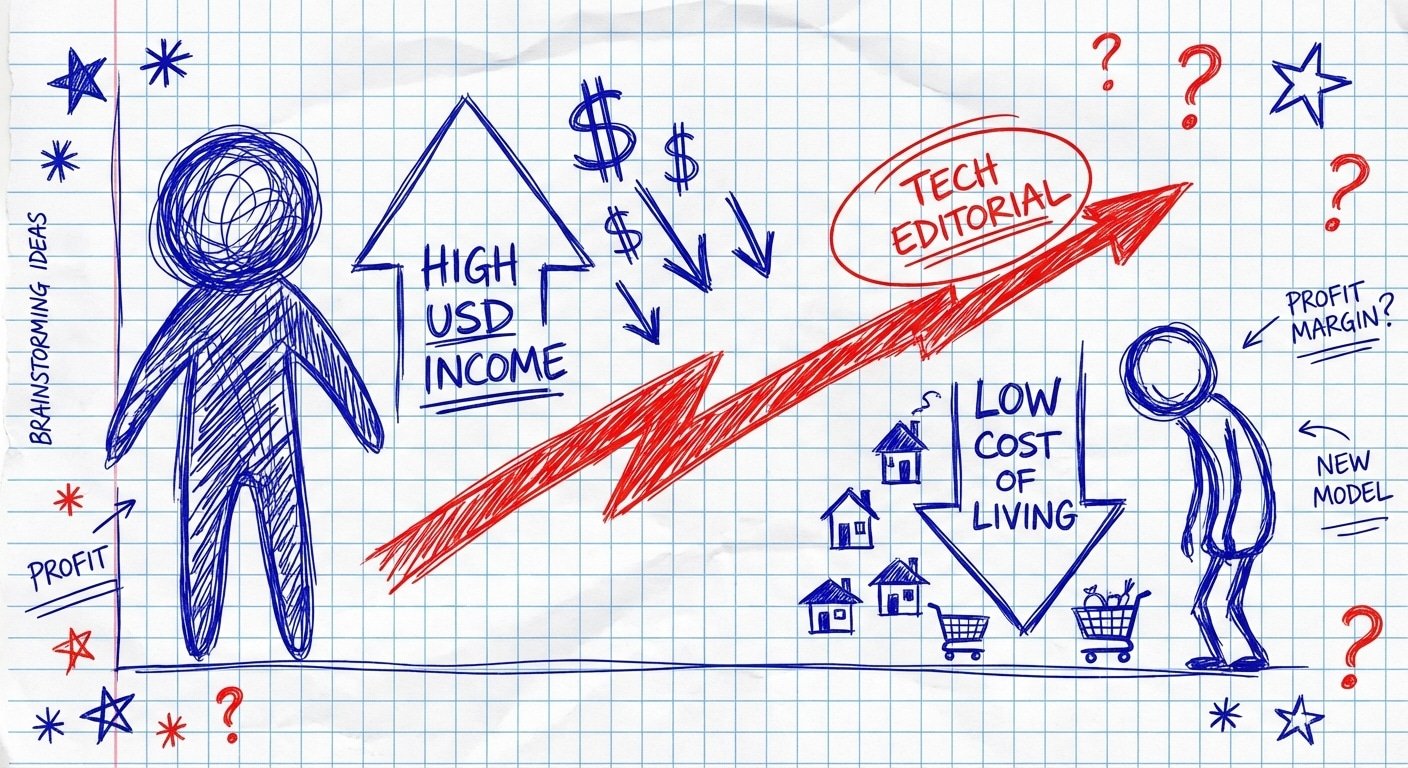
The only reason the digital nomad lifestyle works financially is because of one concept: Geographic Arbitrage.
You earn in a strong currency (like US Dollars or Euros) and you spend in a weaker currency (like Thai Baht, Colombian Pesos, or Vietnamese Dong).
If you earn $5,000 a month in New York City, you are surviving. You are paying $2,500 for a closet-sized apartment. You pay $20 for a sandwich. You have nothing left to invest. Your margins are zero.
If you earn $5,000 a month in Chiang Mai, Thailand, you are rich.
You pay $600 for a luxury condo with a rooftop pool and a gym. You pay $3 for a world-class meal. You spend $1,500 a month total to live like a king. You pocket the remaining $3,500. You invest it. You compound it.
That is the game.
But most beginners get this wrong. They become “nomads” and go to London. Or Paris. Or Tokyo. They take their $5,000 income to a place where the cost of living is identical or higher. They destroy their margins.
If you are not multiplying your purchasing power by changing locations, you are failing at the core premise of being a nomad. You are just a tourist with a laptop.
Go where your money makes you royalty. Protect your margins.
Truth 2: Your Setup Dictates Your Output
You cannot produce world-class work on a hammock.
Your physical environment dictates your cognitive output. If you are uncomfortable, you will get distracted. If your neck hurts, you will stop working early. If you stop working early, your income drops.
Ergonomics is not a luxury. It is a business expense.
When you travel, you do not have a Herman Miller chair. You do not have a standing desk. You are at the mercy of cheap Airbnb kitchen tables and bad coffee shop stools.
You have to build a portable workstation that protects your spine and maximizes your focus. If you skimp on gear, you pay for it in chiropractor bills and lost productivity.
Here is what you actually need:
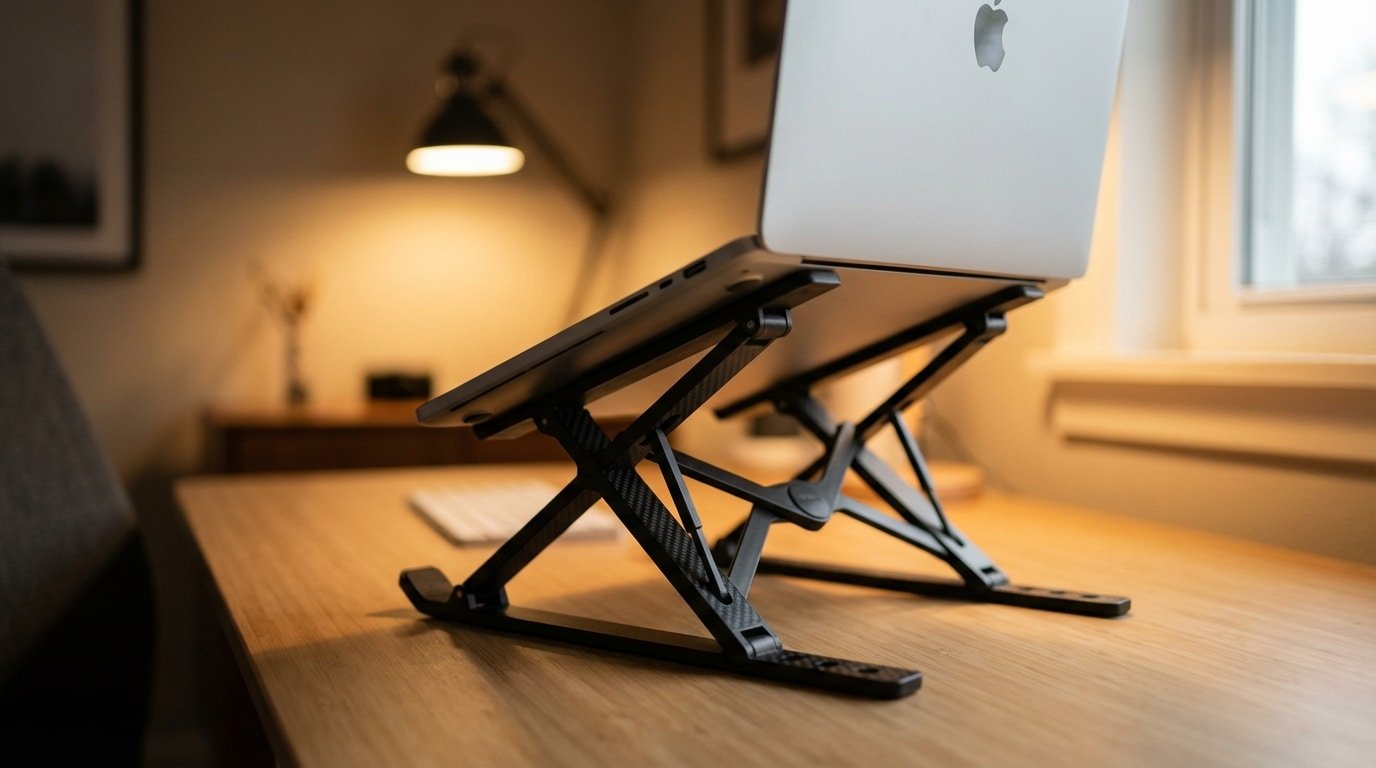
- A Laptop Stand: You need to elevate your screen to eye level. I see people hunching over laptops for 8 hours a day. They look like question marks. It is pathetic. Get the Roost V3. It is incredibly light, folds up tiny, and is practically indestructible. Estimated price: $75 – $90. Check Price on Amazon
- A Real Mouse: Trackpads slow you down. If a trackpad takes you 1 second longer to execute a command, and you do that 1,000 times a day, you are bleeding time. Buy a Logitech MX Master 3S. It works on glass tables. It is ergonomic. Estimated price: $90 – $100. Check Price on Amazon
- Noise-Canceling Headphones: You cannot control your environment. A baby will cry on your flight. Construction will start next to your Airbnb. A blender will run non-stop at the cafe. You need to buy silence. Silence equals deep work. Deep work equals money. I recommend the Sony WH-1000XM5. Estimated price: $348 – $398. Check Price on Amazon

Do not be cheap on the tools that make you money. If a $400 pair of headphones gives you one extra hour of focused work per day, they pay for themselves in a week. That is an infinite ROI.
Truth 3: The Infrastructure Tax
Internet is your oxygen.
If your internet drops during a sales call, you lose the deal. If you lose a $5,000 deal because you wanted to save $10 on a better co-working space, you are an idiot.
Nomads love to romanticize working from exotic locations. But exotic usually means bad infrastructure.
You need backups for your backups.
You need a local physical SIM card with an unlimited data plan the second you land. You also need an eSIM ready to go as a failsafe. You need to verify Airbnb Wi-Fi speeds before you book. Not by asking the host “Is the Wi-Fi good?” because they will always say yes. You demand a screenshot of a speed test.
Furthermore, when you are bouncing between airport lounges, random cafes, and shared co-working networks, your data is completely exposed.
Public Wi-Fi is a playground for hackers. If someone intercepts your client data, your passwords, or your banking details, your business is dead. Your reputation is ruined. You cannot afford to trust foreign public networks.
You have to encrypt your connection. It is non-negotiable.
I don’t care what you use, but you need a VPN. If you don’t have one, Get NordVPN. It is fast, cheap, and it masks your IP so you can still access your home country’s banking sites without getting locked out for “suspicious foreign login activity.” Getting locked out of your bank in a foreign country is a nightmare you want to avoid. Protect your data.
Truth 4: The Silent Margin Killers
Let’s talk about the banks.
Banks love digital nomads. Why? Because naive nomads bleed money to them every single day.
Every time you use a standard credit card abroad, you get hit with a 3% foreign transaction fee. Every time you withdraw cash from a local ATM, your home bank charges you $5, the local ATM charges you $5, and they give you a terrible exchange rate that steals another 4%.
If you spend $3,000 a month abroad, and you are losing 5% to fees and bad exchange rates, you are burning $150 a month. That is $1,800 a year.
You are handing the bank a free vacation because you are too lazy to optimize your finance stack.
You need to stop transferring money like it is 1995.
You need an account that holds multiple currencies and converts them at the mid-market rate. No hidden spreads. No nonsense. This is how you protect your margins.
Set up a multi-currency account. Try Wise. It allows you to receive USD, convert it to local currency at the actual Google exchange rate, and spend it on a local debit card. You cut out the middleman. You keep your own money.
Combine that with a credit card that has zero foreign transaction fees, and you immediately plug the leaks in your financial bucket.
Truth 5: The Medical Roulette
Nobody thinks they are going to get hurt until they are sliding across the pavement in Bali.
Here is a common scenario. A nomad rents a scooter. They have no license. They have no experience. They hit a patch of gravel and shatter their collarbone.
They go to the local hospital. Because they are a foreigner, the hospital demands payment upfront. Their domestic health insurance from the US or UK does not cover them internationally.
Suddenly, they are on the hook for a $15,000 medical bill. If they need a medical evacuation flight, that bill turns into $100,000.
This is unplanned bankruptcy.
Your domestic health insurance is useless when you leave your home country. Traveling without international medical coverage is a negative expected value bet. It is the stupidest risk you can take.
You need travel medical insurance built specifically for nomads. Not the junk trip cancellation insurance airlines try to sell you for $15. You need real medical coverage that covers accidents, hospital stays, and emergency transport.
I recommend SafetyWing. It is built for nomads. It functions like a subscription—you pay monthly, and you can start or stop it anywhere in the world. It covers you in almost every country. Get SafetyWing and stop playing Russian roulette with your life savings.
Pay the small premium. Protect the downside. That is what smart business owners do.
Truth 6: Routine Deficit Will Destroy You
The biggest trap of the nomad lifestyle is the constant movement.
People think they need to change cities every two weeks. They pack. They go to the airport. They navigate a new city. They find a new grocery store. They find a new gym. They find a new cafe to work from.
Do you know what that takes? Time and energy. Cognitive load.
Every hour you spend figuring out the logistics of a new city is an hour you are not building your business.
Travel is a massive distraction. If you travel too fast, your output drops to zero. You fall into a “routine deficit.” You stop working out. Your diet turns to garbage because you are eating at restaurants every day. You sleep poorly. Your business stagnates.
The most successful digital nomads do not move every week. They move every three to six months.
They are “Slowmads.”
They arrive in a city. Within 48 hours, they secure their routine. They join a gym. They find their designated co-working space. They establish their grocery loop. Then, they put their head down and work.
They treat the new city like their home base. They take weekend trips to explore, but Monday through Friday, they execute.
Boring routines make you rich. Exciting chaos makes you broke.
Truth 7: The Social Cost
Let’s talk about the final truth nobody puts on Instagram: Loneliness.
When you constantly move, you constantly say goodbye.
You will meet amazing people. You will connect with them over a week in Lisbon. And then they fly to Mexico, and you fly to Japan. You text for a bit, and then you never speak again.
You end up with a hundred shallow acquaintances and zero deep friendships.
Over time, this drains your soul. Humans are tribal. We need deep connections. We need a network of people who push us to be better.
If you surround yourself with 22-year-old backpackers who are just trying to find cheap beer, you will absorb their standards. You will lower your ambition.
You need to actively build a network of winners. You need to seek out environments where high-level entrepreneurs congregate. Places like Austin, Dubai, Chiang Mai, or Playa del Carmen. You need to join paid masterminds. You need to go to conferences.
Do not isolate yourself. A lone wolf starves.
The Bottom Line
The digital nomad lifestyle is incredible, but only if you strip away the fantasy and treat it like a mathematical equation.
Optimize your geography for high margins.
Invest in the gear that maximizes your output.
Secure your internet and your data.
Stop paying idiot fees to banks.
Protect your health and your downside risk.
Move slowly to protect your routine.
Build a network of winners.
If you do these things, you will have true freedom. You will have a growing business, expanding wealth, and the ability to live anywhere on Earth.
Stop buying the dream. Buy the math.