Stop Buying Cheap Gear. You Are Losing Money.
Most digital nomads are broke. They post photos of coconuts, but their bank accounts are empty. Why?
Because they treat their work like a hobby. They buy a $500 laptop. They work off a single 13-inch screen. They rely on spotty hostel Wi-Fi.
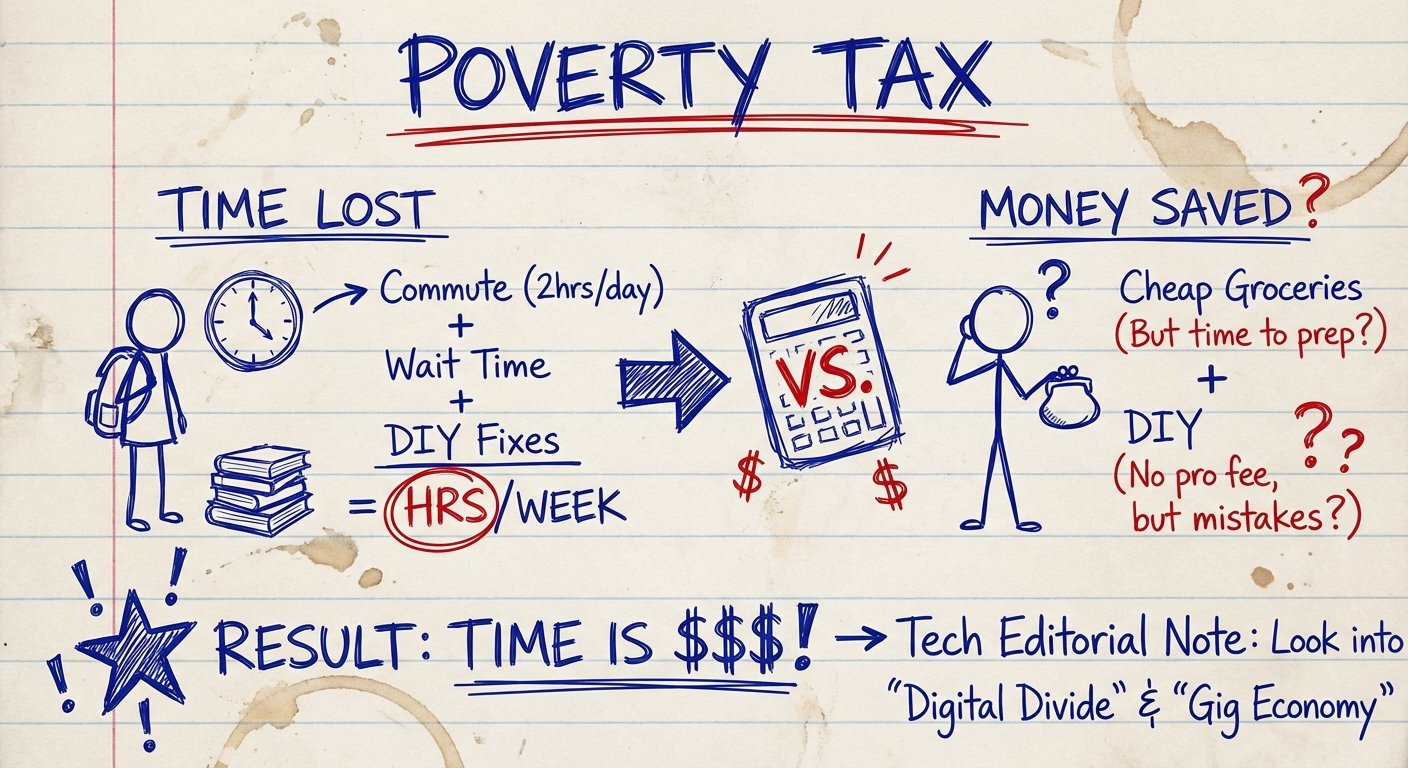
They think they are saving money. They are wrong. They are paying a “poverty tax” every single day.
If you make $100 an hour, and your slow computer wastes 10 minutes a day, that is $16 lost daily. That is $4,000 a year. If your bad audio kills one sales call, that could be $10,000 lost in a second.
Your workstation is not an expense. It is a leverage point. It is the machine that prints your money.
In this breakdown, I am not giving you “budget friendly” options. I am giving you the highest ROI (Return on Investment) setup to dominate 2026. This gear buys you time. Time is the only thing you can’t earn back.
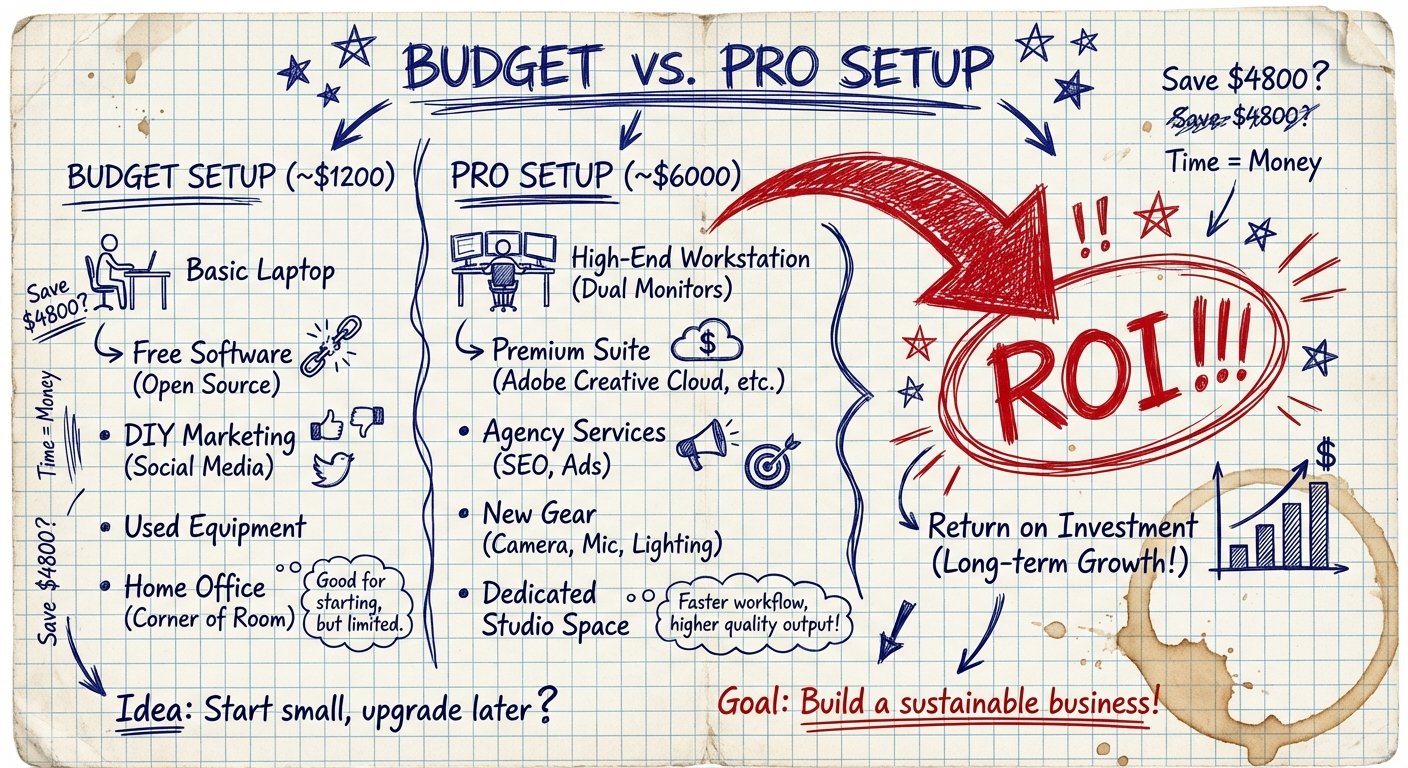
The Math: The Cost of Friction
Before we buy anything, we look at the numbers. Emotions lie. Math doesn’t.
The Scenario: You are a high-performing remote worker. You bill $100/hr (minimum). You work 2,000 hours a year.
The “Budget” Nomad Setup:
- Cost: $1,200 total.
- Friction: Slow rendering, single screen toggling, bad ergonomics, dead batteries.
- Productivity Loss: 15% (Conservative estimate).
- Annual Cost of Being Cheap: $30,000.
The High-Performance Setup:
- Cost: $6,000 total.
- Friction: Zero.
- Productivity Gain: Neutral or Positive.
- Net Profit vs Budget Setup: +$24,000 in Year 1.
You spend $6k to save $30k. That is a 5x return in the first year. If you don’t take that deal, you hate money.
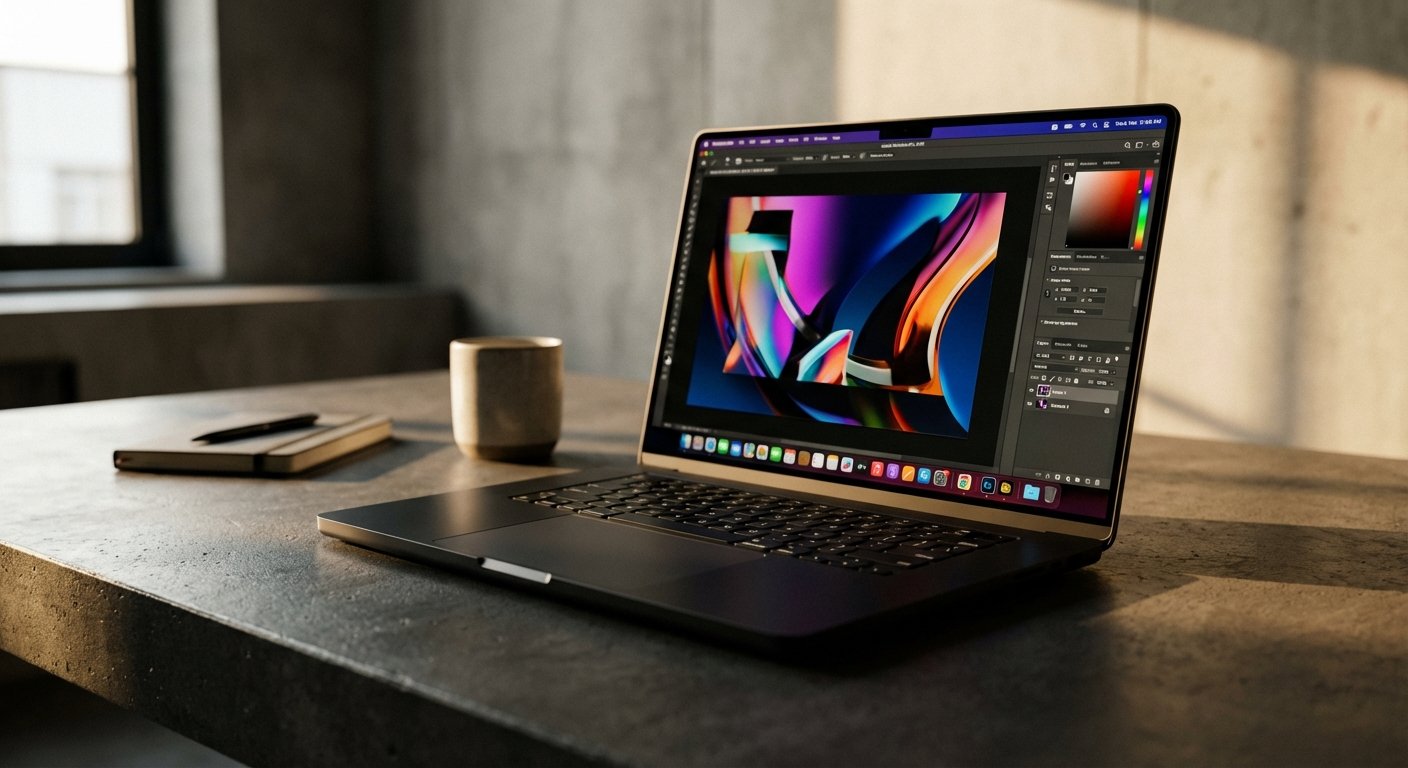
1. The Engine: Apple MacBook Pro 16″ (M4 Max)
Don’t get a Chromebook. Don’t get an Air “because it’s light.” Weight doesn’t matter. Output matters.
You need a machine that waits for you, not the other way around. As of late 2025/early 2026, the M4 Max chip architecture is the standard for mobile dominance. It handles 8K video editing, massive code compilations, and 50 chrome tabs without the fans turning on.
Specs you need: M4 Max Chip, 64GB Unified Memory, 2TB SSD.
The Win: It removes the “rendering” excuse. You finish work 20% faster. You close the laptop sooner. You enjoy your life.
The Trade-off: It is heavy. It is expensive. You will fear getting it stolen.
Price: $3,500 – $4,200
2. The Viewport: ASUS ZenScreen OLED MQ16AH
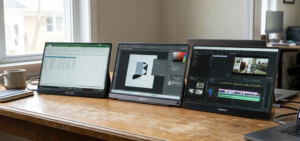
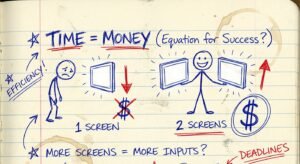
Working on one screen is for amateurs. Research shows dual monitors increase productivity by 42%. If you are traveling without a second screen, you are voluntarily cutting your output in half.
You want OLED. Why? Because you will work in bright cafes and dim airplanes. You need perfect contrast. The ASUS ZenScreen is thin, light, and connects via a single USB-C cable.
The Win: You have a mobile command center. You can reference data on the left while building on the right. No more Alt-Tab switching.
The Trade-off: It is fragile. If you pack it wrong, you crack it. It drains your laptop battery faster.
Price: $300 – $400
3. The Input: Logitech MX Master 3S & Keychron K3 Pro
If you use a trackpad for 8 hours a day, you are destroying your hands. Carpal tunnel is expensive. A mouse is cheap.
The Mouse: Logitech MX Master 3S.
It works on glass (essential for hotel desks). It has an electromagnetic scroll wheel that flies through 1,000 lines of code in a second. It has silent clicks so you don’t annoy people.
The Keyboard: Keychron K3 Pro (Low Profile).
Laptop keyboards are flat and lifeless. The K3 Pro is mechanical but slim. It fits in a backpack. It connects to 3 devices via Bluetooth. It gives you tactile feedback that signals “work mode” to your brain.
The Win: You type faster. You navigate faster. You reduce physical strain.
The Trade-off: They add bulk to your bag. You have two more things to charge.
Price (Mouse): $90 – $100
Price (Keyboard): $90 – $110
Check Price on Amazon (Keyboard)
4. The Sound: Sony WH-1000XM5
The world is loud. Crying babies on planes. Espresso machines in cafes. Construction outside your Airbnb.
Noise is the enemy of deep work. You need a shield.
The Sony XM5s have industry-leading Active Noise Cancellation (ANC). They also have top-tier microphones. When you are closing a $10k deal, you cannot sound like you are in a bathroom. You need to sound like you are in a studio.
The Win: You can create a private office environment anywhere on earth. The microphone isolation is magic.
The Trade-off: They get hot on your ears after 3 hours. The case is bulky compared to earbuds.
Price: $348 – $399

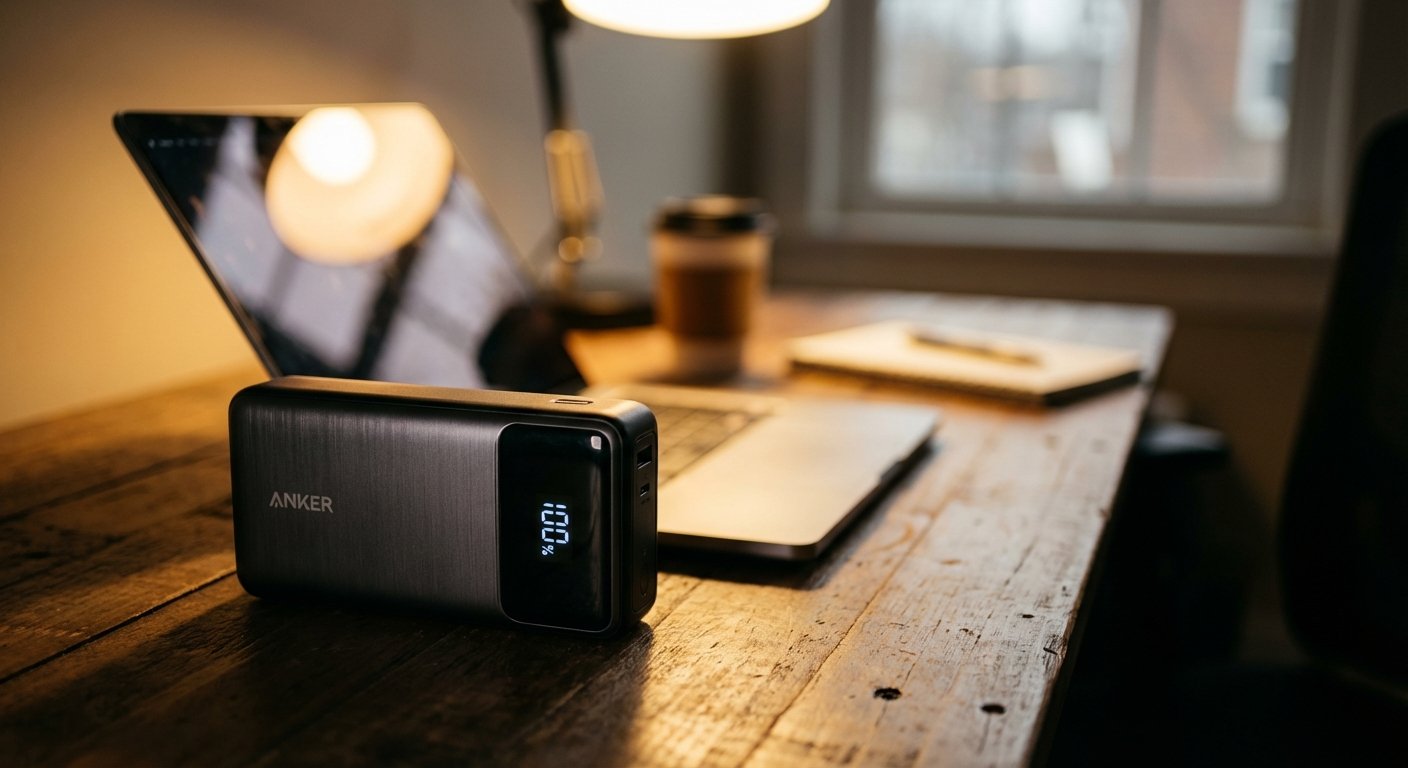
5. The Lifeline: Anker Prime 27,650mAh Power Bank (250W)
You cannot rely on finding an outlet. Outlets are for the desperate. You want autonomy.
Most power banks are toys. They charge a phone once. You need a brick that can power your laptop.
The Anker Prime outputs 250W. It can charge a MacBook Pro to 50% in 30 minutes. It has a smart display so you know exactly how much time you have left. It falls just under the TSA limit (100Wh) so you can fly with it.
The Win: You are never tethered to a wall. You can work from a park bench, a beach, or a delayed train without anxiety.
The Trade-off: It is heavy (creates a dent in your backpack). It is expensive for a “battery.”
Price: $170 – $200
6. The Connection: Starlink Mini
This is the 2026 game changer. In the past, we relied on local SIM cards. They fail. They throttle speeds.
The Starlink Mini is backpack-sized. It draws low power (you can run it off the Anker battery mentioned above). It gives you 100Mbps+ satellite internet in the middle of nowhere.
The Win: Total geographic freedom. You can work from a van in Patagonia or a cabin in the Alps. You are your own ISP.
The Trade-off: High upfront cost. Monthly subscription is pricey ($150+). Requires a clear view of the sky (doesn’t work indoors).
Price (Hardware): $599 – $650
Summary: The Cost of Doing Business
Let’s look at the final bill.
- Laptop: $3,500
- Monitor: $350
- Peripherals: $200
- Audio: $350
- Power: $180
- Internet: $600
- Total Investment: ~$5,180
Five thousand dollars. Some of you are hyperventilating. You are thinking about how many beers that buys in Bali.
Stop it.
If this setup saves you 5 hours a week, that is 250 hours a year. At $100/hr, that is $25,000 in recovered time. You paid $5k to make $25k. That is a 400% ROI.
There is no stock market index that gives you those returns. The best investment you can make is in your own capacity to produce.
Buy the gear. Do the work. Stop making excuses.