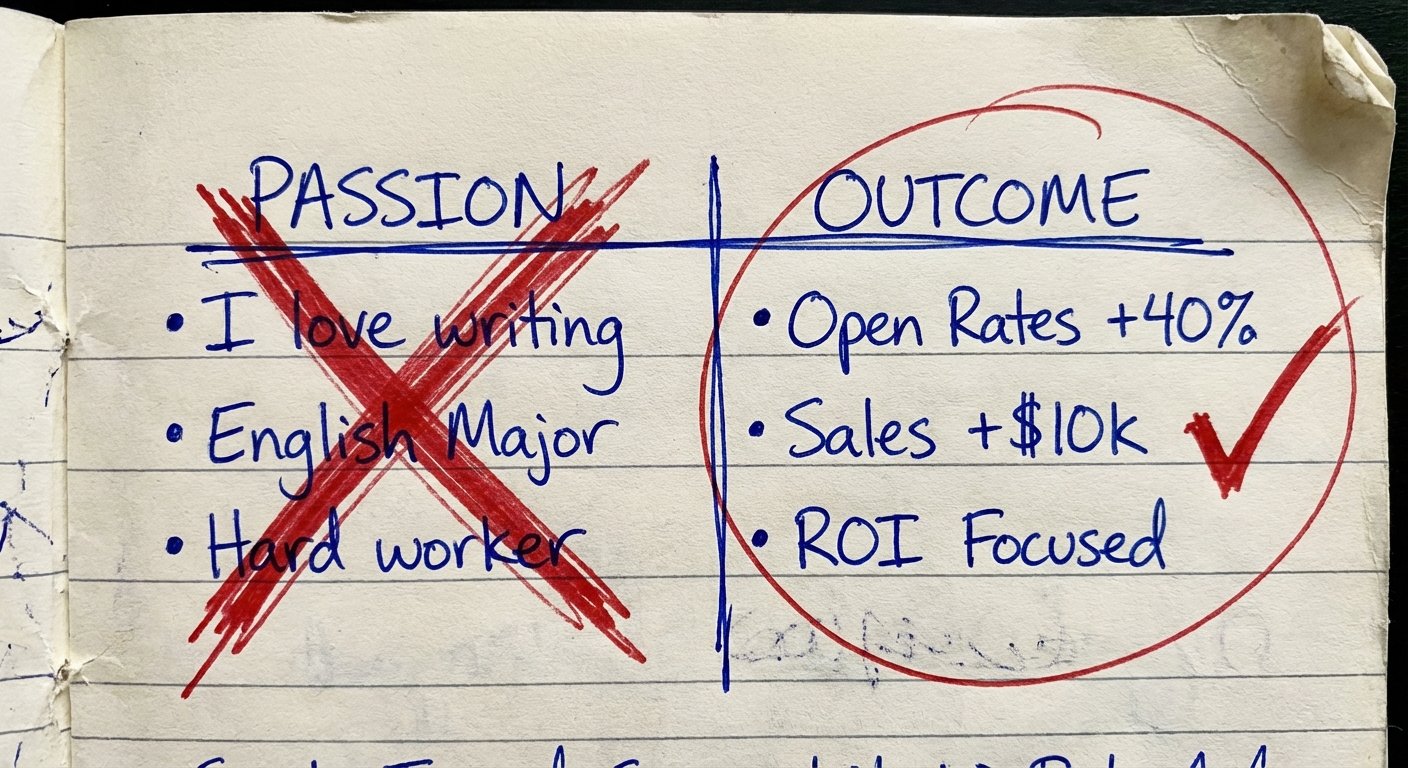
The Marketplace Doesn’t Care About Your “Passion”
Most freelancers on Upwork are broke.
They are broke because they treat their profile like a resume. They list their skills. They list their degrees. They talk about their “passion for excellence.”
Nobody cares.
Clients do not come to Upwork to make friends. They do not come to validate your English degree. They come to buy money.
They have a problem. That problem is costing them time or money. They want to pay you to fix it so they can get that time or money back.
If your profile does not scream “I solve this expensive problem,” you are invisible.
You are a commodity.
And commodities get paid the lowest price possible.
If you are tired of bidding $15 an hour and getting ignored, you need to change your strategy. You need to stop selling effort and start selling outcomes.
The Math of the Profile
Before we fix the words, you need to understand the math. Upwork is a funnel.
- Impressions: People seeing your face in the search results.
- Clicks: People clicking your face to read your profile.
- Conversions: People inviting you to interview.
If you have low impressions, your keywords are wrong.
If you have high impressions but low clicks, your headline and photo are weak.
If you have clicks but no invites, your bio and portfolio are failing to build trust.
You can’t “hope” your way to a six-figure income. You tweak the variables. You fix the funnel.
The 5-Minute Fix: Your Headline
Most headlines read like this:
“Expert Graphic Designer | Photoshop | Illustrator | Fast Turnaround”
This is garbage.
It tells me what you are (a cost). It lists tools (which I don’t care about). It promises “fast,” which implies “low quality.”
You need a headline that acts as a hook. It needs to call out the avatar and the result.
The Formula: [Specific Avatar] + [Specific Outcome] + [Mechanism]
Bad: “Email Copywriter for Hire”
Good: “I Help SaaS Founders Add $10k/Month via Automated Email Flows”
See the difference?
The first one is a person looking for a job. The second one is an investment vehicle. If I pay the second guy $2,000, I expect to make $10,000. That is an ROI calculation. It is easy to say “yes” to ROI.
Change your headline right now. Be specific. If you try to appeal to everyone, you appeal to no one.
The Trust Gap: Why You Need Pro Gear
Here is the hard truth.
Upwork allows you to upload a video introduction. If you don’t have one, you lose. If you have one, but it looks like a hostage video filmed in a basement, you lose harder.
High-value clients judge you instantly.
If your video is grainy, dark, and sounds like you are underwater, the client assumes your work will be sloppy. They assume you are cheap. They assume you don’t take your business seriously.
Perception is reality.
You do not need a Hollywood studio. But you do need to look like a professional who charges $100/hour, not $10/hour. This is a one-time capital expense that pays dividends for years.
Here is the exact setup you need to look expensive.

1. The Visuals (Webcam)
Stop using the built-in camera on your 2018 laptop. It looks like trash. You want 4K resolution and good low-light performance.
The industry standard for “good enough to look like a pro without buying a DSLR” is the Logitech Brio.
It shoots in 4K. It has HDR (High Dynamic Range) so you don’t look washed out. It handles shadows well.
Logitech Brio 4K Webcam
Specs: 4K Ultra HD, 5x Digital Zoom, RightLight 3 with HDR.
Estimated Price: $130 – $160
Get this, plug it in, and put it at eye level. Do not have the camera looking up your nose.

2. The Audio (Microphone)
Bad video is annoying. Bad audio is unbearable.
If a client has to strain to hear you, they will close the tab. You want your voice to sound deep, rich, and authoritative. This is called “radio presence.”
You do not need a $1,000 shotgun mic. You need a solid USB condenser microphone.
The Blue Yeti X is the workhorse here. It is plug-and-play. It has a gain knob right on the front so you can control your volume. It looks professional on camera.
Blue Yeti X Professional Condenser USB Microphone
Specs: 4-capsule array, LED metering, Blue VO!CE effects.
Estimated Price: $130 – $170
Put this within 6 inches of your mouth. Turn the gain down so it doesn’t pick up the dog barking outside. You will sound like a CEO.
3. The Lighting
You can have a $5,000 camera, but if your lighting sucks, the image will look grainy.
Do not rely on your window. Clouds move. The sun goes down. You want consistency.
You need a soft light that hits your face at a 45-degree angle. The Elgato Key Light Air is perfect for desks. It connects to your Wi-Fi so you can control the brightness and temperature from your computer. No reaching behind the desk to fiddle with knobs.
Elgato Key Light Air
Specs: 1400 Lumens, 2900K – 7000K color range, App Control.
Estimated Price: $110 – $130
Buy one. Put it slightly to the side. It removes the shadows from your eyes and makes you look awake and competent.
The Portfolio: Show, Don’t Tell
Clients are skeptical. They have been burned before. They assume you are lying.
Your bio says “I am great.” Every bio says that.
Your portfolio is where you prove it.
Most people upload a random logo or a screenshot of a spreadsheet. This is lazy.
Your portfolio pieces should be case studies. Use the STAR method in the description of every portfolio item:
- Situation: What was the client’s problem?
- Task: What did they hire you to do?
- Action: What specifically did you build/write/design?
- Result: What was the outcome? (Use numbers).
Instead of “Blog Post for Dog Walking Company,” write:
“SEO Article that Ranked #1 for ‘Best Dog Leash’ and Generated 5,000 Visits/Month.”
If you don’t have past client results, do spec work. Build the thing you want to sell. Create a hypothetical project. Show that you can do the work. Competence creates confidence. Confidence creates sales.

Pricing Psychology: Why Being Cheap is Expensive
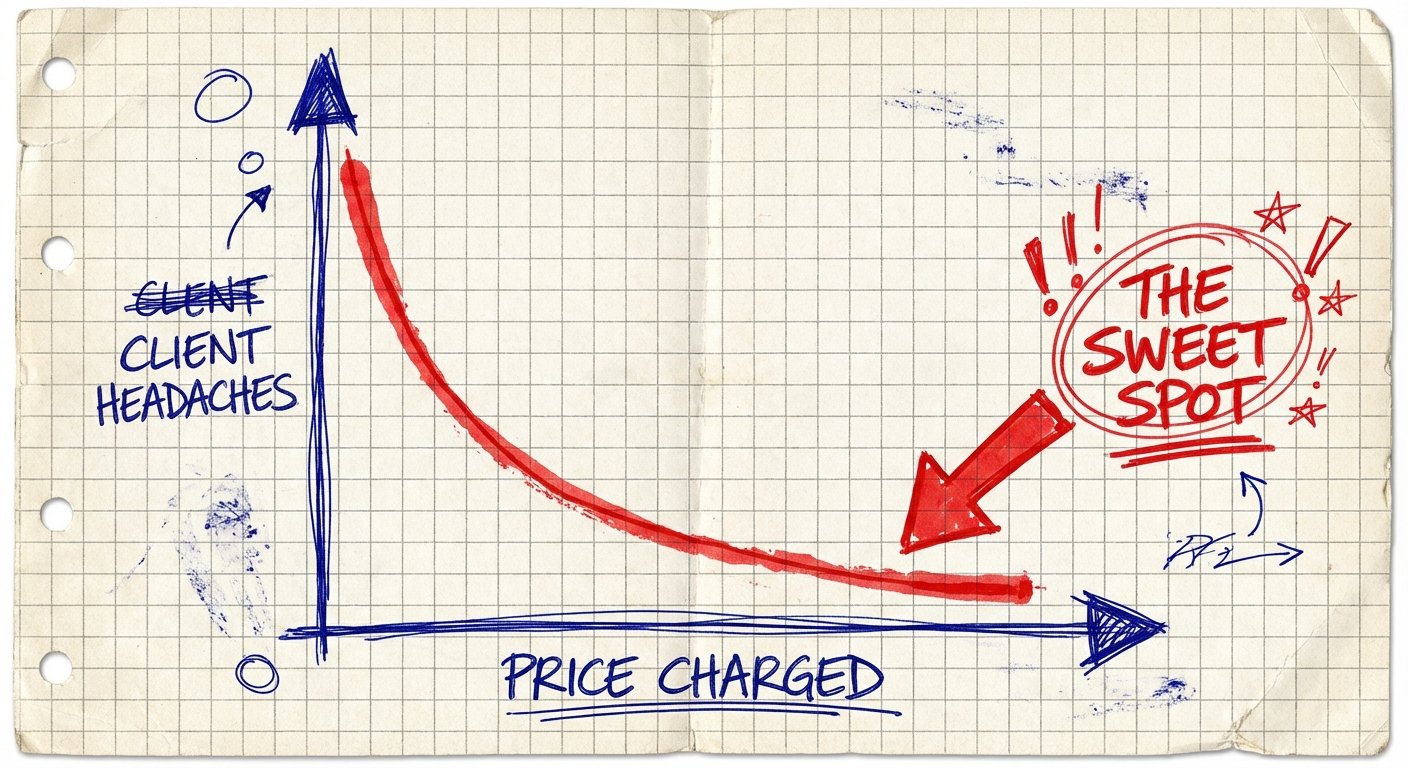
Low prices attract low-quality clients.
When you charge $15/hour, you attract the client who micromanages you. They count every minute. They dispute hours. They are terrified of losing $15.
When you charge $100/hour, you attract business owners who value their time more than their money. They trust you to get it done. They don’t care how many minutes it takes; they care that the result is delivered.
By pricing yourself low, you are signaling risk.
If a heart surgeon offered to operate on you for $50, would you say “What a deal!”?
No. You would run.
You would assume he is unlicensed or dangerous. Clients feel the same way about “cheap” experts.
Raise your rates. You will get fewer leads, but the leads you get will be better. You will make more money for the same amount of time. That is infinite leverage.
The “No Fluff” Bio Structure
Your “About Me” section is not an autobiography. It is a sales letter.
Do not start with “Hi, my name is…” They can see your name at the top.
Do not say “I am a hard worker.” That is the bare minimum expectation.
Use this structure:
- The Hook: Restate their problem better than they can. “Struggling to convert website visitors into leads?”
- The Authority: “I have managed $5M in ad spend for e-commerce brands.”
- The Method: “I use a proprietary 3-step audit process to find leaks in your funnel.”
- The CTA (Call to Action): “Click the green ‘Invite’ button to discuss your project.”
Keep the paragraphs short. Use bullet points. Make it skimmable.
Conclusion
Upwork is not a lottery. It is a marketplace.
Marketplaces respond to value. If you present yourself as high-value—through your headline, your gear, your pricing, and your proof—you will win.
If you present yourself as a desperate commodity, you will lose.
Fix your headline. Buy the webcam. Raise your rates.
Do the work.